
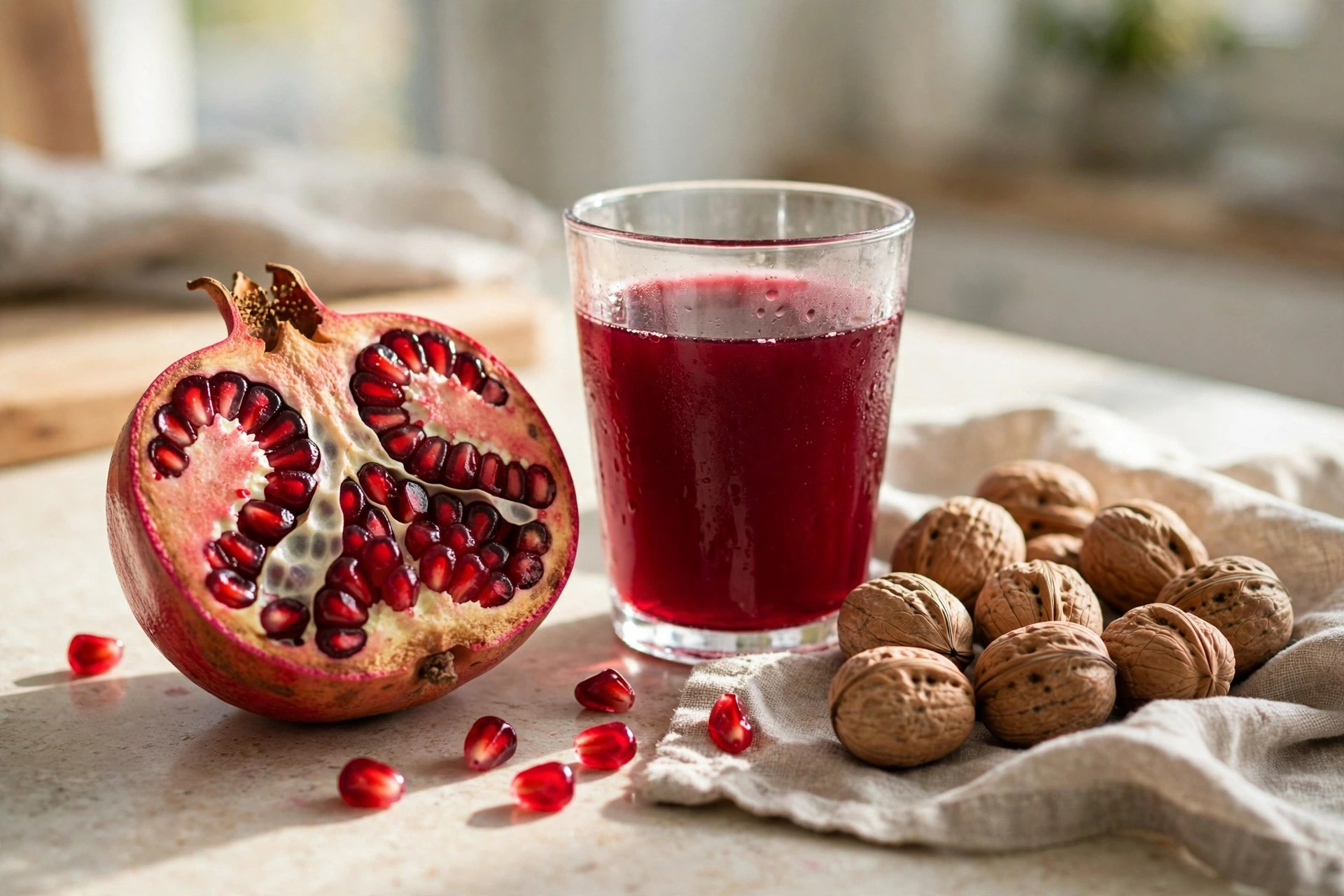
Pomegranate's gut metabolites act very differently on muscle — in human muscle cells
·Eat pomegranate and your gut bacteria convert its polyphenols into urolithins — metabolites with a growing reputation in longevity circles, especially urolithin A, sold as a “mitophagy” supplement. But your microbiome decides which urolithin you actually make, and a new head-to-head study suggests that choice matters a lot. In human skeletal-muscle cells from donors aged 55 to 96, urolithin A and urolithin B ran strikingly different genetic programs.
What the researchers did
The team treated human primary myotubes — muscle cells grown from donors aged 55–96 — with urolithin A or urolithin B for 24 hours and compared their transcriptomes. Urolithin A altered 1,918 genes: inflammatory signaling fell (IL-17B down about 49%) and the antioxidant enzyme NQO1 rose — a pattern consistent with urolithin A's known role in mitophagy, the mitochondrial cleanup process. Urolithin B affected just 339 genes and pushed a different program: cholesterol/adipogenesis pathways and satellite-cell regeneration signals (CXCR4), the machinery of muscle repair and growth. The study appears in the Journal of Cachexia, Sarcopenia and Muscle.
Why it matters — and the caveats
The takeaway is precision nutrition: the health benefit of a polyphenol-rich diet may depend on which urolithin your gut microbiome actually produces — some people are “urolithin A producers,” others make mostly B, and some make little of either. But this is 24-hour gene-expression data in cell culture, not proof of clinical benefit. The authors frame the findings as mechanistic and exploratory. Whether an A-producer's muscles actually age better than a B-producer's is a question for human studies, not dishes.
Where the evidence stands
- Established: Urolithin A's role in supporting mitophagy has been shown in prior preclinical and early human studies.
- Preliminary: The head-to-head A-vs-B comparison was done in human muscle cells over 24 hours; gene-expression changes are not clinical outcomes.
- Absent: No study has shown that being a urolithin A vs. B producer changes muscle aging or healthspan in people.