
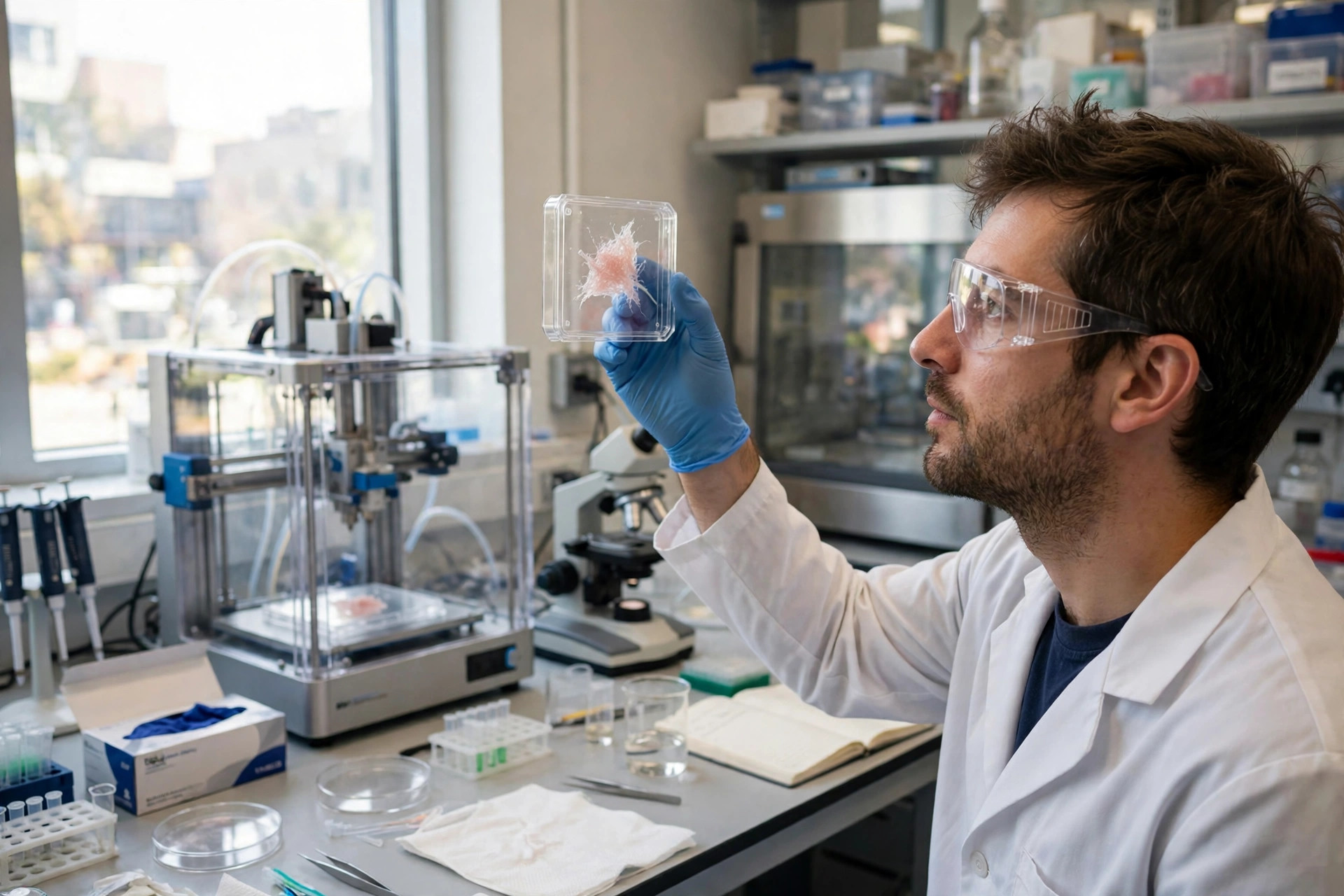
A lab-grown muscle made from a 68-year-old donor's cells aged like the real thing — thinner fibres, weaker contractions, impaired mitochondria
Edited by Samael A. Tejada, Founder & Editor-in-Chief
·Tip: press play, then lock your phone or switch apps — the article keeps reading.
A 3D human skeletal muscle model built from a 68-year-old donor's cells showed thinner fibres, more inflammation, impaired mitochondrial function and weaker contractions than one built from a 17-year-old's cells, a Small Science study reports (November 16, 2026). It is a lab model from two donors, not a patient study.
Aging research has a supply problem: human muscle that ages on demand. This model grows it in a dish — mitochondria and all — so interventions can be tested against the aged phenotype directly.
How was the model built?
The researchers mixed human muscle cells from two male donors — one aged 17, one aged 68 — with decellularized extracellular matrix, a biomaterial scaffold that gives the cells a tissue-like structure to grow in. The result is a 3D skeletal muscle microtissue that can be compared, young versus old, under identical laboratory conditions.
What aged in the dish?
Almost everything that ages in a person. The older-donor tissues formed thinner muscle fibres, fused less, and carried higher inflammation. Their mitochondria — responsible for the energy production muscle runs on — functioned poorly, the calcium responses that trigger contraction were delayed, and the force the tissue produced in response to electrical stimulation was significantly reduced.
What is it for — and what are its limits?
For testing: a human, aged, contractile muscle system in which candidate sarcopenia interventions — including mitochondria-targeted ones — can be screened without animal experiments. The limits are plain in the design: two donors, one of each age, both male. It models hallmarks of aging muscle convincingly; it cannot by itself say how any treatment will perform in older people.
Frequently asked questions
What is sarcopenia?
The age-related decline in skeletal muscle mass, strength and function that reduces mobility and quality of life in old age. Mitochondrial dysfunction is one of its hallmarks.
What is decellularized extracellular matrix?
Tissue material stripped of its cells, leaving the structural scaffold behind. Seeding it with new cells lets researchers build a tissue-like construct with realistic architecture.
Did the study test a treatment?
No. It built and characterized the model, showing the older-donor tissue reproduces aging hallmarks including mitochondrial impairment. Testing treatments in it is the proposed next step.
Where the evidence stands
- Established: Sarcopenia — age-related loss of muscle mass and function — involves mitochondrial impairment and reduced contractile force, and animal models translate imperfectly to human aging.
- Preliminary: The 3D microtissue model itself: one study (Small Science, 2026) using cells from two male donors, aged 17 and 68.
- Absent: Validation across more donors, and any treatment result obtained in the model, let alone in patients.
Join the discussion
To get the conversation started: What questions does this story raise for you? Share them below — every comment is reviewed by our moderators before it appears.
Community discussion only — not medical advice. Every comment is reviewed by our moderators before it appears. Sign in with Google or a free Hyvor account to join in.