
A contact site acts as a loading dock for mitochondria moving down nerve cells — in mice and cells
Edited by Samael A. Tejada, Founder & Editor-in-Chief
·Tip: press play, then lock your phone or switch apps — the article keeps reading.
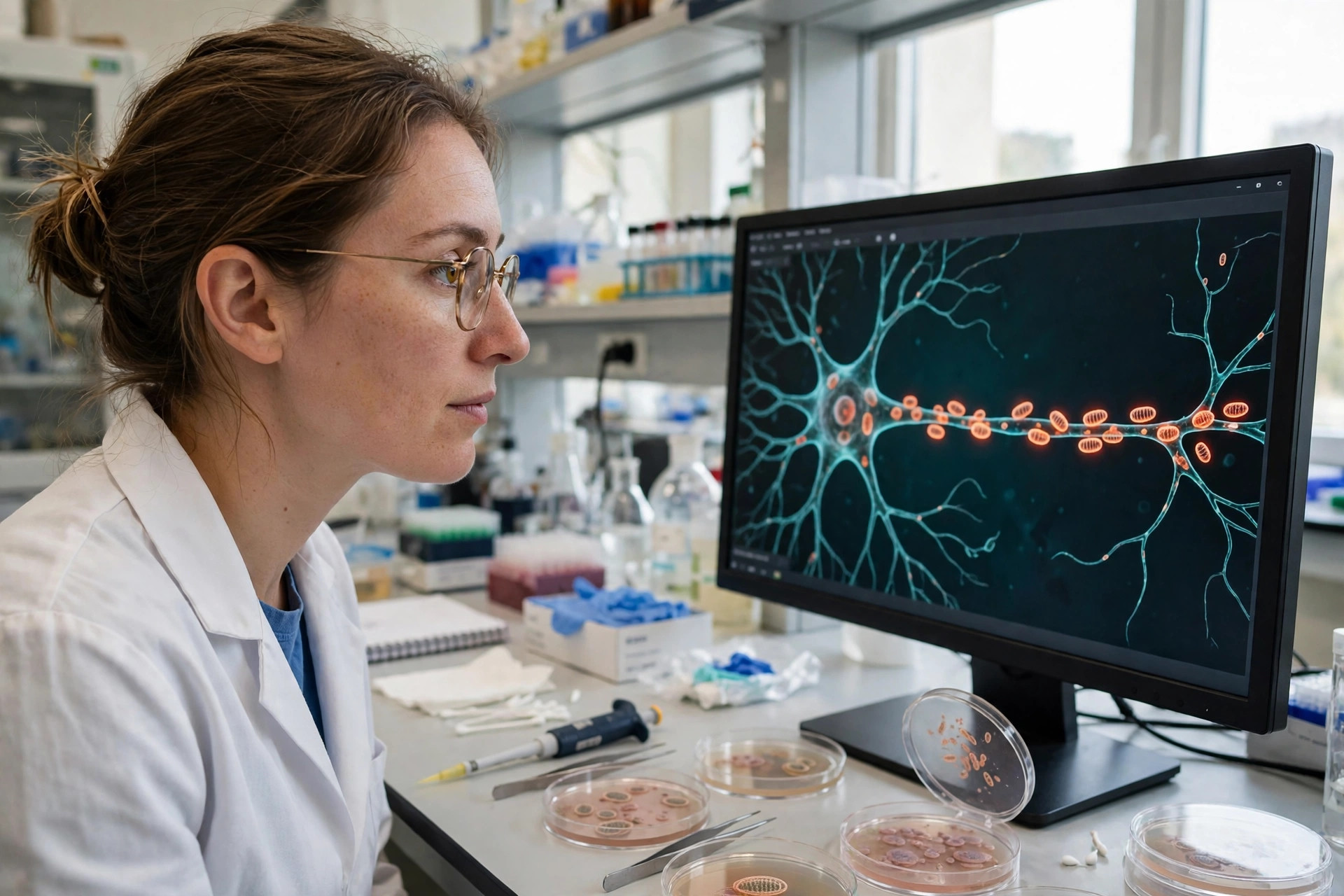
C19orf12, a protein mutated in hereditary spastic paraplegia, sits where the endoplasmic reticulum meets mitochondria and organizes the motor complex that ships mitochondria along nerve axons, tuned by local calcium (Cell Discovery, November 10, 2026). Without it, mice developed progressive motor impairment and neurons lost mitochondria at their far ends. The evidence is from mice and cultured cells — a mechanism finding, not a therapy.
A mitochondrion built in the cell body is useless if it never reaches the end of the axon. This study names the scaffold that loads it onto the track.
What does C19orf12 actually do?
ER-mitochondria contact sites were already known to handle lipid transfer, calcium signaling and mitochondrial division; their role in transport was unclear. The team shows C19orf12 is anchored in the ER, enriched at those contact sites, and acts as a scaffold that connects the ER to the mitochondrial surface — promoting assembly of the Miro1-Kinesin-1 complex, the motor machinery that moves mitochondria along microtubules. The connection is regulated by local calcium: enhanced at the 1-10 micromolar calcium levels typical of contact-site microdomains, and suppressed at high calcium, which correlates with transport arrest.
What happens without it?
Loss of C19orf12 produced severe perinuclear mitochondrial clustering in cells, impaired outward (anterograde) transport in neurons, distal depletion of mitochondria in axons, and progressive locomotor dysfunction in mice that recapitulates key features of hereditary spastic paraplegia. That closes a causal loop: a gene mutated in human SPG43 and in neurodegeneration with brain iron accumulation turns out to run the logistics that keep axons supplied with mitochondria — and axonal integrity fails when the logistics fail.
Why does this matter beyond one rare disease?
It reframes contact sites as logistical hubs, not just exchange points: the place where two organelles touch is also where transport motors get loaded. That idea reaches beyond SPG43 — many common neurological diseases involve axonal mitochondrial shortages. What the study does not do is test any way to restore the scaffold or bypass it, so the therapeutic distance remains long.
Frequently asked questions
What is EMTRAS?
The proposed new name for C19orf12: ER-anchored Mitochondrial Trafficking Scaffold. It sits at ER-mitochondria contact sites and organizes the Miro1-Kinesin-1 motor complex that transports mitochondria.
Which diseases is C19orf12 linked to?
Mutations cause spastic paraplegia type 43 (SPG43), a severe recessive form of hereditary spastic paraplegia, and a form of neurodegeneration with brain iron accumulation (NBIA).
Does this study offer a treatment?
No. It identifies a mechanism in mice and cells. No intervention to restore or bypass the scaffold was tested.
Where the evidence stands
- Established: ER-mitochondria contact sites mediate lipid transfer, calcium signaling and mitochondrial division; C19orf12 mutations cause SPG43 hereditary spastic paraplegia and a form of neurodegeneration with brain iron accumulation; neurons depend on long-distance mitochondrial transport.
- Preliminary: The EMTRAS scaffold mechanism: one study (Cell Discovery, 2026) in cultured cells and knockout mice, with a calcium-tunable Miro1-Kinesin-1 assembly model. Not yet independently replicated.
- Absent: Any intervention — no treatment targeting C19orf12 or contact-site transport was tested, and no human tissue validation is reported.
Join the discussion
To get the conversation started: What questions does this story raise for you? Share them below — every comment is reviewed by our moderators before it appears.
Community discussion only — not medical advice. Every comment is reviewed by our moderators before it appears. Sign in with Google or a free Hyvor account to join in.