
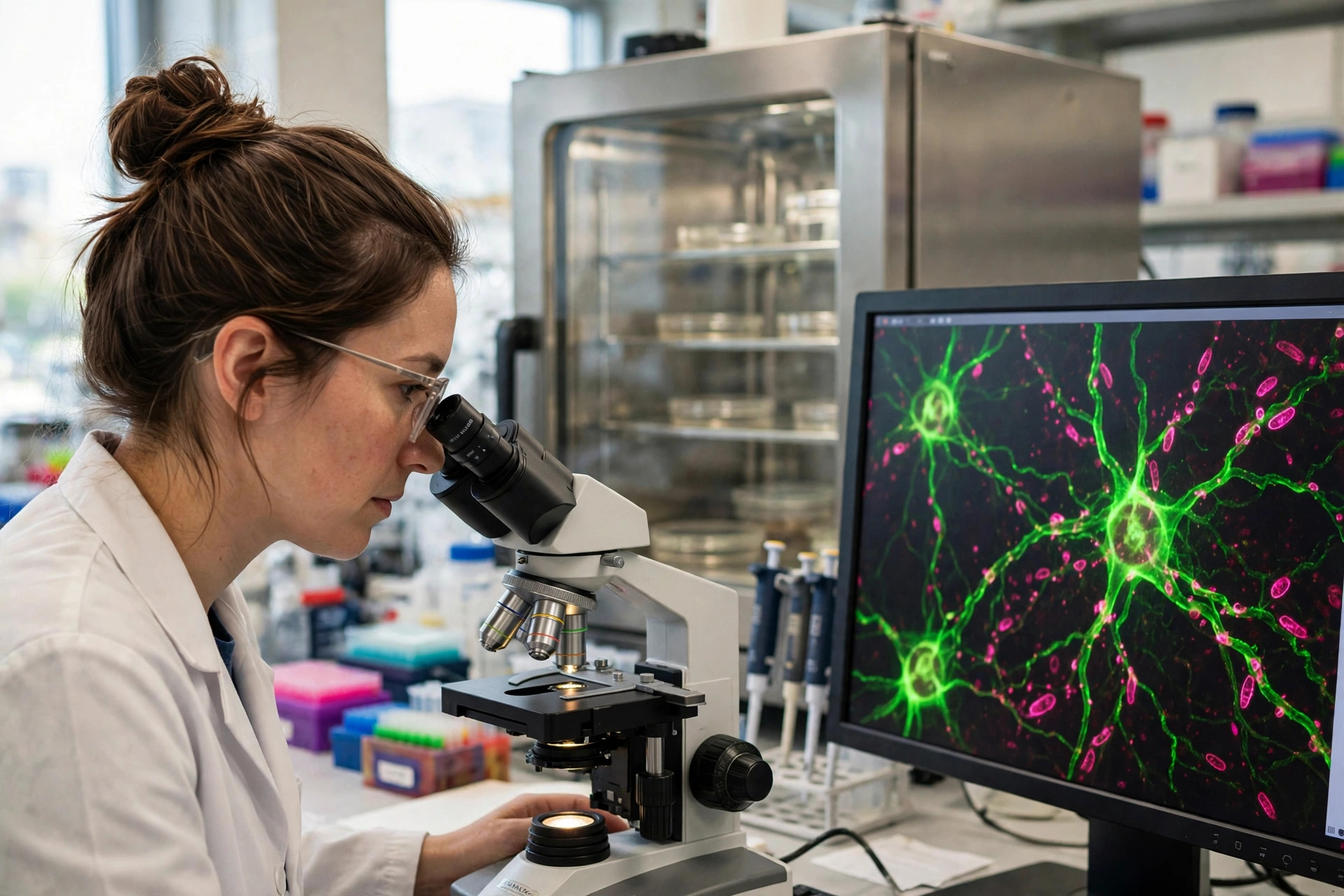
Mutations in the mitochondrial fission gene DRP1 stalled mitochondria in developing brain cells and silenced synapse-building genes — in lab-grown human neurons
Edited by Samael A. Tejada, Founder & Editor-in-Chief
·Tip: press play, then lock your phone or switch apps — the article keeps reading.
Human cortical neurons grown from stem cells carrying patient DRP1 (DNM1L) mutations showed disrupted mitochondrial fission and transport, a collapse in synaptic ribosome gene expression, and abnormal calcium responses, a Journal of Neurodevelopmental Disorders study reports (November 2026). The work is in lab-grown neurons, not patients.
A developing neuron is a logistics problem: mitochondria must travel down growing processes to power synapses that are still being built. This study shows what happens to that construction project when the fission enzyme is broken from the start.
What did the researchers model?
Early corticogenesis — the building of the cerebral cortex — in a dish. They generated cortical neuron cultures from human induced pluripotent stem cells carrying DRP1 mutations associated with EMPF1 encephalopathy, then compared their structure, physiology and gene expression with healthy-donor neurons as they matured.
What went wrong in the mutant neurons?
Differentiation itself succeeded: the stem cells became cortical neurons. The failures were in operation. With mitochondrial fragmentation disrupted, organelle transport along neurites was perturbed, so mitochondria could not be positioned normally. The transcriptional programme for synaptic maturation was hit hard — expression of synaptic ribosome genes fell dramatically — and when the neurons were stimulated with glutamate, they generated abnormal intracellular calcium surges, a sign their signalling control is immature or unstable.
Why does a fission defect hit synapses so hard?
Synapses are the most energy-demanding structures a neuron builds, and they depend on mitochondria being delivered to, and remodelled at, the right places at the right developmental moments. If fission is broken, mitochondria cannot be sized and shipped properly — and this study suggests the neuron's gene-expression programme for building synapses stalls in response, linking an organelle-shape defect directly to a maturation defect.
Frequently asked questions
What is DRP1?
Dynamin-related protein 1, the enzyme encoded by the DNM1L gene that pinches mitochondria in two during fission. It is essential for sizing, moving and quality-controlling mitochondria.
What is EMPF1?
Encephalopathy due to defective mitochondrial and peroxisomal fission 1 — a severe developmental disorder caused by pathogenic DRP1 variants, featuring developmental delay, treatment-resistant epilepsy, microcephaly and optic atrophy.
Were patients treated in this study?
No. The researchers studied neurons grown in the laboratory from human stem cells carrying patient mutations. No person received any intervention.
Where the evidence stands
- Established: DNM1L/DRP1 executes mitochondrial fission, and pathogenic DRP1 variants cause EMPF1 encephalopathy with developmental delay, refractory epilepsy, microcephaly and optic atrophy.
- Preliminary: The transport, ribosome-gene and calcium findings: one study (Journal of Neurodevelopmental Disorders, 2026) in human stem-cell-derived cortical neurons carrying patient mutations.
- Absent: Confirmation in patient brain tissue, any intervention, and evidence on whether restoring fission dynamics can rescue maturation.
Join the discussion
To get the conversation started: What questions does this story raise for you? Share them below — every comment is reviewed by our moderators before it appears.
Community discussion only — not medical advice. Every comment is reviewed by our moderators before it appears. Sign in with Google or a free Hyvor account to join in.