
Mammalian cells make and store elemental sulfur, and it shields them from a rust-like form of cell death
·Tip: press play, then lock your phone or switch apps — the article keeps reading.
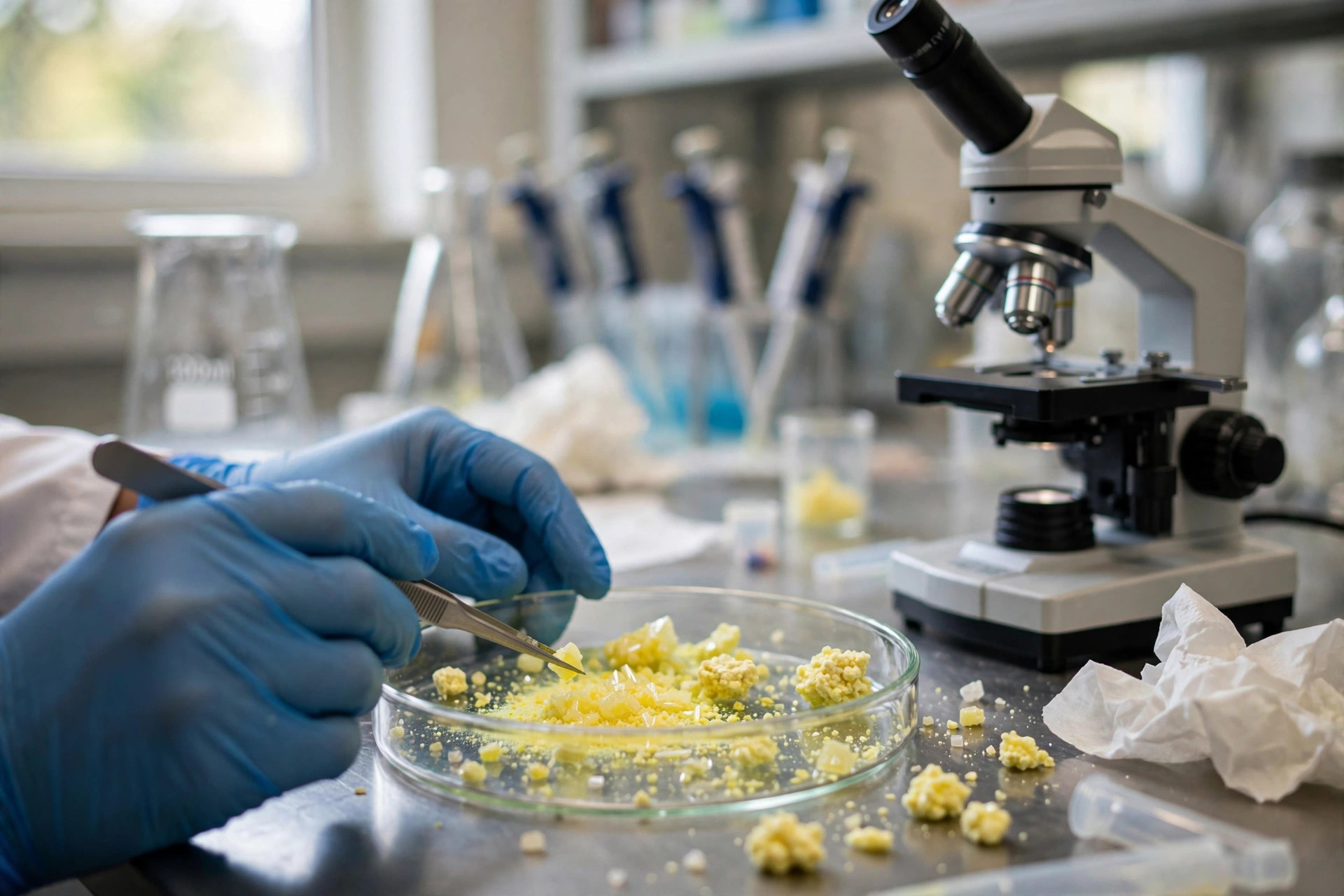
Sulfur sits at the heart of some of the cell's oldest chemistry, but its elemental form — rings of eight sulfur atoms called cyclo-octasulfur, or S8 — was not thought to be something mammals make. A study published in Science and reported October 15, 2026 (Barayeu, Ogata, Takata and colleagues) shows that mammalian cells do produce S8, through enzymes better known for making nitric oxide, and stash it in mitochondria and lipid droplets.
What happens when the sulfur shield runs low?
When the researchers depleted cells' endogenous S8, lipid peroxidation rose and ferroptosis — a form of cell death driven by oxidized lipids and iron — increased. Supplying S8 did the opposite, protecting fat cells and blood-vessel lining cells from ferroptotic damage. The chemistry runs through glutathione, the cell's workhorse antioxidant: S8 reacts with it to generate supersulfides, a class of molecules increasingly recognized as potent suppressors of lipid damage.
What did the animal test show?
In a mouse model of osteoarthritis, injecting solubilized S8 into the knee joint lowered levels of 4-hydroxynonenal, a marker of lipid peroxidation — an early sign that the pathway can be nudged from outside, at least locally and in animals. The team also reported elevated S8 in breast cancer tissue, a reminder that a protective system can be co-opted: shielding cells from ferroptosis is good for healthy tissue and potentially useful to tumors, which is one reason ferroptosis is studied as a cancer vulnerability.
How big a deal is a new sulfur system?
It reframes where mitochondria sit in antioxidant defense. Mitochondria are usually cast as sources of damaging oxidants; here they are also warehouses for a stored antioxidant precursor. The work is basic biology — mostly cells, plus one mouse joint experiment — and it will take time to learn how S8 production is regulated, how it varies between tissues and people, and whether it can be measured or modified safely. Diseases tied to lipid peroxidation, from osteoarthritis to metabolic and aging-related conditions, are the obvious places researchers will look first.
Where the evidence stands
- Established: Ferroptosis is an iron-dependent form of cell death driven by lipid peroxidation, and supersulfides are recognized suppressors of that lipid damage.
- Preliminary: Mammalian cells produce and store cyclo-octasulfur (S8) in mitochondria and lipid droplets; depleting it increased lipid peroxidation and ferroptosis in cells, supplying it protected cells, and local S8 administration lowered a lipid-peroxidation marker in a mouse osteoarthritis model (Science, 2026).
- Absent: Human data on S8 levels, regulation, or measurement, and any evidence that modifying this system prevents or treats disease in people.
Join the discussion
To get the conversation started: What questions does this story raise for you? Share them below — every comment is reviewed by our moderators before it appears.
Community discussion only — not medical advice. Every comment is reviewed by our moderators before it appears. Sign in with Google or a free Hyvor account to join in.