
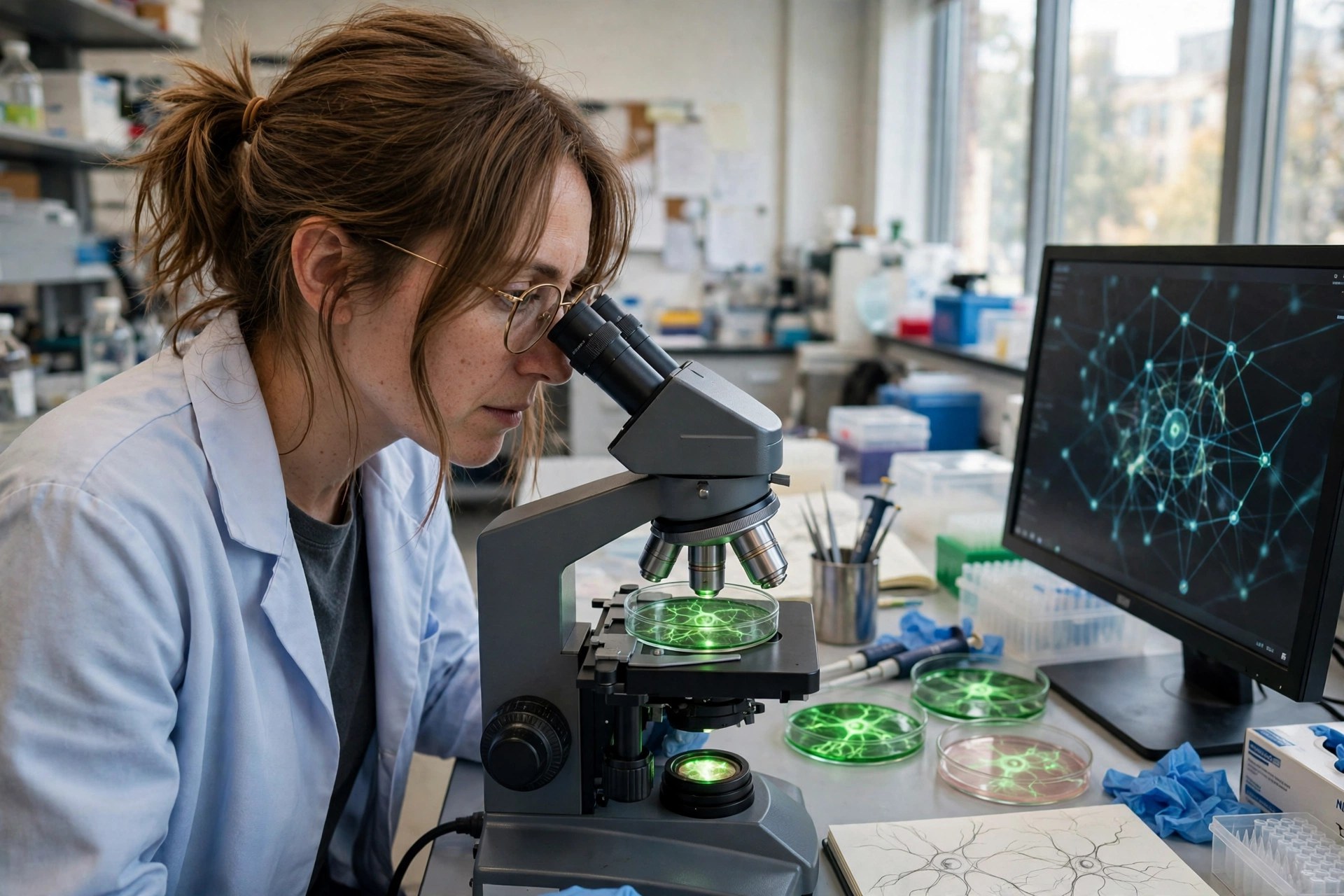
When a DNA-repair pathway fails, developing brain cells lose their mitochondria too — in lab-grown human cells
Edited by Samael A. Tejada, Founder & Editor-in-Chief
·Tip: press play, then lock your phone or switch apps — the article keeps reading.
In human cell models of Fanconi anemia, losing the FANCL DNA-repair gene caused a buildup of the body's own formaldehyde during neuron development, producing DNA-protein crosslinks, mitochondrial dysfunction, defective electrical activity and cell death (Cell Death & Disease, November 2, 2026). Restoring FANCL or the formaldehyde-detoxifying enzyme ADH5 rescued the defects. The evidence is lab-grown cells only, with no patient or treatment data.
A disorder famous for failing bone marrow also quietly damages the developing brain, and nobody could say why. This study follows the damage to an unlikely culprit — a surge of formaldehyde the cells make themselves — and shows mitochondria among the casualties when the repair crew that should clear it is missing.
What did the study actually find?
Fanconi anemia (FA) is a congenital DNA-repair disorder classically marked by bone-marrow failure, yet patients also show congenital malformations and progressive neurodegeneration that lacked a mechanism. Working in human cellular models, Shi and colleagues found that loss of the FA pathway selectively compromised neuroectodermal lineage progression — the developmental path that produces neurons and glia. Cells lacking FANCL showed impaired neuronal morphology, defective expression of neuronal and oligodendroglial markers, mitochondrial dysfunction, and defective electrophysiology: the cells looked wrong, powered themselves wrong, and fired wrong.
Where does formaldehyde come in?
The mechanism is endogenous — the poison is homemade. Transcriptional reprogramming during neural differentiation triggers a metabolic surge of formaldehyde, a normal metabolic byproduct. In healthy cells the FA pathway and detoxifying enzymes handle the resulting DNA-protein crosslinks (DPCs). In FANCL-deficient cells the crosslinks accumulated and apoptosis followed. The decisive test: restoring either FANCL or ADH5, the formaldehyde-detoxifying enzyme, effectively rescued the defects. The team also found that conditioned media from the deficient cultures induced a reactive astrogliosis-like response in recipient cells — a non-cell-autonomous, pro-inflammatory component, meaning the harm radiates outward to neighboring cells that do not carry the defect.
What does this mean for patients — and for mitochondria science?
Boundaries first: these are human cellular models, not patients; no person received FANCL restoration, ADH5 support, or any intervention, and the study tests no treatment. What it changes is the map. It establishes the FA pathway as a safeguard of neurodevelopment, puts mitochondrial dysfunction inside the causal chain of a DNA-repair disorder's brain effects rather than downstream as a vague association, and names a druggable-looking node — formaldehyde detoxification — for future work. Whether boosting ADH5 or limiting formaldehyde helps a human brain is entirely untested, and this page does not claim otherwise.
Frequently asked questions
What is Fanconi anemia?
A congenital DNA-repair disorder classically known for bone-marrow failure. This study addresses its less-understood brain effects — congenital malformations and progressive neurodegeneration — in human cell models.
How do mitochondria fit in?
Cells lacking the FANCL repair gene showed mitochondrial dysfunction alongside impaired neuronal development and faulty electrical activity. Restoring FANCL or the formaldehyde-detoxifying enzyme ADH5 rescued the defects in the cell models.
Is there a treatment from this?
No. The rescue experiments were in lab-grown cells. No patient was treated and no therapy was tested; formaldehyde detoxification is a research lead, not a treatment.
Where the evidence stands
- Established: Fanconi anemia is a congenital DNA-repair disorder classically characterized by bone-marrow failure; formaldehyde is an endogenous metabolite that creates DNA-protein crosslinks; and mitochondrial dysfunction is a recognized feature of several neurodegenerative conditions.
- Preliminary: In human cellular models (Cell Death & Disease, Nov 2, 2026; DOI 10.1038/s41419-026-09388-4), FANCL loss impaired neuronal morphology and markers, caused mitochondrial dysfunction and defective electrophysiology, and drove formaldehyde-linked crosslink accumulation and apoptosis — all rescued by restoring FANCL or ADH5, with a pro-inflammatory effect on recipient cells from conditioned media.
- Absent: Patient intervention data of any kind, in-vivo confirmation of the formaldehyde mechanism, and any tested therapy targeting ADH5 or formaldehyde in Fanconi anemia.
Join the discussion
To get the conversation started: What questions does this story raise for you? Share them below — every comment is reviewed by our moderators before it appears.
Community discussion only — not medical advice. Every comment is reviewed by our moderators before it appears. Sign in with Google or a free Hyvor account to join in.