
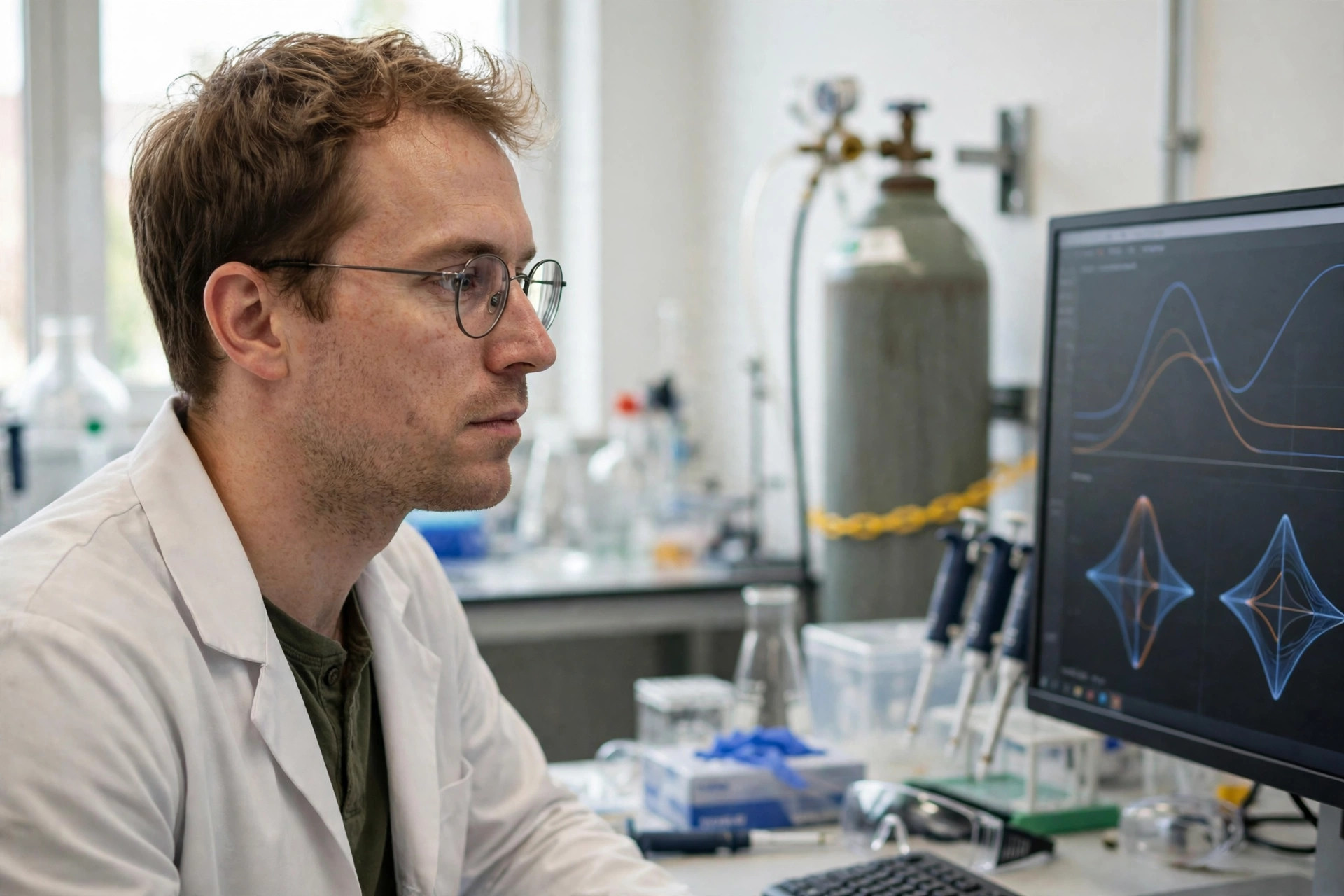
How could hydrogen gas possibly work in the body? A first-principles calculation finds the one mitochondrial state where it can split — in computer models
Edited by Samael A. Tejada, Founder & Editor-in-Chief
·Tip: press play, then lock your phone or switch apps — the article keeps reading.
First-principles calculations modelled on mitochondrial Complex I and III find molecular hydrogen can split only via a neutral semiquinone radical under hyper-reductive pressure, with a barrier near 27 kcal/mol aided by a conserved tyrosine and quantum tunnelling, Physical Chemistry Chemical Physics reports (November 18, 2026). It is a computational mechanism study — no cells, animals or patients were tested.
Hydrogen therapy's weakest point has always been mechanism: a famously inert molecule with reported effects and no obvious way to react. This study does not prove the effects — it asks whether chemistry permits the first step, and finds the conditions are surprisingly specific.
What did the calculation actually test?
Using quantum-chemical models of the Complex I Q-chamber (structure 7QSK) and the Complex III Qo site (1PP9), the authors tested whether semiquinone — a half-reduced quinone radical — can dissociate H₂. The anionic form Q•− had no reaction pathway at either site. Only the protonated neutral radical QH• opened a homolytic hydrogen-atom-transfer route, confirmed at the electronic level by the spin density shifting to a free hydrogen atom.
Why does 'hyper-reductive pressure' matter?
QH• in the buried reaction site arises only when the quinone pool is over-reduced and membrane potential is high at the same time — a stressed, backed-up electron transport chain. That specificity cuts both ways: it gives hydrogen a plausible, testable site of action, and it predicts H₂ should do little in mitochondria that are not in that state. Reaction energies of +21 to +26 kcal/mol mean the barrier is high and sharp, with tunnelling making a substantial contribution to crossing it at body temperature.
What does this change for hydrogen research?
It converts a vague 'antioxidant' story into falsifiable predictions — effects should track hyper-reductive states and semiquinone occupancy — that cell and animal experiments can now test. Until they do, this remains elegant chemistry: a mechanism shown possible in silico, not a demonstration that inhaled or dissolved hydrogen reaches this site or helps any condition.
Frequently asked questions
What is a semiquinone?
A half-reduced form of quinone — the electron-carrying molecule of the mitochondrial respiratory chain — carrying an unpaired electron, which makes it chemically reactive.
What is hydrogen-atom transfer?
A reaction in which a hydrogen atom (proton plus electron together) moves from one molecule to another. Here it is the proposed first step that splits H₂.
Does this prove hydrogen therapy works?
No. It shows a chemically possible mechanism under specific mitochondrial conditions, in computer models. Biological and clinical proof would require separate experiments.
Where the evidence stands
- Established: The H–H bond is exceptionally strong, animal cells lack metal hydrogenases, and semiquinone radicals form in mitochondrial Complexes I and III during electron transport.
- Preliminary: The QH• hydrogen-atom-transfer mechanism, its hyper-reductive preconditions and tunnelling contribution: one first-principles computational study (Physical Chemistry Chemical Physics, 2026).
- Absent: Experimental confirmation in mitochondria, cells or animals for this specific pathway, and any clinical conclusion about hydrogen therapy.
Join the discussion
To get the conversation started: What questions does this story raise for you? Share them below — every comment is reviewed by our moderators before it appears.
Community discussion only — not medical advice. Every comment is reviewed by our moderators before it appears. Sign in with Google or a free Hyvor account to join in.