
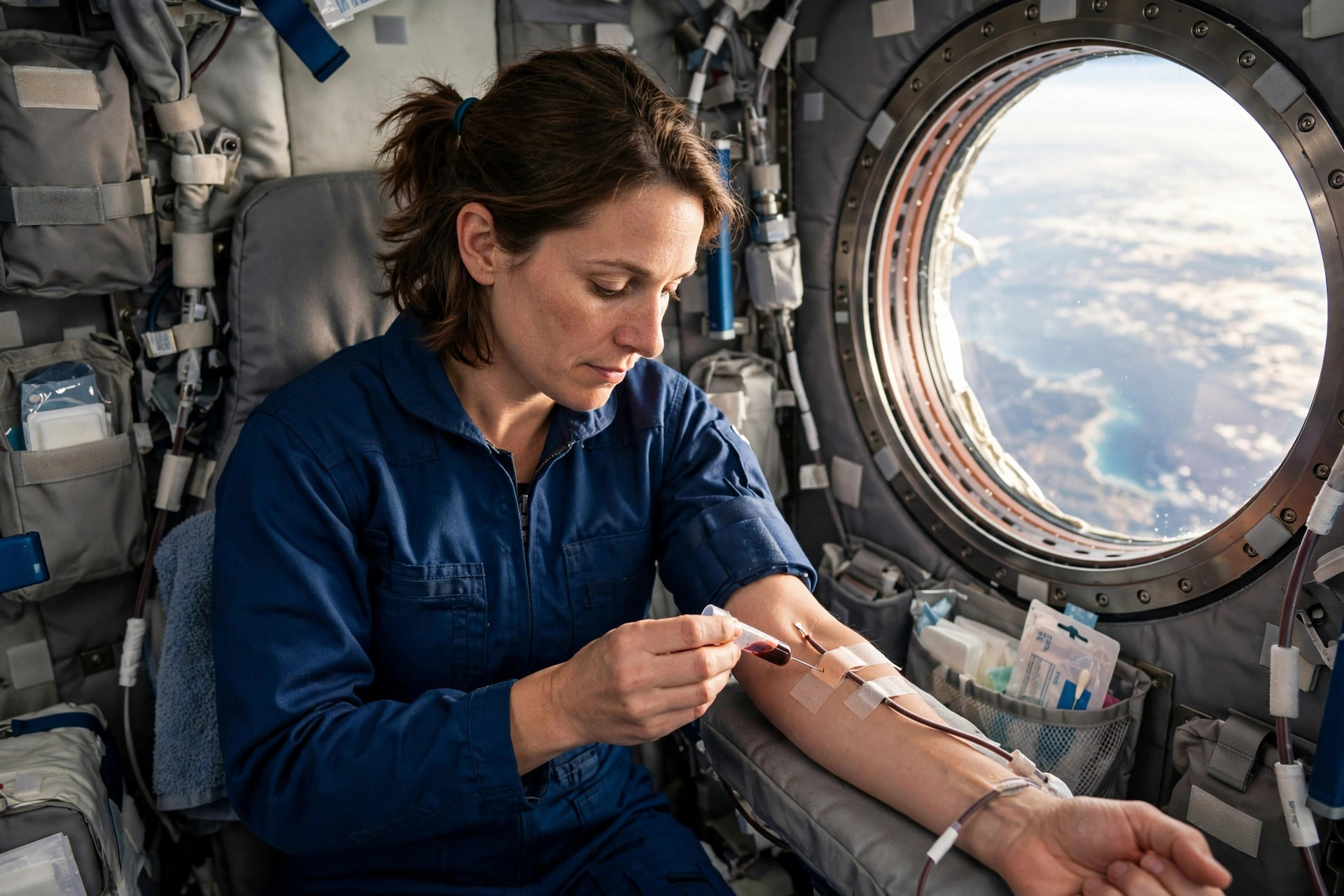
Younger astronauts showed the strongest mitochondrial stress signals in orbit
·Tip: press play, then lock your phone or switch apps — the article keeps reading.
Spaceflight stresses the human body in ways no Earth environment quite matches, and mitochondria — the cell's energy producers — are among the first systems to register that stress. A study published October 12, 2026 in npj Microgravity (Jimenez-Chavez, Ding, Krieger and colleagues, including NASA Johnson Space Center researchers) asked a deceptively simple question: does age change how the body responds up there?
How was the study done?
The team analyzed blood samples from 10 ISS crewmembers who were 34 to 61 years old at launch. Samples were collected during flight, between days 75 and 210 of their missions, and the researchers ran transcriptomic analyses — readouts of which genes are switched on or off — on peripheral blood mononuclear cells, a key population of immune cells.
They then stratified the results by age and sex, looking for patterns in how gene expression changed in flight and which cellular pathways those changes pointed to.
What did they find?
The response to spaceflight was clearly age-dependent, with no clear sex-related effect in this small crew sample. Younger crewmembers showed more differentially expressed genes — more of their gene activity shifted in flight — and the number of shifted genes also grew with mission duration. Pathway analysis pointed in the same direction: younger astronauts showed more severe signs of mitochondrial dysfunction in their immune cells than older astronauts did.
That is the opposite of the intuition many readers will bring — that older bodies are always the more fragile ones. The authors are careful about what it means: whether the stronger response in younger crew is harmful, helpful, or simply a more vigorous adaptation is not yet known.
Why does this matter back on Earth?
For space medicine, the practical message is that countermeasures — exercise, nutrition, and one day perhaps mitochondria-targeted support — may need to be tuned by age and mission length rather than applied uniformly. For everyone else, astronaut blood remains one of the cleanest human models of accelerated physiological stress: the same mitochondrial pathways that falter in orbit are implicated in aging and immune decline on the ground.
The limits are real: 10 people, one cell type, and gene-expression signals rather than direct measures of mitochondrial performance. The study is an early map of who responds most strongly to spaceflight, not a verdict on what that response does over years.
Where the evidence stands
- Established: Spaceflight alters immune function and gene expression; mitochondrial pathways are consistently among the systems affected in astronaut studies.
- Preliminary: In 10 ISS crew (ages 34–61, samples at 75–210 days), in-flight gene-expression changes were age-dependent and stronger in younger astronauts, with pathway analysis indicating more severe mitochondrial dysfunction in younger crew; no clear sex effect was seen.
- Absent: Direct functional measures of mitochondrial performance in these crew, data on whether the stronger young-crew response is harmful or adaptive, and any tested age-specific countermeasure.
Join the discussion
To get the conversation started: What questions does this story raise for you? Share them below — every comment is reviewed by our moderators before it appears.
Community discussion only — not medical advice. Every comment is reviewed by our moderators before it appears. Sign in with Google or a free Hyvor account to join in.