
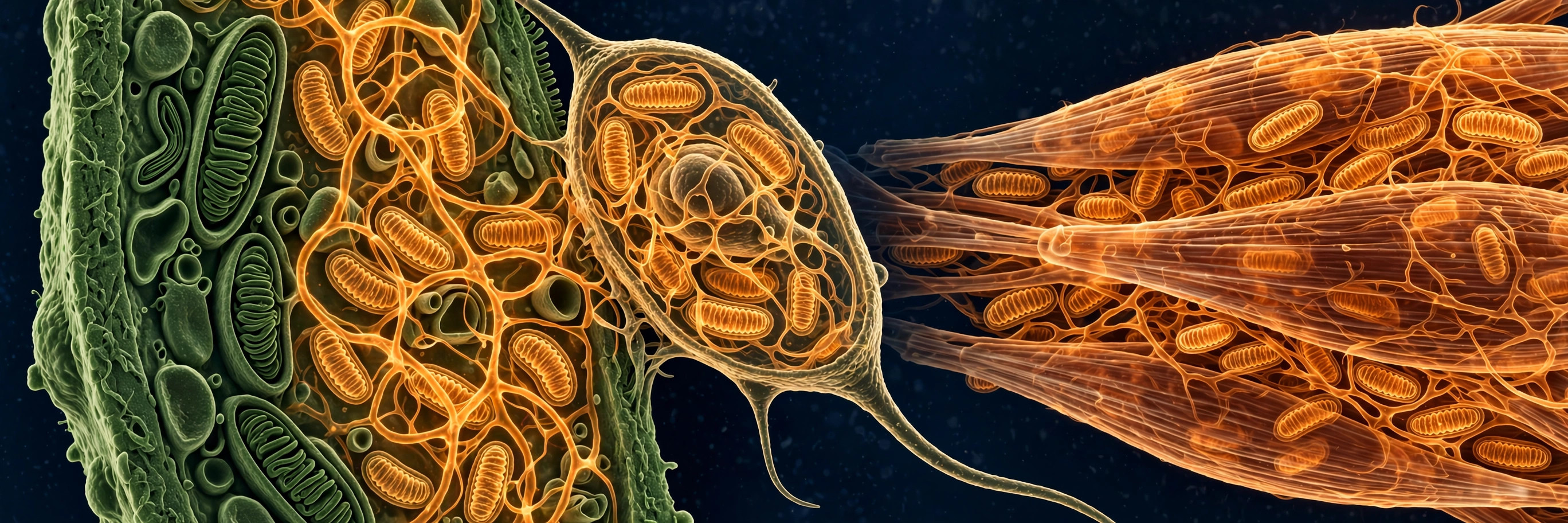
Mitochondrial proteome census across the tree of life — new in Cell
·Every mitochondrion is a machine built from proteins — but until now, nobody had a complete parts list for the machines in most species. A new study in Cell changes that, publishing comparative mitochondrial protein catalogs across the tree of life: from plants to the parasites that cause leishmaniasis and sleeping sickness to humans.
What did the scientists actually find?
The work comes from teams at the Broad Institute, Mass General Brigham, Harvard, and Boston University, led by researchers including Sarah Calvo (a senior computational scientist at the Broad), Luke Chao of Mass General Brigham and Harvard Medical School, Manoj Duraisingh of the Harvard T.H. Chan School of Public Health, and John Samuelson, Ruslan Afasizhev, and Inna Afasizheva of Boston University.
For plants, the new inventory is described as the most comprehensive and accurate to date, built with an approach the authors say should work for other plants. The surprise came from the parasites: Leishmania and Trypanosoma carry mitochondrial proteomes that are 50% larger than the human one, stuffed with proteins unique to those classes. And more than half of the proteins across these catalogs have unknown functions — the map is drawn, but much of the territory is blank.
Why should you care about parasite mitochondria?
Those parasite-unique proteins are potential drug targets: anything the parasite's mitochondria do differently from ours is a lever a future medicine could pull without touching human cells. The catalogs also sharpen human mitochondrial-disease research — knowing which proteins are conserved across species and which are lineage-specific helps geneticists judge which mutations are likely to matter.
And there is a bigger question in play. 'This project is one step in the larger scientific effort to use the existing diversity on Earth as a stepping stone toward answering one of the deepest questions: How did complex life evolve on our planet?' said team member Sarah Calvo.
What happens next?
The team made all the data freely available at mitocarta.org, so any lab in the world can now hunt through these inventories for proteins with unusual jobs. Expect the 'unknown function' proteins to be the story of the next few years: every one that gets a job description could reveal a new facet of how mitochondria — and the diseases that break them — actually work.
Where the evidence stands
- Established: Human mitochondrial protein catalogs (MitoCarta) are well validated and widely used in research.
- Preliminary: The cross-species inventories are new; some of the 'unusual functions' are computationally predicted and await experimental confirmation.
- Absent: No direct human health application yet — this is foundational biology, not a therapy.