
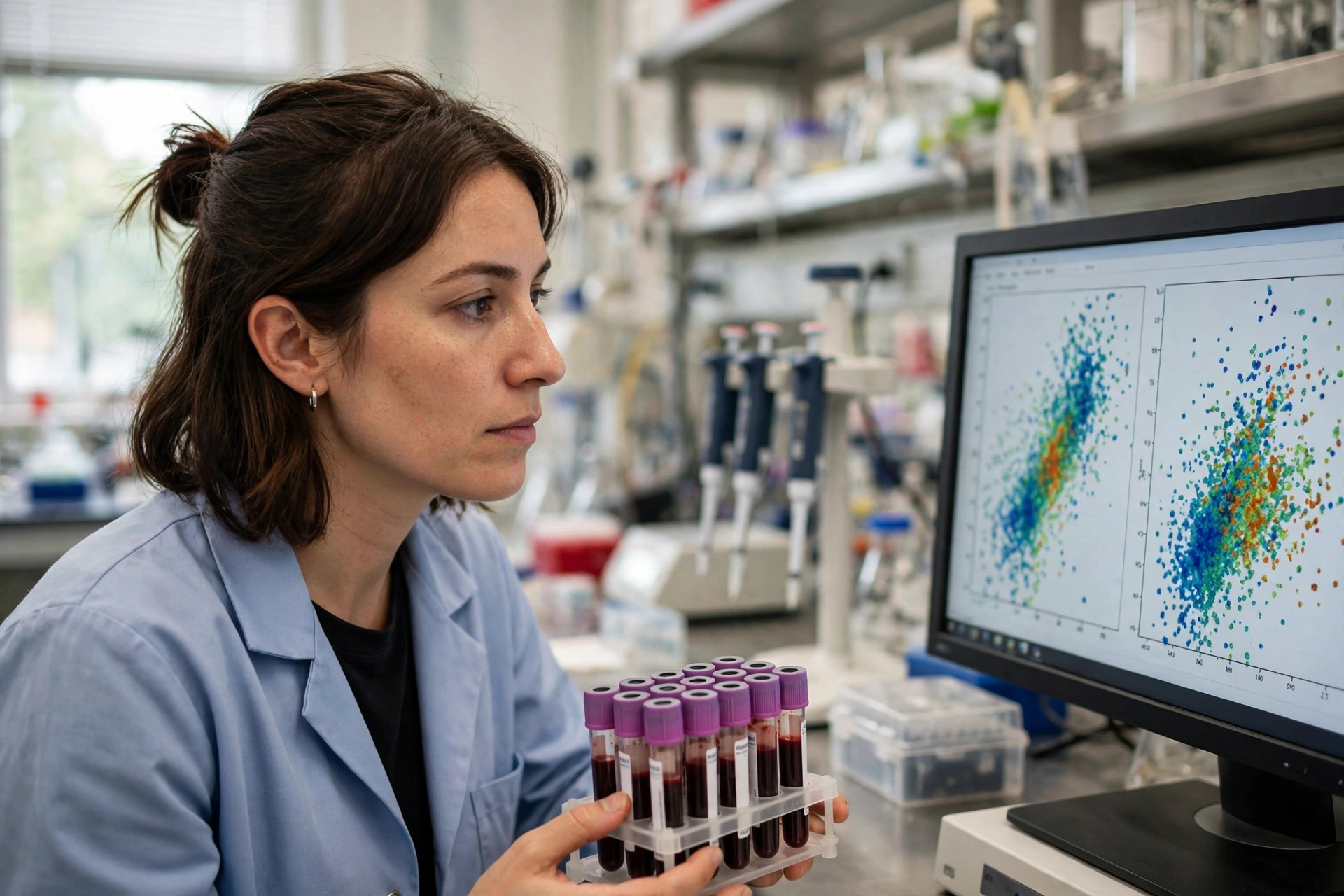
A variant in mitochondrial DNA revealed a hidden 31-amino-acid protein tied to sex-specific immune differences in people
Edited by Samael A. Tejada, Founder & Editor-in-Chief
·Tip: press play, then lock your phone or switch apps — the article keeps reading.
A mitochondrial DNA variant (G16393A) changes one amino acid in a newly described 31-amino-acid microprotein, MASL, and tracked with immune-cell differences in women in the Health and Retirement Study, an Immunity & Ageing study reports (November 19, 2026), with partial support in UK Biobank data. Effects of giving MASL to aged mice ran in the opposite, male direction, so the biology is unresolved.
Mitochondria keep turning out to have more genes than the textbook count. MASL joins MOTS-c in the growing list of tiny mitochondrial proteins — and this one was found by starting from human immune data, not from the genome alone.
How was MASL found?
By association first, annotation second. The team ran a mitochondrial-wide association study in the Health and Retirement Study (a US cohort of more than 37,000 adults over 50), testing 85 mitochondrial variants against blood immune measures. Only G16393A (rs869031877) was significant across all three markers in non-Hispanic white participants: carriers had higher lymphocyte percentages (beta 2.1, p = 0.008), lower neutrophil percentages (beta -2.5, p = 0.005) and a lower neutrophil-to-lymphocyte ratio. Stratified by sex, the signal came entirely from women. In 409,152 UK Biobank participants the lymphocyte association held; the neutrophil one did not. The variant occurs in about 2.5% of non-Hispanic white and Hispanic populations and about 0.2% of African American populations.
What is the protein itself doing?
MASL was confirmed as a real, translated protein: antibodies detected it in a human cell line, distributed across cytoplasm and nucleus, and a custom blood test found it circulating in human plasma — at lower levels in women than men, and lower in people aged 50 and over. Among 67 bariatric-surgery patients followed for a year, those whose MASL rose after surgery had a lower neutrophil-to-lymphocyte ratio (1.08 vs 1.47, p = 0.044) than those whose MASL fell. Gene-expression profiling of 1,926 participants showed sharply sex-divergent patterns: immune pathways (immunoglobulin signalling, B-cell activation) in female carriers, metabolic and bioenergetic pathways in male carriers.
Why did the mouse experiment complicate the story?
Because it pointed the other way. Aged mice (77-84 weeks) given synthetic MASL twice daily for three weeks (10 mg/kg) showed effects in males, not females: males gained muscle, lost fat, and their circulating lymphocytes fell while neutrophils rose — the reverse direction of the human female association — with rises in inflammatory cytokines such as IL-1beta. The variant form of the peptide produced weaker cytokine responses. The authors are explicit about the limits: the human genetics used array data without targeted sequencing validation, single-variant effects cannot be fully separated from mitochondrial haplogroup background, and acute high-dose peptide in mice is not the same as lifelong carriage of a variant in people.
Frequently asked questions
What is MASL?
A 31-amino-acid microprotein encoded by a small open reading frame in the mitochondrial DNA D-loop region, newly characterised in this study. A common variant changes its 18th amino acid (V18I).
What is the neutrophil-to-lymphocyte ratio?
A routine blood marker: the proportion of neutrophils to lymphocytes. Higher values generally indicate more systemic inflammation; the MASL variant tracked with a lower ratio in female carriers.
Does carrying this variant change my health?
Unknown. The study found statistical associations with immune-cell percentages in specific populations, not disease outcomes, and the mouse experiments showed context-dependent effects in the opposite sex. No clinical action follows from it today.
Where the evidence stands
- Established: Mitochondrial DNA encodes 13 canonical proteins plus a growing set of small microproteins such as MOTS-c, and the neutrophil-to-lymphocyte ratio is an established marker of systemic inflammation.
- Preliminary: MASL itself, its immune associations and its sex specificity: one study (Immunity & Ageing, 2026) combining human cohorts (Health and Retirement Study; UK Biobank), cell assays, plasma profiling and aged-mouse injections.
- Absent: Targeted sequencing validation of the variant, a known receptor or mechanism for MASL, and any clinical use of MASL measurement or treatment.
Join the discussion
To get the conversation started: What questions does this story raise for you? Share them below — every comment is reviewed by our moderators before it appears.
Community discussion only — not medical advice. Every comment is reviewed by our moderators before it appears. Sign in with Google or a free Hyvor account to join in.