
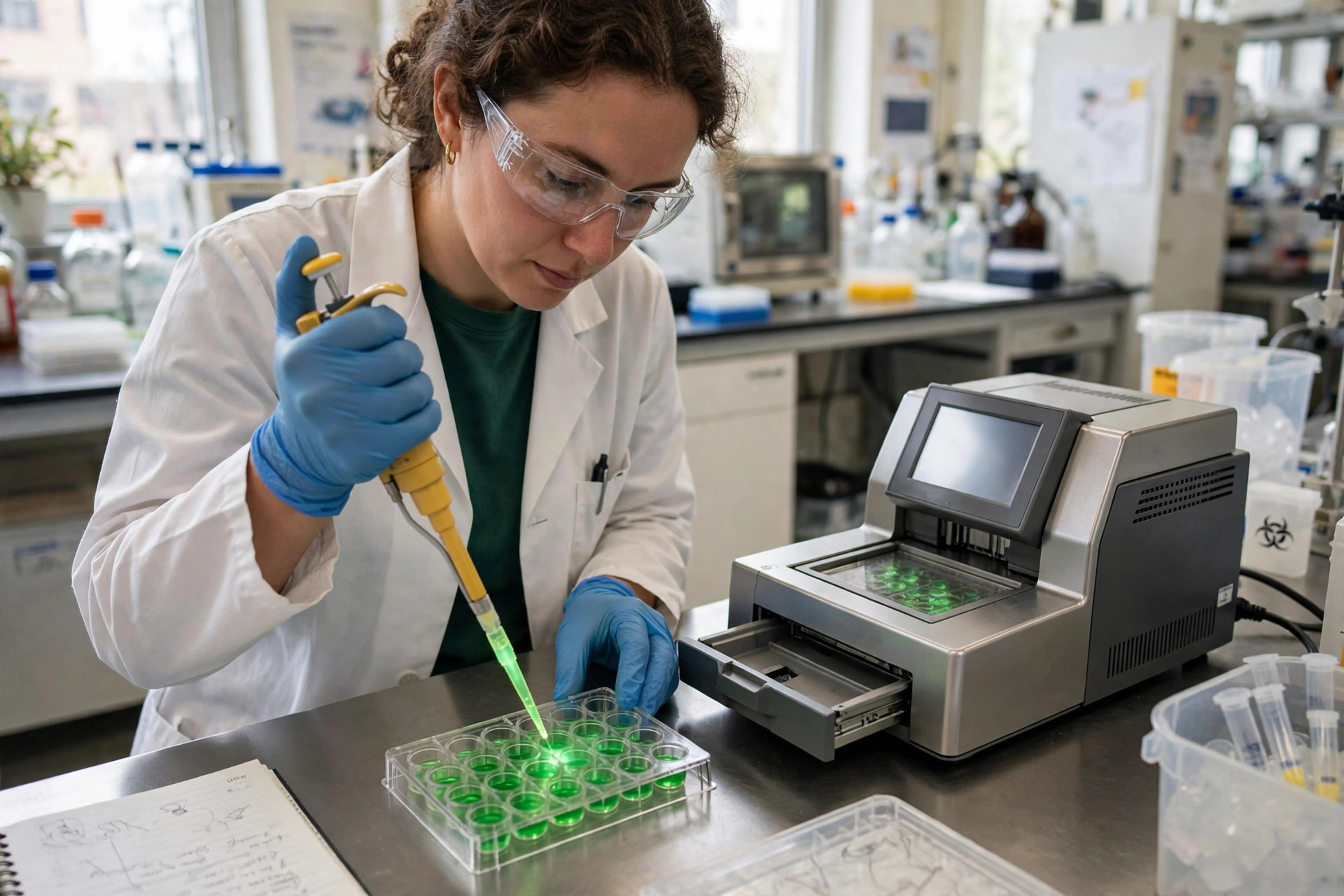
A new chemical tool damages mitochondrial DNA on demand — letting researchers watch inflammation start, step by step — in lab-grown human cells
Edited by Samael A. Tejada, Founder & Editor-in-Chief
·Tip: press play, then lock your phone or switch apps — the article keeps reading.
UC Riverside researchers built a mitochondria-targeted chlorambucil derivative that damages mitochondrial DNA on demand in lab-grown human airway cells, driving mitochondrial nucleic-acid release and innate immune signalling, a Free Radical Biology and Medicine study reports (2026). It is a research tool for cells, not a test or treatment for patients.
Most inflammation experiments start with a flood — a toxin, an infection, a whole tissue injured at once. This one starts with a scalpel: one organelle's DNA, damaged deliberately, so the first domino can be seen falling.
How does the tool work?
Chlorambucil is a chemotherapy drug that damages DNA. The team chemically modified it so that instead of damaging DNA indiscriminately, the molecule concentrates in mitochondria and damages mitochondrial DNA specifically. That controlled injury drives the output of mitochondrial nucleic acids from the organelle and activates innate immune signalling — the cell's alarm system — in a sequence researchers can now time and measure.
Why airway cells?
Because the airway lining is where inhaled inflammation-triggering pollutants make first contact. If mitochondrial DNA damage is one of the mechanisms by which air pollution and similar exposures ignite airway inflammation, a tool that reproduces exactly that first step — in the exact cell type that meets the exposure — lets researchers test the mechanism cleanly instead of inferring it from downstream inflammation.
What is it for — and what is it not?
It is a measurement and mechanism tool for the laboratory: a way to investigate how mitochondrial injury contributes to inflammation, and potentially to screen ideas against that pathway. The team plans to test versions causing different amounts of damage to map the dose-response. It is not a diagnostic test, it has not been used in animals or people in this work, and the parent compound is a chemotherapy drug — nothing here is a therapy.
Frequently asked questions
Why damage DNA on purpose?
To create a controlled, timed starting point. If researchers know exactly when and where mitochondrial DNA damage begins, they can measure the order of everything that follows — which signals fire first, and which interventions interrupt them.
What are mitochondrial nucleic acids?
The DNA (and RNA) normally kept inside mitochondria. When injury lets them escape into the rest of the cell, the innate immune system can detect them and treat them as an alarm signal.
Could this become a test for patients?
Not from this study. It is a laboratory research tool used in cultured cells; no patient samples were tested and no diagnostic use was evaluated.
Where the evidence stands
- Established: Damaged mitochondrial DNA can escape mitochondria and activate innate immune signalling, and airway epithelial cells are a frontline tissue for inhaled inflammatory exposures.
- Preliminary: The targeted chlorambucil tool itself and the signalling sequence it reveals: one study (Free Radical Biology and Medicine, 2026) in lab-grown human airway cells.
- Absent: Animal or human validation, any diagnostic application, and any therapeutic use.
Join the discussion
To get the conversation started: What questions does this story raise for you? Share them below — every comment is reviewed by our moderators before it appears.
Community discussion only — not medical advice. Every comment is reviewed by our moderators before it appears. Sign in with Google or a free Hyvor account to join in.