
Closer Mediterranean eating tracked with higher levels of two mitochondrial microproteins
Edited by Samael A. Tejada, Founder & Editor-in-Chief
·Tip: press play, then lock your phone or switch apps — the article keeps reading.
Humanin has been studied since 2003 as a mitochondria-derived signal tied to insulin sensitivity, cardiovascular protection and cognition, and SHMOOSE — discovered in Pinchas Cohen's lab — is linked to brain health and Alzheimer's risk. This study connects both to something refreshingly ordinary: what people actually eat, measured component by component.
Which foods tracked with which protein?
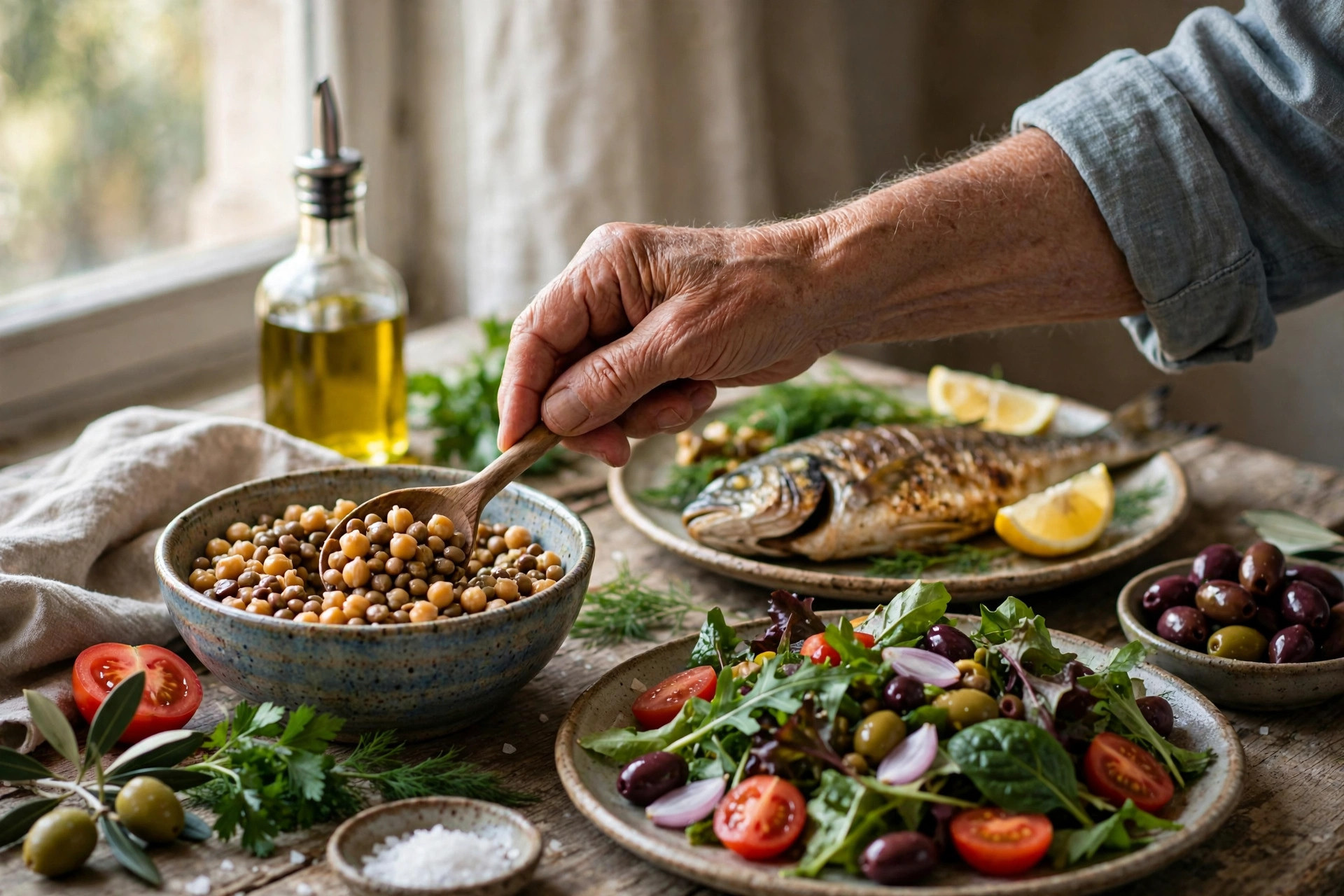
The component analysis is the most actionable part of the paper. Humanin correlated positively with olive oil (p = 0.0069), fish (p = 0.038) and legumes (p = 0.0282). SHMOOSE was higher with olive oil consumption (p = 0.020) and with low intake of refined bread (p = 0.029). Overall high adherence to the Mediterranean pattern — rich in olive oil, fish, legumes, fruits and vegetables — was associated with higher levels of both microproteins than low-to-medium adherence in this 49-patient sample.
What is the proposed heart-protection mechanism?
Humanin was inversely associated with sNox2-dp, a marker of activity of the Nox2 enzyme that produces reactive oxygen species (p = 0.019, and still significant after adjusting for sex and BMI), and with the oxidative-stress marker 8-iso-PGF2alpha (p = 0.049). The authors propose a two-part model: the diet lowers oxidative stress directly, while higher humanin may further damp Nox2-driven oxidant production — a putative humanin-Nox2 cardioprotective crosstalk. 'Putative' is their word and the right one: the data are cross-sectional correlations in a small sample.
What would prove this is more than a correlation?
A feeding trial: assign people to a Mediterranean diet or a control diet, measure humanin and SHMOOSE before and after, and show the proteins move with the diet and mediate changes in oxidative stress or clinical markers. Until then, the study's own framing is the honest one — mitochondrial microproteins are promising candidate biomarkers for tailoring nutritional strategies for healthy aging, and the causal nature of the associations is undetermined. The finding is best read as a mechanism hypothesis with named molecules and named foods, which is exactly what makes it testable.
Frequently asked questions
What are humanin and SHMOOSE?
They are microproteins encoded by small open reading frames in the mitochondrial genome — regions once thought nonfunctional. Humanin, identified in 2003, is linked to insulin sensitivity, cardiovascular protection and cognition; SHMOOSE is a more recently discovered microprotein tied to brain health and Alzheimer's risk.
What did this study find?
In 49 patients, those with high adherence to a Mediterranean diet had significantly higher blood levels of humanin and SHMOOSE. Olive oil tracked with both; fish and legumes tracked with humanin; low refined-bread intake tracked with SHMOOSE. Higher humanin was also associated with lower Nox2 activity and a lower oxidative-stress marker.
Does this prove the Mediterranean diet raises these proteins?
No. The study is observational and cross-sectional: it shows association at one point in time, not causation. The authors call for further studies to determine whether the diet changes microprotein levels and whether those changes cause health benefits.
Where the evidence stands
- Established: Humanin and SHMOOSE are microproteins encoded in the mitochondrial genome; humanin has been linked in prior research to insulin sensitivity, cardiovascular protection and cognition, and a SHMOOSE variant is associated with Alzheimer's disease risk. Mediterranean dietary patterns are associated with lower cardiovascular and cognitive risk in large observational literatures.
- Preliminary: In 49 patients (Frontiers in Nutrition, March 2026), high Mediterranean-diet adherence was associated with higher circulating humanin and SHMOOSE, specific components (olive oil, fish, legumes, low refined bread) tracked with individual proteins, and humanin was inversely associated with Nox2 activity and an oxidative-stress marker.
- Absent: Causal evidence: no feeding intervention, no demonstration that raising these microproteins improves any clinical outcome, and no replication in a larger cohort.
Join the discussion
To get the conversation started: What questions does this story raise for you? Share them below — every comment is reviewed by our moderators before it appears.
Community discussion only — not medical advice. Every comment is reviewed by our moderators before it appears. Sign in with Google or a free Hyvor account to join in.