
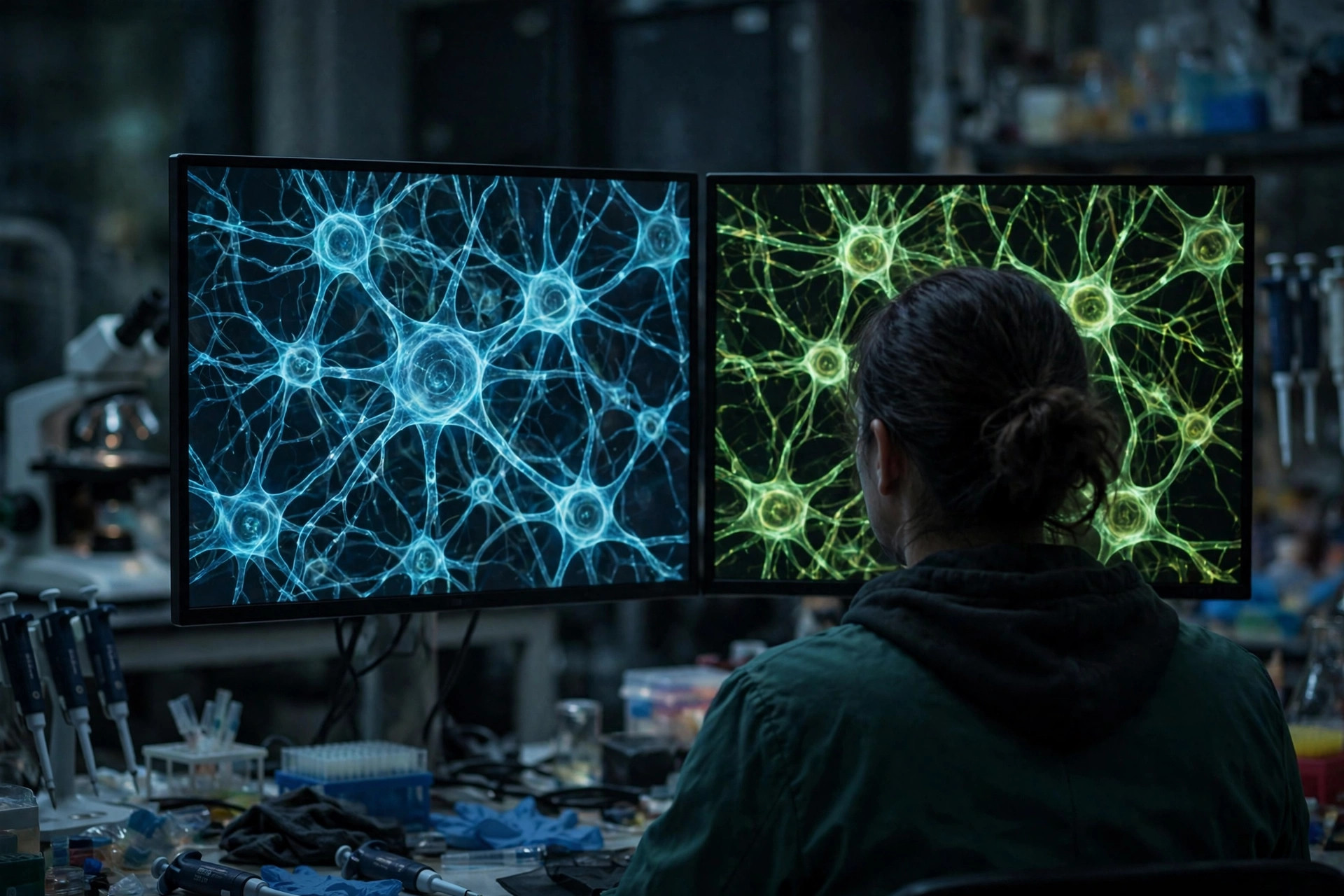
Tau enters mitochondria and runs their electron chain in reverse — in lab models
Edited by Samael A. Tejada, Founder & Editor-in-Chief
·Tip: press play, then lock your phone or switch apps — the article keeps reading.
Tau tangles and mitochondrial failure are both hallmarks of tauopathies, but which causes which was unclear. This work says tau has a normal job — regulating reverse electron transport — that aging and stress turn pathological, and that the loop can be interrupted, at least in models.
What is reverse electron transport, and what does tau do to it?
Normally electrons flow forward through complex I to help make ATP. Under aging or stress, flow can reverse (RET), generating reactive oxygen species. The team showed across flies, mice and human iPSC-derived neurons that tau regulates RET: depleting tau eliminated stress-induced RET and conferred resilience, while phosphorylated tau entered mitochondria and interacted directly with the complex I subunit NDUFS3 to promote RET in a phosphorylation-dependent manner.
Why is the loop self-perpetuating?
Elevated RET raised reactive oxygen species, reduced the NAD+/NADH ratio, and further drove tau hyperphosphorylation — so the modified tau that promotes RET is itself produced in greater amounts by RET. Inhibiting RET ameliorated tau toxicity across species in the study, which is why the authors present RET regulation as a previously unrecognized normal tau function that becomes pathological in disease, and a candidate therapeutic target.
How close is this to a treatment?
Not close. The rescue evidence is in flies, mice and cultured human neurons; reporting on the work notes an experimental compound approach and a disclosed commercial interest around it, with no human testing. It changes no diagnosis or treatment today — its value is a specific, testable mechanism where previously there was a correlation.
Frequently asked questions
What is reverse electron transport?
It is a backward flow of electrons through mitochondrial complex I that occurs under aging or stress conditions. It produces excess reactive oxygen species and lowers the NAD+/NADH ratio, stressing the cell.
What did this study show tau does inside mitochondria?
Phosphorylated tau enters mitochondria and binds NDUFS3, a subunit of complex I, promoting reverse electron transport. That in turn drives more tau hyperphosphorylation, forming a self-perpetuating loop linked to neurodegeneration in fly, mouse and human-cell models.
Is there a treatment based on this finding?
No human treatment exists. Inhibiting reverse electron transport reduced tau toxicity in laboratory and animal models, making it a candidate target for future drug development only.
Where the evidence stands
- Established: Tau hyperphosphorylation and aggregation are pathological hallmarks of Alzheimer's disease and other tauopathies, and mitochondrial dysfunction is a common feature of those diseases; reverse electron transport at complex I generates reactive oxygen species.
- Preliminary: In flies, mice and human iPSC-derived neurons (Neuron, Aug 6, 2026; preview Oct 22, 2026), phosphorylated tau entered mitochondria, bound NDUFS3, and promoted RET, which in turn drove further tau hyperphosphorylation; inhibiting RET reduced tau toxicity across models.
- Absent: Human clinical data, a tested drug in people, and any change to diagnosis or treatment.
Join the discussion
To get the conversation started: What questions does this story raise for you? Share them below — every comment is reviewed by our moderators before it appears.
Community discussion only — not medical advice. Every comment is reviewed by our moderators before it appears. Sign in with Google or a free Hyvor account to join in.