
A mitochondrial fusion protein has a second job — stopping toxic protein clumps — and its failure may explain a nerve disease
·Tip: press play, then lock your phone or switch apps — the article keeps reading.
Charcot-Marie-Tooth disease (CMT) is one of the most common inherited nerve disorders — progressive weakness and sensory loss, currently incurable. Its best-known gene is MFN2, encoding mitofusin 2, a protein that fuses mitochondria into networks. But many other CMT genes have no mitochondrial role at all, which has long hinted that MFN2's link to the disease might run through something other than fusion. A study published in Nature Communications and reported October 17-18, 2026, from teams at the University of Cologne's Institute of Genetics with partners in Bochum, Padova and Angers, identifies that something.
What is MFN2's second job?
The researchers found that MFN2 interacts with the proteasome — the cell's protein-shredding machinery — and with molecular chaperones that shepherd newly synthesized proteins into safe shapes. Together they prevent aggregation: the clumping of misfolded proteins that is toxic to cells and a hallmark of many neurodegenerative diseases. In this picture, MFN2 is not only a membrane-fusion factor but a guardian of protein quality at the mitochondrial surface.
What happens in patients' cells when MFN2 is mutated?
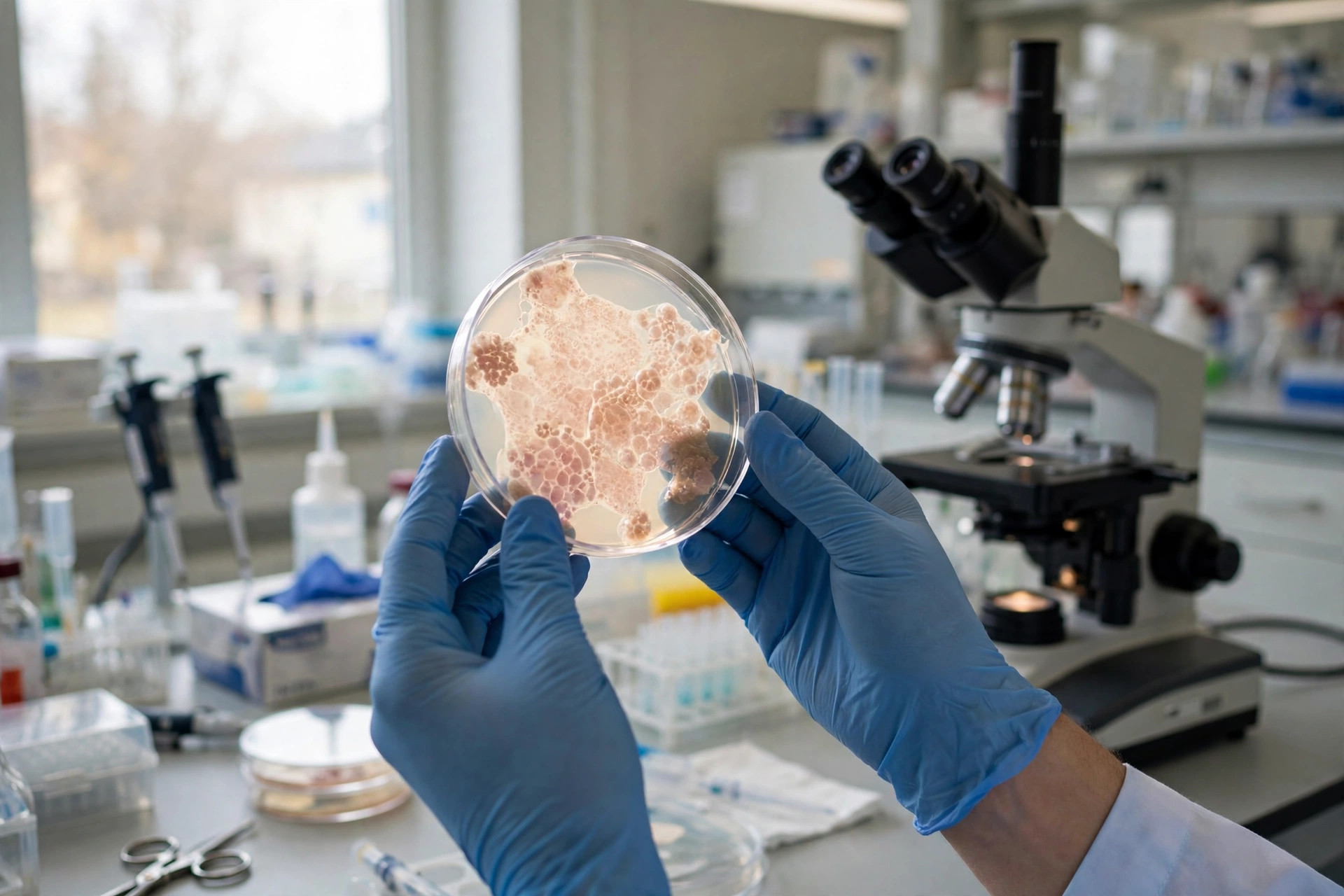
In skin cells taken from people with CMT, MFN2 mutations caused a loss of this protective function, and detrimental protein clumping followed. That observation matters because it connects a mitochondrial protein to proteostasis — the cell-wide balance of protein production, folding and disposal — and suggests the nerve damage in MFN2-related CMT may be driven less by failed mitochondrial fusion and more by accumulating protein aggregates that long nerve cells are especially poor at clearing.
Does this open a treatment path?
It opens a target, not a treatment. If protein aggregation is a driver, then strategies that support proteasome function, chaperone capacity or aggregate clearance become rational candidates to test — in cell and animal models first. The study is mechanistic cell biology, largely in cultured cells including patient skin cells; whether neurons in people behave the same way, and whether any intervention can rescue them, remains untested. Still, reframing a disease mechanism is often the step that makes a previously invisible drug target visible.
Where the evidence stands
- Established: MFN2 mutations are a major cause of Charcot-Marie-Tooth disease, and MFN2's established role is mitochondrial fusion; protein aggregation is toxic to cells and implicated in neurodegeneration.
- Preliminary: A Nature Communications study (2026) reports MFN2 interacts with the proteasome and chaperones to prevent protein aggregation, and that CMT-linked MFN2 mutations in patient skin cells disable that protection, causing protein clumping.
- Absent: Confirmation in human neurons in vivo and any therapy targeting proteostasis for MFN2-related Charcot-Marie-Tooth disease.
Join the discussion
To get the conversation started: What questions does this story raise for you? Share them below — every comment is reviewed by our moderators before it appears.
Community discussion only — not medical advice. Every comment is reviewed by our moderators before it appears. Sign in with Google or a free Hyvor account to join in.