
A new imaging library captures mitochondrial cell death frame by frame — and anyone can use it
·Tip: press play, then lock your phone or switch apps — the article keeps reading.
Intrinsic apoptosis — the cell's built-in death program — turns on one event: permeabilization of the mitochondrial outer membrane. Once that membrane opens, cytochrome c escapes and the cell is committed. Yet the choreography of that moment, and how mitochondrial shape-shifting (dynamics) modulates it, is still argued over.
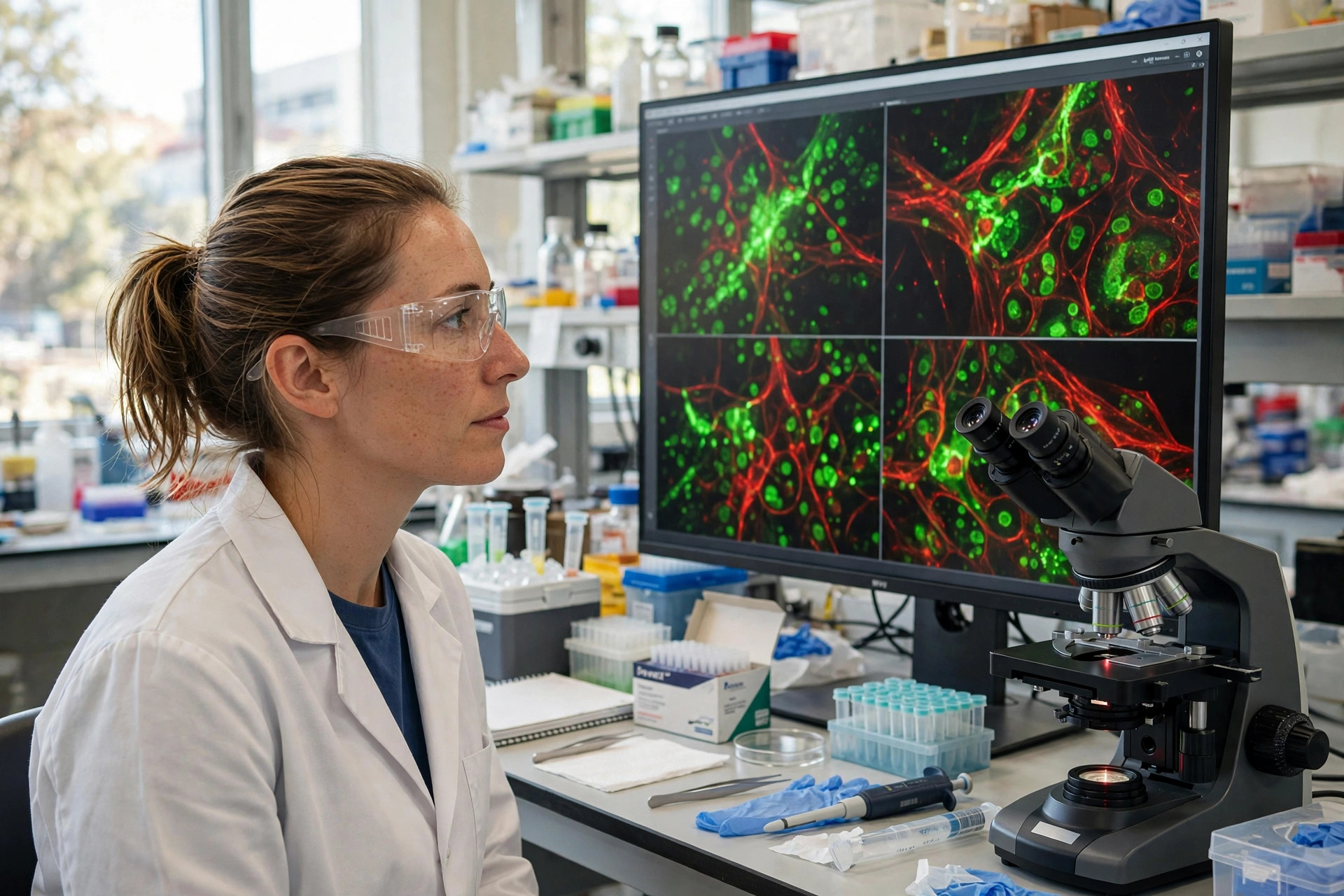
A dataset published October 15, 2026 in Scientific Data (Hellwig, Meigel, Stachelscheid and colleagues) was built to let researchers study it directly. The team treated mouse embryonic cells with the mitochondrial dynamics inhibitor M1, induced apoptosis with actinomycin D, and imaged the process by high-throughput spinning-disk confocal microscopy.
What does a shared dataset like this actually do?
It turns one laboratory's expensive imaging run into a common yardstick. Other groups can re-analyze the same mitochondrial death sequences, test competing models of how pro-apoptotic protein complexes form at the outer membrane, and train image-analysis tools on consistent data instead of each lab's one-off pictures.
How does this connect to yesterday's ceramide story?
It complements it. Controlled membrane experiments have just challenged the idea that ceramides form death channels in mitochondria; high-resolution imaging of real cells undergoing apoptosis is the other half of the toolkit — watching the membrane event itself, in living systems, at scale. Together they narrow how the field explains the moment a mitochondrion decides a cell's fate.
Where the evidence stands
- Established: Permeabilization of the mitochondrial outer membrane is the committing step of intrinsic apoptosis, modulated by mitochondrial dynamics.
- Preliminary: A high-throughput confocal dataset (Scientific Data, Oct 15, 2026) records mitochondrial apoptosis in mouse embryonic cells under dynamics inhibition, as a reusable research resource.
- Absent: Any direct clinical application; this is a research dataset, not a treatment or a test for patients.
Join the discussion
To get the conversation started: What questions does this story raise for you? Share them below — every comment is reviewed by our moderators before it appears.
Community discussion only — not medical advice. Every comment is reviewed by our moderators before it appears. Sign in with Google or a free Hyvor account to join in.