
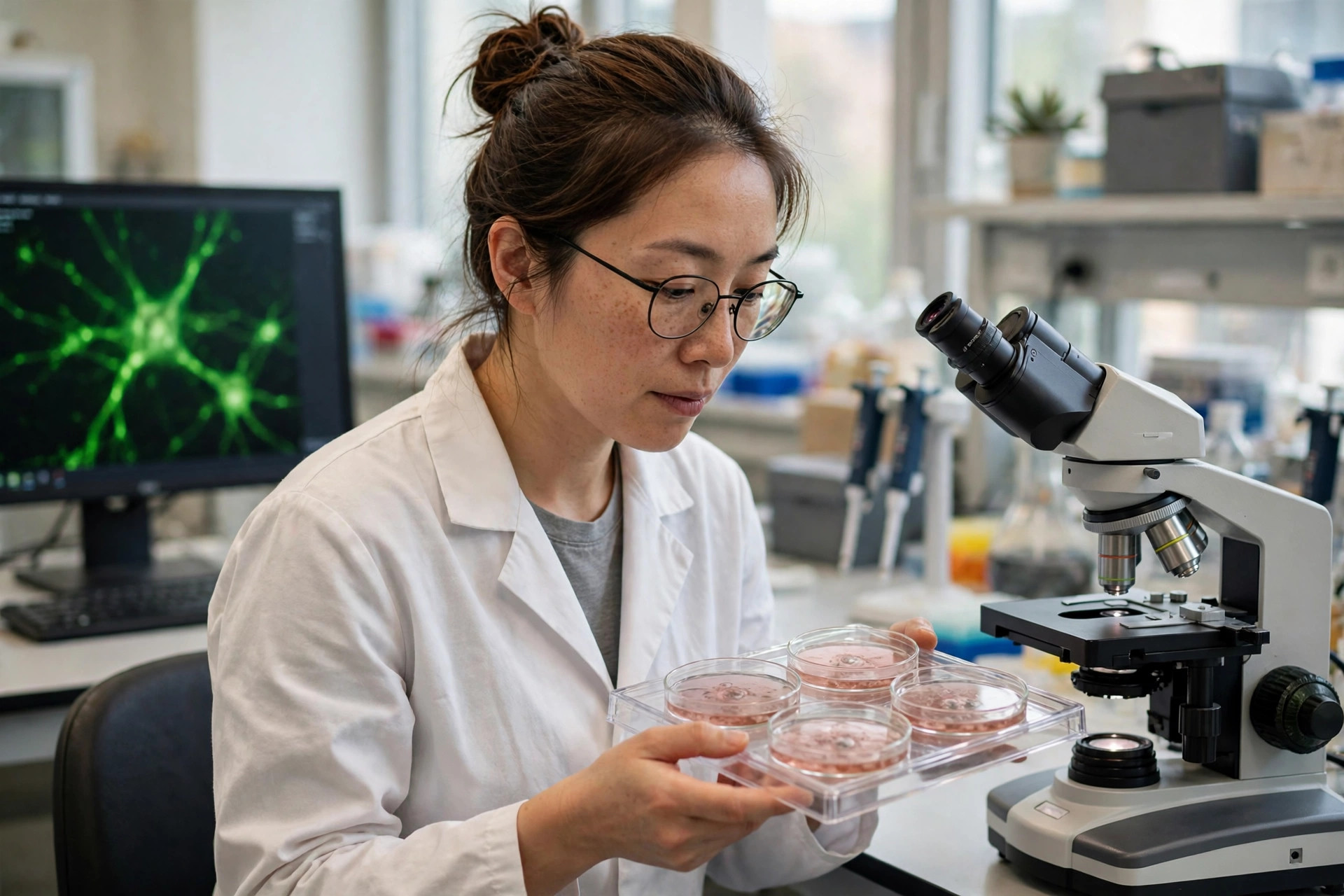
The mitophagy guardian PINK1 is built at the ER — and how it is imported depends on where its instructions sit — in neurons
Edited by Samael A. Tejada, Founder & Editor-in-Chief
·Tip: press play, then lock your phone or switch apps — the article keeps reading.
PINK1, the kinase that initiates mitophagy, is produced through an ER-associated biogenesis route in neurons, switching between co- and post-translational import depending on where its mRNA localises under AMPK regulation, a Nature Communications study reports (November 20, 2026). It is basic cell biology relevant to Parkinson's mechanisms, not a treatment.
Before the guardian can watch the mitochondria, the cell has to build the guardian — and this study shows the building site is the neighbouring organelle, with the delivery route chosen by where the blueprint is parked.
Why does PINK1's birthplace matter?
PINK1 must reach mitochondria fast and in the right state: on healthy mitochondria it is imported and destroyed; on damaged ones it is stranded on the surface, where it recruits Parkin and starts mitophagy. How a neuron guarantees a ready supply of such a short-lived, precisely targeted protein was an open question — and a relevant one, since PINK1 loss-of-function is a proven cause of early-onset Parkinson's disease.
What did the study show?
That neuronal mitochondria associate with Pink1 mRNA, and that this localisation is regulated by AMPK, the cell's energy sensor. Depending on the mRNA's localisation, the newly made PINK1 protein switches between being imported into mitochondria while it is still being synthesised (co-translational) and being imported after completion (post-translational), with ER chaperones involved in the handling — an ER-associated biogenesis pathway, published as a featured article in Nature Communications' organelles collection on November 20, 2026.
What could this eventually explain?
If PINK1 supply depends on mRNA localisation and ER handling, then failures in that supply chain could weaken mitophagy even when the PINK1 gene itself is normal — a possible contributing layer in neuronal mitochondrial decline. That is a hypothesis this paper makes testable, not a demonstrated disease mechanism, and no intervention follows from it yet.
Frequently asked questions
What is mitophagy?
The selective recycling of damaged mitochondria. PINK1 and Parkin are its best-known initiators: PINK1 flags the failed organelle, Parkin tags it for disposal.
What does co-translational import mean?
The protein is fed into its target organelle while the ribosome is still building it, rather than being completed in the cytosol first (post-translational import).
What is AMPK?
AMP-activated protein kinase, the cell's fuel gauge. When energy runs low, AMPK switches on energy-producing and recycling programmes, including autophagy.
Where the evidence stands
- Established: PINK1 initiates PINK1/Parkin mitophagy on damaged mitochondria, inherited PINK1 defects cause early-onset Parkinson's disease, and AMPK is a central cellular energy sensor.
- Preliminary: The ER-associated biogenesis route and mRNA-localisation-dependent import switching: one study (Nature Communications, 2026) in neuronal models.
- Absent: Evidence that this biogenesis pathway fails in human Parkinson's disease, and any therapeutic approach based on it.
Join the discussion
To get the conversation started: What questions does this story raise for you? Share them below — every comment is reviewed by our moderators before it appears.
Community discussion only — not medical advice. Every comment is reviewed by our moderators before it appears. Sign in with Google or a free Hyvor account to join in.