Brain tissue grown from PSP patients lost its energy reserve — a coordinated mitochondrial defect, in lab-grown human organoids
Edited by Samael A. Tejada, Founder & Editor-in-Chief
·Tip: press play, then lock your phone or switch apps — the article keeps reading.
Midbrain organoids grown from patients with progressive supranuclear palsy–Richardson's syndrome showed a marked loss of maximal respiration and spare respiratory capacity, with respiratory chain remodelling, oxidative stress and metabolic reprogramming tied to tau pathology (Cellular and Molecular Life Sciences, November 3, 2026). It is a human tissue model — an association within organoids, not proof of cause and not a treatment lead yet.
A spare tyre matters only when the road gets rough. Neurons live on rough roads — and in tissue grown from PSP patients, the spare respiratory capacity is exactly what is missing.
What did the organoids show?
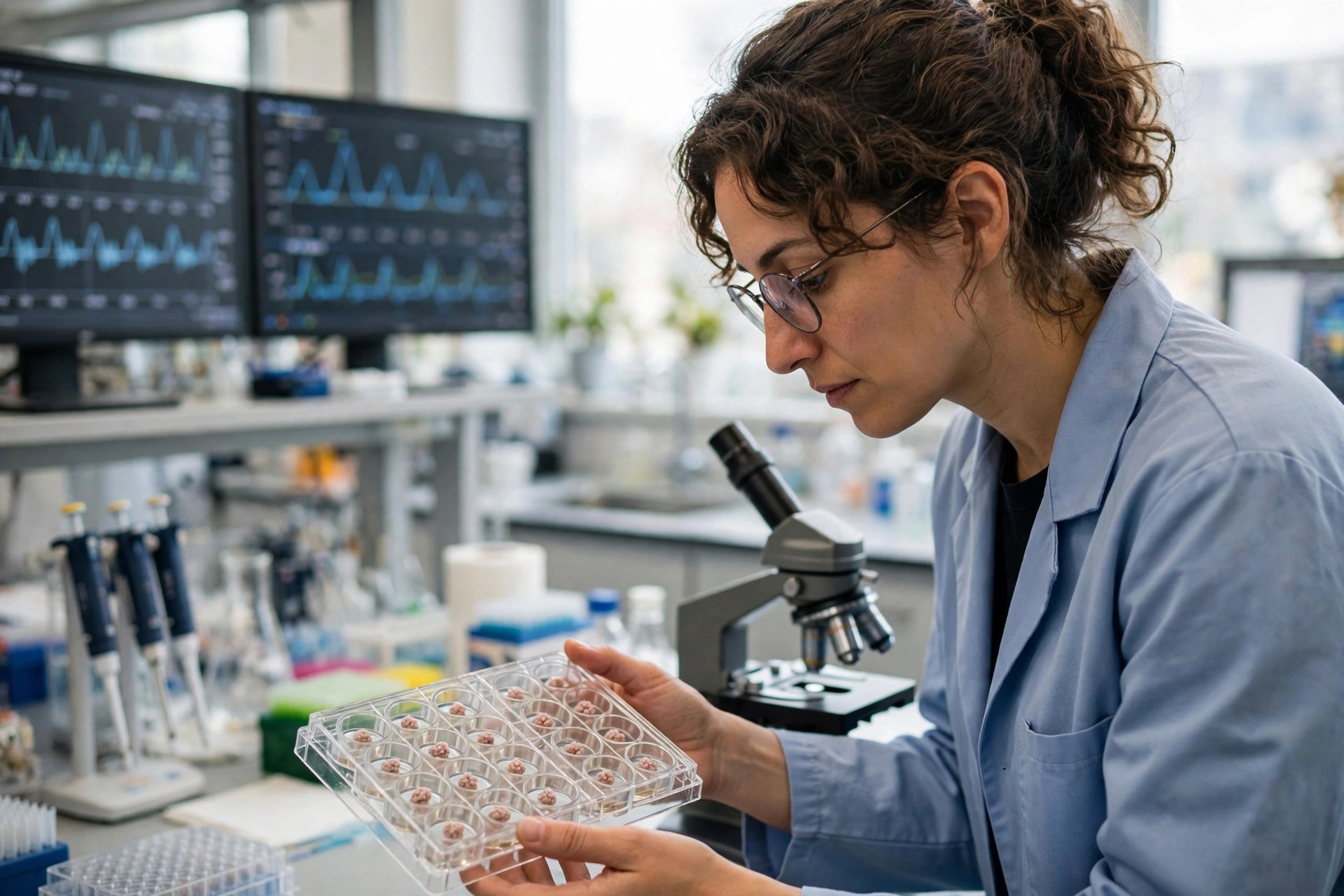
Patient-derived midbrain organoids carrying PSP-RS biology showed a coordinated set of mitochondrial defects. Functionally, maximal respiration and spare respiratory capacity were markedly reduced: the tissue could meet baseline demand but had lost the buffer that lets cells surge energy production under stress. Proteomics showed remodelling of the respiratory chain itself, metabolomics showed a reprogrammed metabolic profile, and redox imaging showed the oxidative-stress signature that accompanies failing energy systems. Four independent measurement types pointing the same way is what makes this a phenotype, not an artefact of one assay.
Why does spare capacity matter in a tauopathy?
Neurons are among the body's most energy-demanding cells, and the brain regions PSP attacks must sustain firing, transport and repair for decades. A neuron with normal resting respiration but no reserve fails precisely at moments of peak demand — the pattern that fits a disease of selective neuronal vulnerability. PSP is defined by 4-repeat tau accumulation, and this work connects that tau pathology to the energy system in human tissue: not in a mouse engineered to overproduce tau, but in organoids carrying patients' own biology. That makes the mitochondrial phenotype a candidate part of the disease process to test interventions against.
What are the limits of an organoid result?
The authors state them, and they are real. Organoids are simplified, young, laboratory-grown tissue: no blood supply, no immune system, no aging brain environment, and no direct equivalence to measurements in a living patient's brain. The study documents associations within the model — respiratory chain remodelling associated with impaired bioenergetic flexibility — and explicitly does not claim a cause of PSP or a therapeutic target. What it does provide is a human, patient-derived testbed: compounds or genetic interventions that restore spare capacity in these organoids would earn a serious look, and ones that fail here can be set aside early.
Frequently asked questions
What is progressive supranuclear palsy (PSP)?
PSP is a neurodegenerative disease classified as a primary 4-repeat tauopathy, in which abnormal deposits of a specific tau protein isoform accumulate in vulnerable neurons. The Richardson's syndrome form (PSP-RS) is the most common clinical presentation.
What did the organoid study find?
Midbrain organoids grown from PSP-RS patients showed markedly reduced maximal respiration and spare respiratory capacity, together with respiratory chain remodelling, oxidative stress and metabolic alterations — a coordinated mitochondrial phenotype associated with tau pathology in a human tissue model.
Does this prove mitochondria cause PSP?
No. The authors document an association in a laboratory model and explicitly do not claim a cause of the disease or a therapeutic target. The organoids provide a patient-derived testbed for future experiments.
Where the evidence stands
- Established: PSP-Richardson's syndrome is a primary 4-repeat tauopathy with selective neuronal vulnerability; spare respiratory capacity is a standard, validated measure of mitochondrial bioenergetic reserve; patient-derived organoids are an accepted human disease-modelling system.
- Preliminary: The PSP mitochondrial phenotype: one study (2026) in patient-derived midbrain organoids integrating bioenergetics, proteomics, metabolomics and redox imaging. Not yet replicated, and not measured in living patient brain tissue.
- Absent: Causality and therapy: the study identifies no cause of PSP and no therapeutic target, and no intervention has been shown to restore respiration in this model.
Join the discussion
To get the conversation started: What questions does this story raise for you? Share them below — every comment is reviewed by our moderators before it appears.
Community discussion only — not medical advice. Every comment is reviewed by our moderators before it appears. Sign in with Google or a free Hyvor account to join in.