
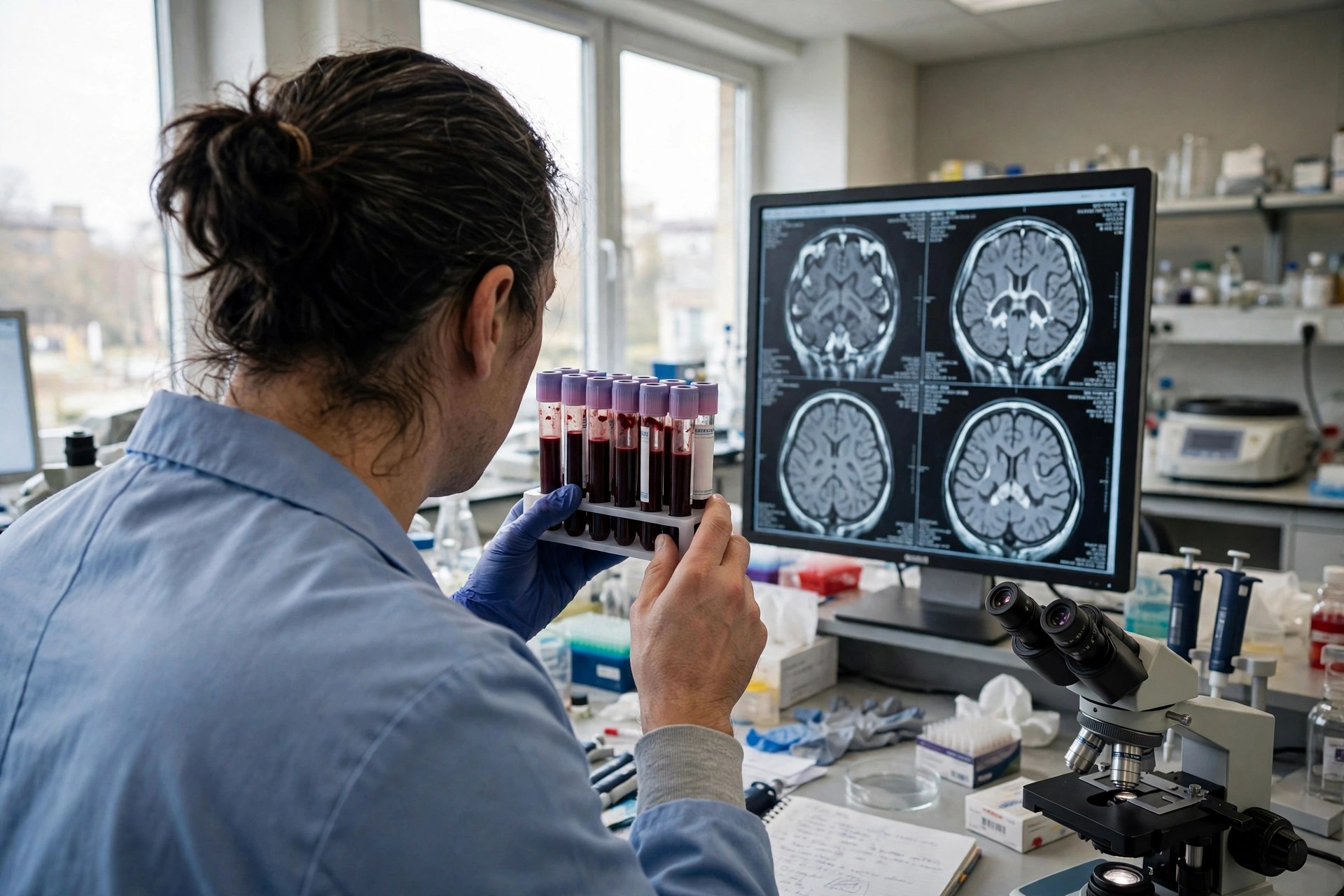
Smoking-linked cadmium switches on a brain signal that damages neuronal mitochondria — in human data and lab-grown neurons
Edited by Samael A. Tejada, Founder & Editor-in-Chief
·Tip: press play, then lock your phone or switch apps — the article keeps reading.
Combining NHANES population data, brain transcriptomics and neuron experiments, researchers linked smoking-associated cadmium to activation of the JNK2/MAPK9 stress kinase, which was elevated in Alzheimer's brain tissue and, in neurons, raised amyloid precursor protein and impaired mitochondria including complex I (Journal of Translational Medicine, November 3, 2026). The study nominates a mechanism; it does not prove cadmium causes Alzheimer's disease.
Epidemiology can point at a toxin for decades without ever naming the wire it pulls inside a neuron. This study tries to name the wire — a stress kinase that sits, suspiciously, at the junction of amyloid and the mitochondrion's first energy complex.
How did the team connect smoking, cadmium and a brain gene?
The study is a layered triangulation. First, survey-weighted NHANES data established the exposure link in the general population: ever-smoking was associated with higher whole-blood cadmium concentrations. Second, transcriptomic and single-nucleus analyses of brain data searched for the molecular meeting point, and highlighted c-Jun N-terminal kinase 2 (JNK2), encoded by MAPK9, as the candidate gene — enriched in excitatory neurons, with heightened cell communication and a link to amyloid-beta-associated mitochondrial complex I dysfunction. Third came validation: in human brain, JNK2 phosphorylation was increased in Alzheimer's disease, and in neurons, cadmium chloride elevated JNK2 phosphorylation and APP protein abundance and impaired mitochondria. Each layer is a different kind of evidence — population association, computational nomination, tissue and cell validation — and the paper's strength is that the layers point at the same node.
Why do mitochondria sit at the center of it?
Complex I is the entry gate of the electron transport chain — the first and largest machine in the mitochondrial energy assembly line — and its dysfunction is a recurring finding in Alzheimer's research. Here, the single-nucleus signal tied MAPK9/JNK2 activity in excitatory neurons specifically to amyloid-beta-linked complex I dysfunction, and the cell experiments showed cadmium exposure impairing mitochondria while raising APP, the precursor from which amyloid-beta is cut. That sketches a feed-forward loop worth testing: exposure activates a stress kinase; the kinase's neuronal context intersects both amyloid production and mitochondrial failure; each of those is independently known to worsen the other. The study demonstrates the components and their cadmium responsiveness in models — it does not demonstrate the full loop operating in a living human brain.
What about sanguinarine — and what should readers not conclude?
The paper's most speculative element is its candidate compound: molecular docking and dynamics simulations supported sanguinarine, a plant alkaloid, binding MAPK9 stably, and the authors report it mitigating mitochondrial dysfunction in their experimental models, nominating it as a candidate for targeting the pathway. Docking is a computational prediction, sanguinarine has its own toxicity history, and nothing here is a prevention or treatment recommendation. The firmer conclusions are the negative-space ones: a common exposure (smoking) demonstrably raises body cadmium; a plausible, testable molecular route from cadmium to neuronal mitochondrial impairment now exists in print; and the exposure itself — unlike the pathway — is already avoidable on evidence that long predates this paper.
Frequently asked questions
Does this study prove smoking or cadmium causes Alzheimer's disease?
No. It shows smoking is associated with higher blood cadmium in population data, nominates the MAPK9/JNK2 pathway through brain data analysis, and validates pieces of the mechanism in human brain tissue and neurons. That is a mechanism nomination, not causal proof.
What is JNK2's connection to mitochondria?
JNK2 (encoded by MAPK9) is a stress-activated kinase. In this study it was enriched in excitatory neurons in connection with amyloid-beta-linked mitochondrial complex I dysfunction, and cadmium exposure raised its activation while impairing mitochondria in neurons.
Is sanguinarine a treatment candidate now?
Only in the earliest computational sense: docking simulations supported it binding MAPK9, and the authors report it mitigating mitochondrial dysfunction in their models. There is no clinical evidence, and sanguinarine is not a recommended supplement or treatment.
Where the evidence stands
- Established: Cadmium exposure is linked to cognitive decline and Alzheimer's risk; smoking raises body cadmium burden; mitochondrial complex I dysfunction is a recognized feature of Alzheimer's disease biology; and JNK-family stress kinases respond to toxicant stress in neurons.
- Preliminary: In NHANES survey-weighted analysis, brain transcriptomics/single-nucleus data, human brain tissue and neuron experiments (J Transl Med, Nov 3, 2026; DOI 10.1186/s12967-026-09105-x), ever-smoking tracked with higher blood cadmium; MAPK9/JNK2 was nominated and enriched in excitatory neurons with amyloid-linked complex I dysfunction; JNK2 phosphorylation was increased in Alzheimer's brain; and cadmium chloride raised JNK2 phosphorylation and APP and impaired mitochondria in neurons, with sanguinarine docking stably to MAPK9.
- Absent: Any causal proof that cadmium exposure causes Alzheimer's disease in humans, longitudinal exposure-to-disease data, and any clinical evidence for sanguinarine or JNK2 inhibition.
Join the discussion
To get the conversation started: What questions does this story raise for you? Share them below — every comment is reviewed by our moderators before it appears.
Community discussion only — not medical advice. Every comment is reviewed by our moderators before it appears. Sign in with Google or a free Hyvor account to join in.