
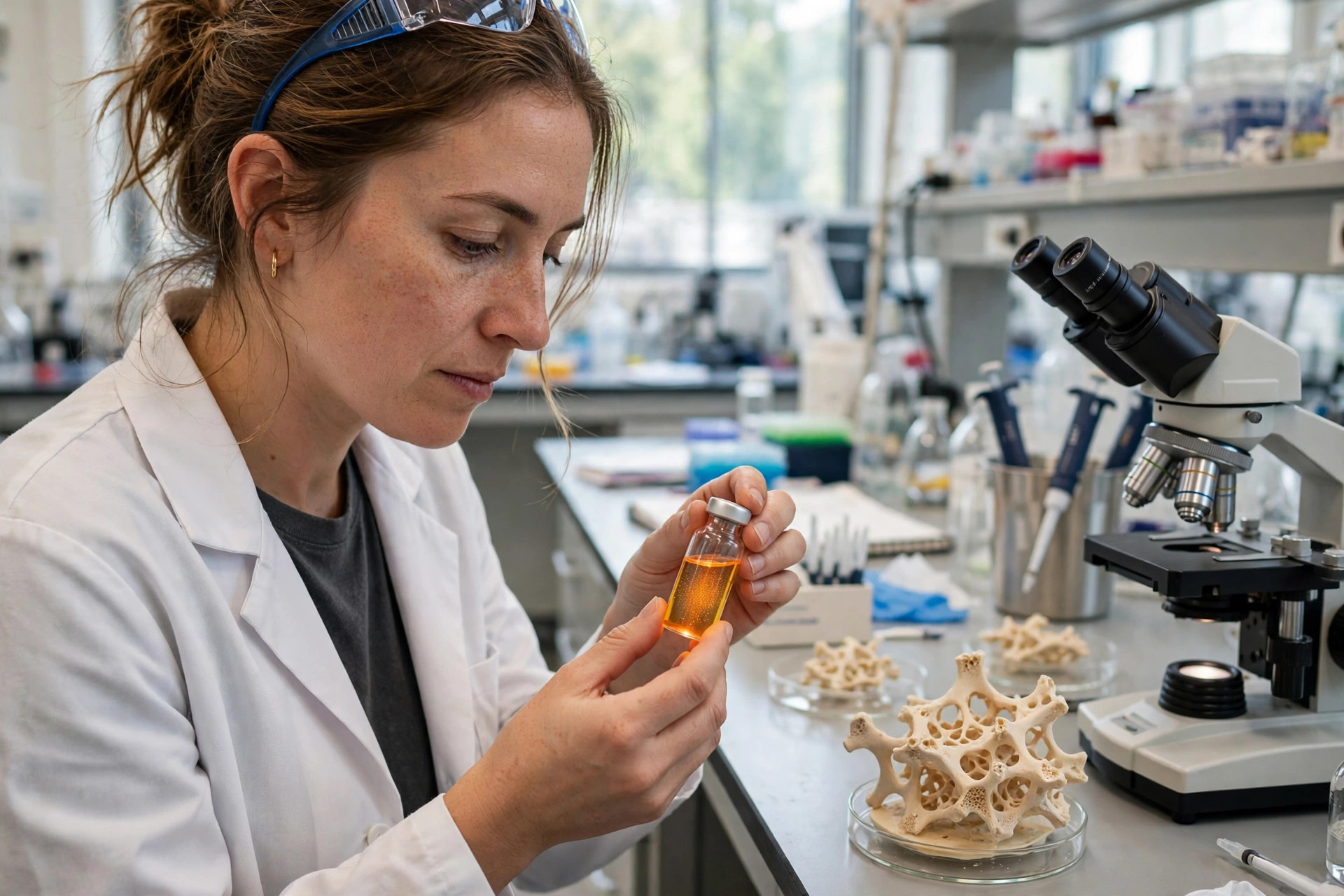
Engineered quantum dots restored healthy mitochondrial transfer and energy balance in diabetic bone — in preclinical models
Edited by Samael A. Tejada, Founder & Editor-in-Chief
·Tip: press play, then lock your phone or switch apps — the article keeps reading.
Quantum dots engineered at the atomic level restored functional mitochondrial transfer and energy homeostasis in diabetic bone regeneration models, lowering reactive-oxygen-species chemistry and activating the CaMKK-beta–AMPK pathway, a Nature Communications study reports (November 17, 2026). The work is preclinical; no patients were treated.
Bone repair runs on energy, and in diabetes the supply chain breaks in an unexpected place: not just inside cells, but in the traffic of mitochondria between them. This study maps that traffic — and engineers a way to police it.
What did the researchers find about mitochondrial transfer?
Mitochondria do not only work inside the cell that made them — they can be transferred between cells, and that transfer is part of how regenerating tissue rescues its energy supply. In diabetes, the authors show, the same process can be turned harmful, propagating inflammation through the osteoimmunological environment. They identified the key donor cell population whose mitochondrial transfer is functionally coupled to whether diabetic bone heals or stalls.
What do the quantum dots do?
The nanotherapeutic is built from quantum dots whose atomic-level coordination was engineered for two jobs. First, they markedly reduce the energy barrier of the catalytic reaction that generates reactive oxygen species, protecting mitochondria from oxidative damage. Second, as the dots degrade, their manganese-coordinated fragments activate the CaMKK-beta–AMPK signalling axis — a central energy-sensing pathway — in the diabetic tissue. The combined effect, the team reports, is restored functional mitochondrial transfer and energy homeostasis.
How close is this to a treatment?
Not close yet. This is a preclinical nanotherapeutic study: it establishes a mechanism — hijacked mitochondrial transfer as a driver of failed diabetic bone healing — and a candidate way to correct it. Safety, dosing, delivery to human bone and any effect on actual fracture healing in people all remain untested, and quantum-dot therapeutics face a long regulatory road.
Frequently asked questions
What is mitochondrial transfer?
The movement of mitochondria from one cell to another. Receiving cells gain working energy-producing organelles, which can rescue tissue under metabolic stress — but, as this study shows, the traffic can also spread inflammatory signals.
What are quantum dots in medicine?
Engineered nanoparticles, only a few nanometres wide, whose chemical behaviour can be tuned at the atomic level. Here they are used as a drug-like nanotherapeutic that scavenges reactive oxygen species and releases signalling fragments as it degrades.
Was this tested in people?
No. The study is preclinical research in diabetic bone regeneration models. No human received the quantum dots.
Where the evidence stands
- Established: Diabetes impairs bone regeneration, mitochondrial dysfunction and oxidative stress contribute to that impairment, and mitochondria can be transferred between cells as a metabolic rescue mechanism.
- Preliminary: The donor-cell map and the quantum-dot rescue itself: one study (Nature Communications, 2026) in preclinical diabetic bone regeneration models.
- Absent: Any human data — no patient was treated, and no clinical trial of this nanotherapeutic exists.
Join the discussion
To get the conversation started: What questions does this story raise for you? Share them below — every comment is reviewed by our moderators before it appears.
Community discussion only — not medical advice. Every comment is reviewed by our moderators before it appears. Sign in with Google or a free Hyvor account to join in.