
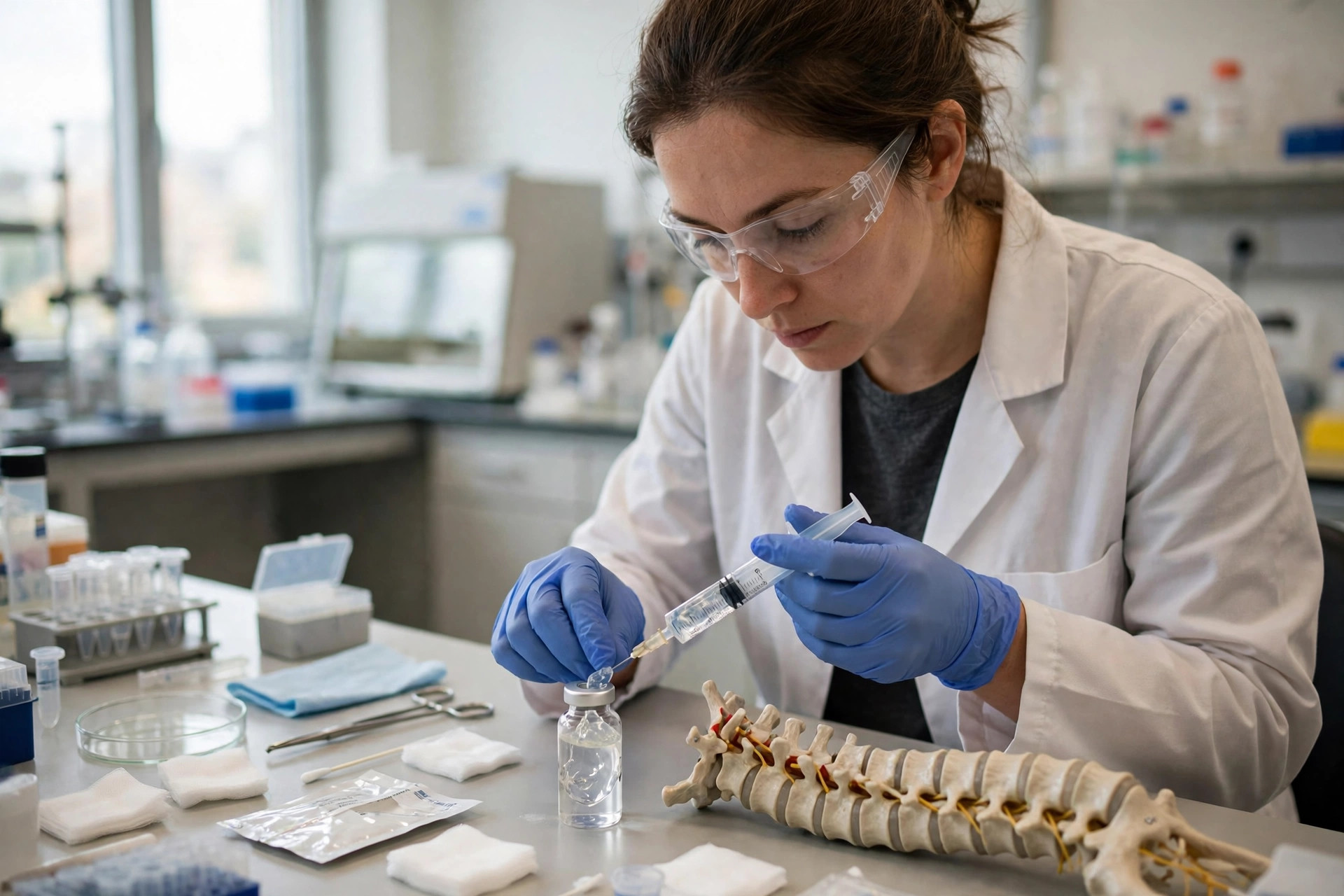
A temperature-responsive gel kept transplanted mitochondria working and restored spinal cord respiration after injury — in rats
Edited by Samael A. Tejada, Founder & Editor-in-Chief
·Tip: press play, then lock your phone or switch apps — the article keeps reading.
Mitochondria delivered in a temperature-responsive hyaluronic-acid semi-gel kept their respiratory function and restored spinal cord respiration to uninjured levels 48 hours after injury in a rat contusion model, an ACS Applied Bio Materials study reports (November 12, 2026). No human testing has been done.
Transplanting an organelle is an odd idea with a practical flaw: the cargo wanders off and fades. This study treats it as a packaging problem — and the packaging, in rats, worked.
What problem does the gel solve?
Two of them. Free mitochondria injected into tissue disperse under flow, and isolated mitochondria lose respiratory function and membrane potential quickly outside cells. The HA-PNIPAAm semi-gel is liquid enough to inject, thickens above its transition temperature once in place, resists being washed away, and then dissolves over hours, releasing mitochondria where they were placed.
What did the experiments show?
In the laboratory, encapsulation preserved mitochondrial respiratory function and membrane potential compared with free mitochondria over the time window relevant to delivery. In vivo, in adult female rats with a contusion spinal cord injury, subdural delivery of gel-carried mitochondria restored spinal cord mitochondrial respiration to uninjured levels at the 48-hour post-injury time point — the acute window when mitochondrial dysfunction after contusion is most pronounced.
What would readers be wrong to conclude?
That a spinal cord treatment is near. This is a delivery-platform result at a single early time point in rats: restored respiration is a bioenergetic measurement, not recovered movement, and durability, safety, dosing and any functional benefit are untested. The authors' own claim is measured — a tunable, injectable platform that supports further evaluation of mitochondrial transplantation.
Frequently asked questions
What is mitochondrial transplantation?
An experimental strategy that delivers healthy, isolated mitochondria into injured or dysfunctional tissue to restore cellular energy production. It is under study for conditions from spinal cord injury to heart damage, and remains preclinical.
What does subdural delivery mean?
Delivery beneath the dura, the membrane surrounding the spinal cord — placing the gel-carried mitochondria directly at the injured cord rather than into the bloodstream.
Was function restored in the rats?
Mitochondrial respiration in the spinal cord tissue was restored to uninjured levels at 48 hours. The study did not report recovered movement or other functional outcomes.
Where the evidence stands
- Established: Spinal cord injury causes acute mitochondrial dysfunction, and isolated mitochondria rapidly lose function and disperse when delivered free — the two problems this carrier addresses.
- Preliminary: The semi-gel platform and the 48-hour respiration result: one study (ACS Applied Bio Materials, 2026) in the laboratory and in a rat contusion model.
- Absent: Functional recovery outcomes, durability beyond 48 hours, safety data, and any human evidence.
Join the discussion
To get the conversation started: What questions does this story raise for you? Share them below — every comment is reviewed by our moderators before it appears.
Community discussion only — not medical advice. Every comment is reviewed by our moderators before it appears. Sign in with Google or a free Hyvor account to join in.