
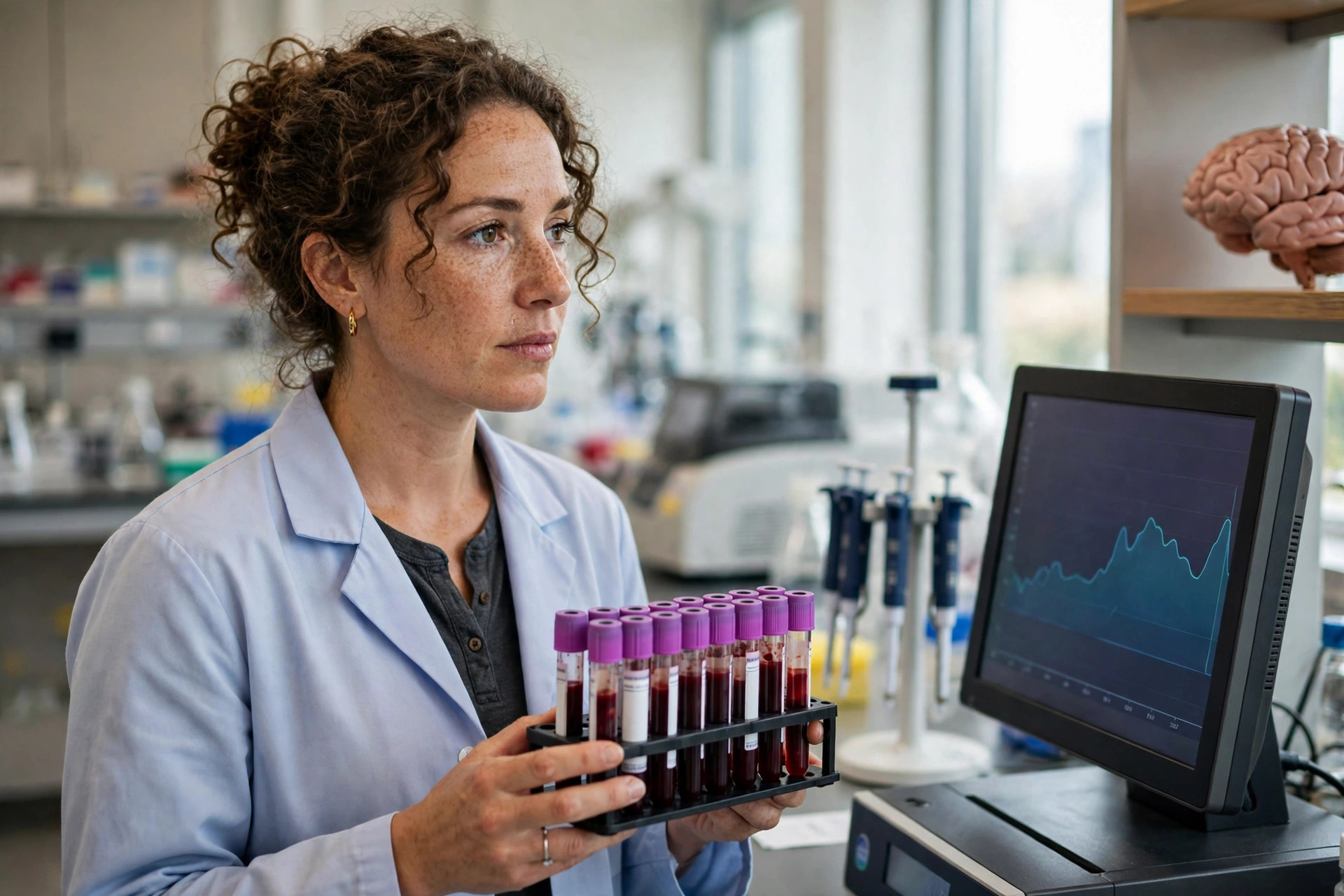
Five mitochondrial genes in a blood sample flagged major depression with strong accuracy — in a single validation study
Edited by Samael A. Tejada, Founder & Editor-in-Chief
·Tip: press play, then lock your phone or switch apps — the article keeps reading.
A five-gene blood signature — HADHB, NDUFB7, ACADVL, NDUFAF4 and NDUFS7, all mitochondrial genes — distinguished major depression with an AUC of 0.876 in a clinical validation cohort, a BMC Psychiatry study reports (November 13, 2026). It is one study with no independent validation, and no clinical test exists yet.
Every gene in this panel lives in the mitochondria. Whether that makes it a future blood test for depression — or a clue about the condition's biology — is the question this study opens.
How was the panel built?
In two stages. First, discovery: from a human prefrontal-cortex transcriptomic dataset, the researchers identified 743 genes differentially expressed in major depressive disorder (453 upregulated, 290 downregulated) and used machine-learning prioritisation to find candidates tied to programmed cell death and mitochondria — the authors call them PMD (programmed cell death–mitochondria–depression) signature genes. Second, validation: the five final genes' encoded proteins were measured in a clinical blood cohort and found markedly reduced in patients.
How well did it perform?
A binary logistic model using the five genes achieved an AUC of 0.876 (95% CI 0.784–0.969) in the clinical cohort — strong discrimination for a blood panel. The genes themselves are squarely mitochondrial: NDUFB7, NDUFAF4 and NDUFS7 belong to respiratory complex I, the entry point of the mitochondrial energy chain, while HADHB and ACADVL drive mitochondrial fatty-acid oxidation. Corroborating the direction, Columbia University work presented at the Society for Neuroscience's 2026 meeting (reported November 14) examined mitochondrial gene changes in brain and blood in depression as potential biomarkers — conference-stage only.
What stands between this and a real test?
Everything that usually does: independent validation in other cohorts and populations, prospective testing, standardised assays, and proof that the panel adds anything over clinical assessment. AUC in a discovery-linked validation cohort routinely shrinks on replication. Readers should treat this as early biomarker science with a clear mitochondrial thread — not a purchasable test, and not evidence about what causes depression or how to treat it.
Frequently asked questions
What does AUC 0.876 mean?
Area under the curve measures how well a test separates two groups: 0.5 is chance, 1.0 is perfect. 0.876 is strong for a research panel — but it was measured in the study's own validation cohort, not in independent clinical use.
Why mitochondria genes for a brain condition?
The brain is among the most energy-hungry organs, and three of the five genes are components of mitochondrial complex I while the other two run mitochondrial fat burning. The study frames them as a programmed-cell-death–mitochondria signature, not proof of cause.
Can I get this test?
No. It is a research finding from a single study. No clinical laboratory offers a validated version, and it has not been prospectively tested.
Where the evidence stands
- Established: Mitochondrial dysfunction — including complex I biology — is repeatedly implicated in major depression research, and no blood test is currently validated for diagnosing depression.
- Preliminary: The five-gene panel itself: one peer-reviewed study (BMC Psychiatry, 2026) with a clinical validation cohort; no external or prospective validation.
- Absent: A clinically available test, evidence the panel improves diagnosis or treatment decisions, and any causal claim about mitochondria and depression.
Join the discussion
To get the conversation started: What questions does this story raise for you? Share them below — every comment is reviewed by our moderators before it appears.
Community discussion only — not medical advice. Every comment is reviewed by our moderators before it appears. Sign in with Google or a free Hyvor account to join in.