
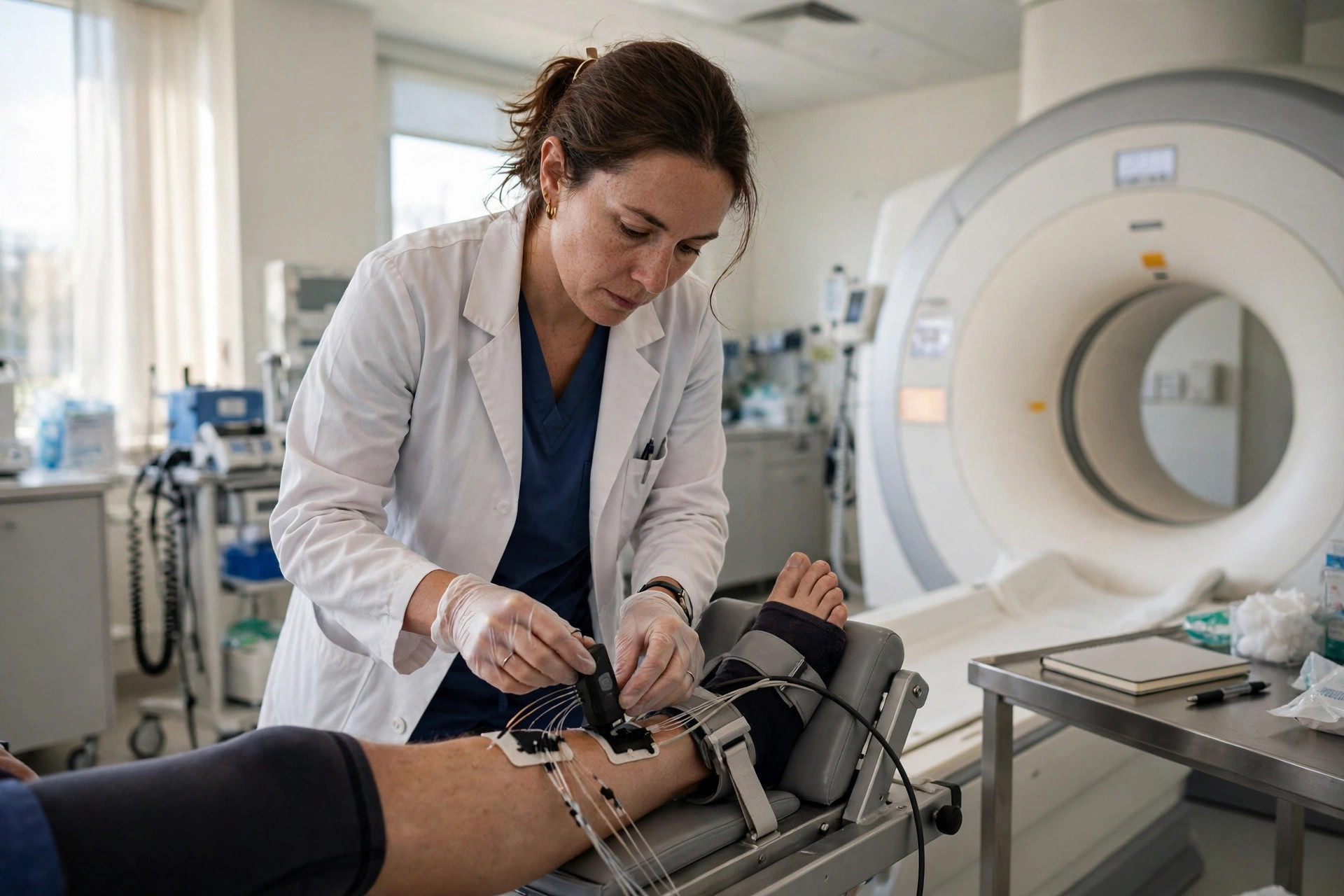
An Oxford team is measuring muscle energy recovery directly in people with ME/CFS — recruitment is three-quarters complete
Edited by Samael A. Tejada, Founder & Editor-in-Chief
·Tip: press play, then lock your phone or switch apps — the article keeps reading.
An Oxford case-control study using MRI and near-infrared spectroscopy to measure calf-muscle energy production and oxygen use in ME/CFS has reached 75 percent of its recruitment target (15 of 20 participants), the ME Association's project update reports (November 17, 2026). No results have been published yet.
Some symptoms resist measurement for decades, not because they are not real but because the right instrument was never pointed at them. This study points two instruments — an MRI scanner and a light-based oxygen sensor — at the exact moment ME/CFS patients describe: recovery after exertion.
What is the study asking?
Its first-stage question is precise: does poor oxygenation and a delay in muscle energy recovery contribute to fatigue and post-exertional malaise in ME/CFS? Stage 1 is a baseline cross-sectional comparison — people with mild ME/CFS against sedentary healthy controls — running from April 2026 to March 2027, with the muscle under study being the calf.
How do you measure mitochondria inside a living leg?
Non-invasively, with two complementary techniques. Magnetic resonance imaging — in this context, MR spectroscopy — can follow the muscle's energy currency and its recovery after exercise inside the scanner. Near-infrared spectroscopy shines harmless near-infrared light through the skin to track how much oxygen the muscle is extracting and how fast it recovers. Together they watch mitochondrial energy production and oxygen use in vivo, in the person, rather than in a biopsy dish.
What has it found so far?
Nothing published yet — and that is the honest headline. The November 17 update is a progress report: nine months in, recruitment stands at 15 of 20 participants with ME/CFS, 75 percent of target. The study's value at this stage is methodological and evidential: a registered, controlled design measuring the exact physiological claim — delayed muscle energy recovery — that sits at the centre of the PEM debate. Results, when they come, will either give that claim a number or complicate it; either outcome moves the field.
Frequently asked questions
What is post-exertional malaise?
A worsening of ME/CFS symptoms — fatigue, pain, cognitive difficulty — after physical or mental exertion, often delayed by a day or more and lasting days. It is the condition's hallmark and the symptom this study is designed to measure objectively.
What is near-infrared spectroscopy?
A non-invasive technique that shines near-infrared light into tissue and reads how much is absorbed by oxygen-carrying proteins, revealing how much oxygen a muscle is using and how quickly it recovers after exercise.
Can I join or use this test?
The study is a research project recruiting a defined group (mild ME/CFS and sedentary controls) at Oxford. Its measurements are research tools, not a clinical diagnostic test for ME/CFS.
Where the evidence stands
- Established: Post-exertional malaise is a defining feature of ME/CFS, and MRI spectroscopy plus near-infrared spectroscopy are validated non-invasive ways to measure muscle energy metabolism and oxygen use in vivo.
- Preliminary: The study itself is in progress: recruitment at 75 percent (15 of 20) as of the November 17, 2026 update, with no results reported.
- Absent: Any finding — the study has published no data yet on whether muscle energy recovery differs in ME/CFS, and it tests no treatment.
Join the discussion
To get the conversation started: What questions does this story raise for you? Share them below — every comment is reviewed by our moderators before it appears.
Community discussion only — not medical advice. Every comment is reviewed by our moderators before it appears. Sign in with Google or a free Hyvor account to join in.