
Brown's gas devices: it's the hydrogen fraction that counts, a modeling study finds
·Tip: press play, then lock your phone or switch apps — the article keeps reading.
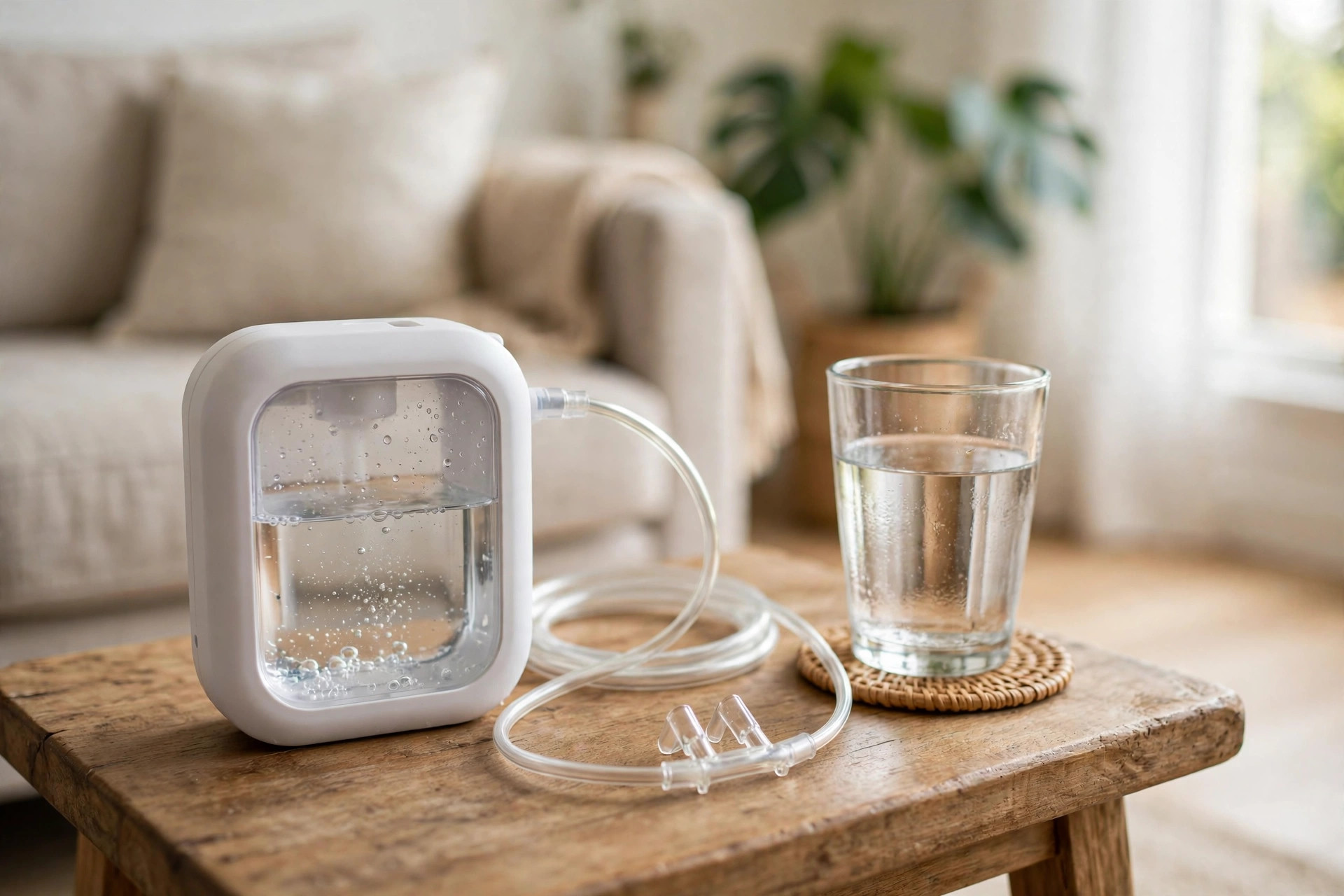
Molecular hydrogen is studied for its selective antioxidant and signaling effects, including inside mitochondria, and home inhalation devices are a growing consumer market. One popular category — oxyhydrogen or 'Brown's gas' generators — delivers roughly 67% hydrogen and 33% oxygen, and buyers could reasonably assume the oxygen half of the pitch matters. A peer-reviewed modeling study by Tyler W. LeBaron and colleagues in Respiratory Research (2026;27:259), broken down in an October 18, 2026 explainer from Revive Hydrogen (a hydrogen-industry site, noted here for transparency), tests that assumption with respiratory math.
What does the arithmetic actually show?
Take a generator producing 1,000 mL/min of combined gas: about 667 mL/min is hydrogen and 333 mL/min is oxygen. But the gas displaces room air that is already 21% oxygen, and a nasal cannula flows during exhalation as well as inhalation. After accounting for both, the model finds only about 40 mL/min of additional oxygen is actually inspired, raising the inspired oxygen fraction (FiO2) from about 21% to 21.36% — a change the authors compare to descending about 160 meters (525 feet) in altitude. In their words, at typical flow rates that amount of supplemental oxygen is unlikely to exert meaningful physiological effects in a healthy person.
So how should buyers compare devices?
By FiH2 — the fraction of inspired hydrogen the device actually delivers. A '1,000 mL/min' Brown's gas machine delivers roughly 667 mL/min of hydrogen, not 1,000; a pure-hydrogen device with a lower headline number may deliver more of the molecule being studied. The modeling paper found no scientific evidence that oxyhydrogen outperforms hydrogen alone when the delivered FiH2 is equivalent. The authors also flag a safety asymmetry: an H2/O2 mixture is intrinsically flammable and potentially detonatable, a risk they say must be weighed against the lack of demonstrated added benefit from the oxygen component.
What are the limits of this finding?
It is a modeling study of gas delivery and respiratory physiology — not a clinical trial, and it does not test whether hydrogen inhalation itself improves any health outcome; clinical efficacy of hydrogen therapy remains unproven and under investigation. Supplemental oxygen remains medically important for people with impaired lung function or low blood oxygen, and at much higher flow rates the oxygen contribution can become relevant. The takeaway is narrow but useful for shoppers: pay for delivered hydrogen fraction and safety engineering, not for an oxygen percentage that barely changes what you breathe.
Where the evidence stands
- Established: Room air is ~21% oxygen; supplemental gas from a nasal cannula is diluted and partially lost during exhalation, so delivered fractions differ from device output fractions; hydrogen/oxygen mixtures are flammable.
- Preliminary: Respiratory-physiology modeling (Respiratory Research, 2026) estimates a 1,000 mL/min oxyhydrogen device adds only ~40 mL/min inspired oxygen (FiO2 21% → ~21.36%) and finds no evidence oxyhydrogen beats hydrogen alone at equivalent FiH2.
- Absent: Clinical-trial evidence that hydrogen inhalation — oxyhydrogen or pure — improves health outcomes in people; the modeling paper addresses delivery, not efficacy.
Join the discussion
To get the conversation started: What questions does this story raise for you? Share them below — every comment is reviewed by our moderators before it appears.
Community discussion only — not medical advice. Every comment is reviewed by our moderators before it appears. Sign in with Google or a free Hyvor account to join in.