
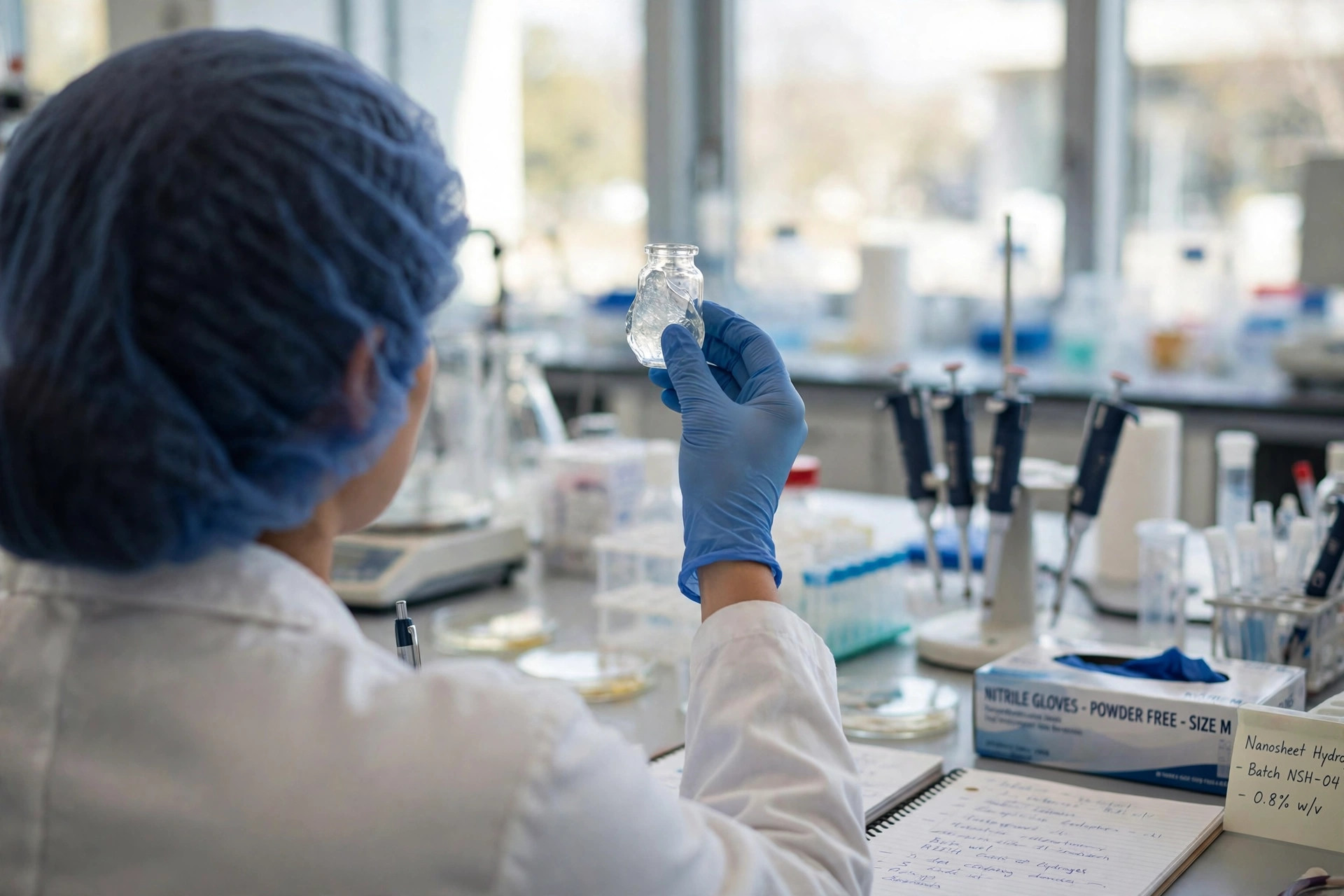
Sticky nanosheets that drip hydrogen inside the scrotum rejuvenated aging testes — in mice
·Tip: press play, then lock your phone or switch apps — the article keeps reading.
Aging takes a quiet toll on male fertility: sperm production declines, quality deteriorates, and current options like testosterone replacement can actually suppress the sperm production they aim to support. A new study in Materials Today Bio (Liang, Lv, Li et al., 2026, vol. 41, Article 103732) reports a strikingly different approach: bioadhesive silicon nanosheets (dubbed "S-H/B") that slowly release molecular hydrogen inside the scrotum for a month, rejuvenating the testes of naturally aged mice through a clearly defined mitochondrial mechanism.
What did the nanosheets actually do?
The platform solves a real delivery problem: molecular hydrogen is therapeutic but dissipates almost immediately when administered. The team built hydrogenated silicon nanosheets that react spontaneously with water under physiological conditions to release hydrogen without harmful byproducts — then wrapped them in a custom polymer coating (polylactic acid fused with aldehyde-functionalized hyperbranched polyglycerol). The hydrophobic segment acts as a molecular raincoat that slows the hydrogen-generating reaction (from 66% released in four hours uncoated to about 31% over 72 hours coated), while the aldehyde groups form linkages with tissue proteins that glue the particles in place. In 18-month-old mice, about 40% of the material remained at the site after 30 days, with no significant changes in body weight, liver enzymes, or tissue histology. A single injection partially reversed testicular shrinkage, roughly doubled germ-cell and proliferating-cell counts, more than doubled epididymal sperm concentration, improved progressive motility, and cut abnormally shaped sperm from about 50% to 25%.
How does hydrogen feed sperm production?
The mitochondrial angle runs through the testis's support cells. Single-cell RNA sequencing revealed that more than 90% of the treatment-induced gene changes appeared in somatic cells rather than germ cells — strongest in Sertoli cells, the metabolic caretakers of the seminiferous tubules. The chain: hydrogen scavenged peroxynitrite, a potent oxidant that accumulates in aged Sertoli cells; peroxynitrite had been acting as an oxygen donor for PHD1, the enzyme that tags the metabolic master regulator HIF-1 alpha for destruction. With peroxynitrite removed, PHD1 slowed, HIF-1 alpha stabilized (its protein rose while its messenger RNA did not — post-translational regulation), moved to the nucleus, and switched on glycolytic genes including glucose transporters GLUT1 and GLUT3 and enzymes hexokinase 2 and pyruvate kinase. Lactate production rose — and lactate is the preferred fuel Sertoli cells export to developing germ cells. In short, hydrogen reprogrammed the support cells' mitochondria-adjacent metabolism to feed sperm production.
Why does this matter for male aging?
The causality testing was rigorous for animal work: blocking HIF-1 alpha abolished the metabolic and reproductive benefits; inhibiting PHD1 reproduced them; and purified-protein assays confirmed peroxynitrite drives the key hydroxylation step. That makes this more than a correlative observation — it is a proof of concept with a defined molecular chain from gas to gene to fuel. For the field of male reproductive aging, where legitimate options are thin and commercial claims are thick, the work matters as a genuinely novel convergence of materials chemistry and reproductive biology: a single localized injection delivering a month-long therapeutic trickle, with no systemic hormone manipulation. The molecular-hydrogen line also continues to accumulate tissue-specific mechanisms, which may matter for hydrogen therapy more broadly.
The honest catch — and what would have to happen next
The authors are candid that this is a proof of concept, not a therapy. Everything happened in naturally aged mice; effects on pregnancy rates, live births, and offspring health were not tested — sperm numbers are not babies. Intrascrotal injection has clinical precedent (as in hydrocele procedures), but human dosing, the polymer coating's degradation and clearance, and formulation stability during storage are all unknown, since water-responsive materials risk premature hydrogen generation. And because the material is adhesive by design, long-term tissue effects of the coating itself need watching. Anyone encountering this story should understand it as an early, mechanistic laboratory finding — impressive, but years from anything resembling a treatment.
Where the evidence stands
- Established: Male fertility declines with age as sperm production and quality deteriorate; molecular hydrogen is an established antioxidant; Sertoli cells export lactate as the preferred fuel for developing germ cells.
- Preliminary: The sustained hydrogen release, peroxynitrite scavenging, HIF-1 alpha stabilization, and restored sperm production were demonstrated in naturally aged mice. Causality was tested by blocking HIF-1 alpha and by inhibiting PHD1 — the benefits vanished and were reproduced, respectively — but this is still animal evidence.
- Absent: Any data on actual reproductive outcomes — pregnancy rates, live births, or offspring health — and any human safety, dosing, or polymer-degradation data.
Join the discussion
To get the conversation started: What questions does this story raise for you? Share them below — every comment is reviewed by our moderators before it appears.
Community discussion only — not medical advice. Every comment is reviewed by our moderators before it appears. Sign in with Google or a free Hyvor account to join in.