
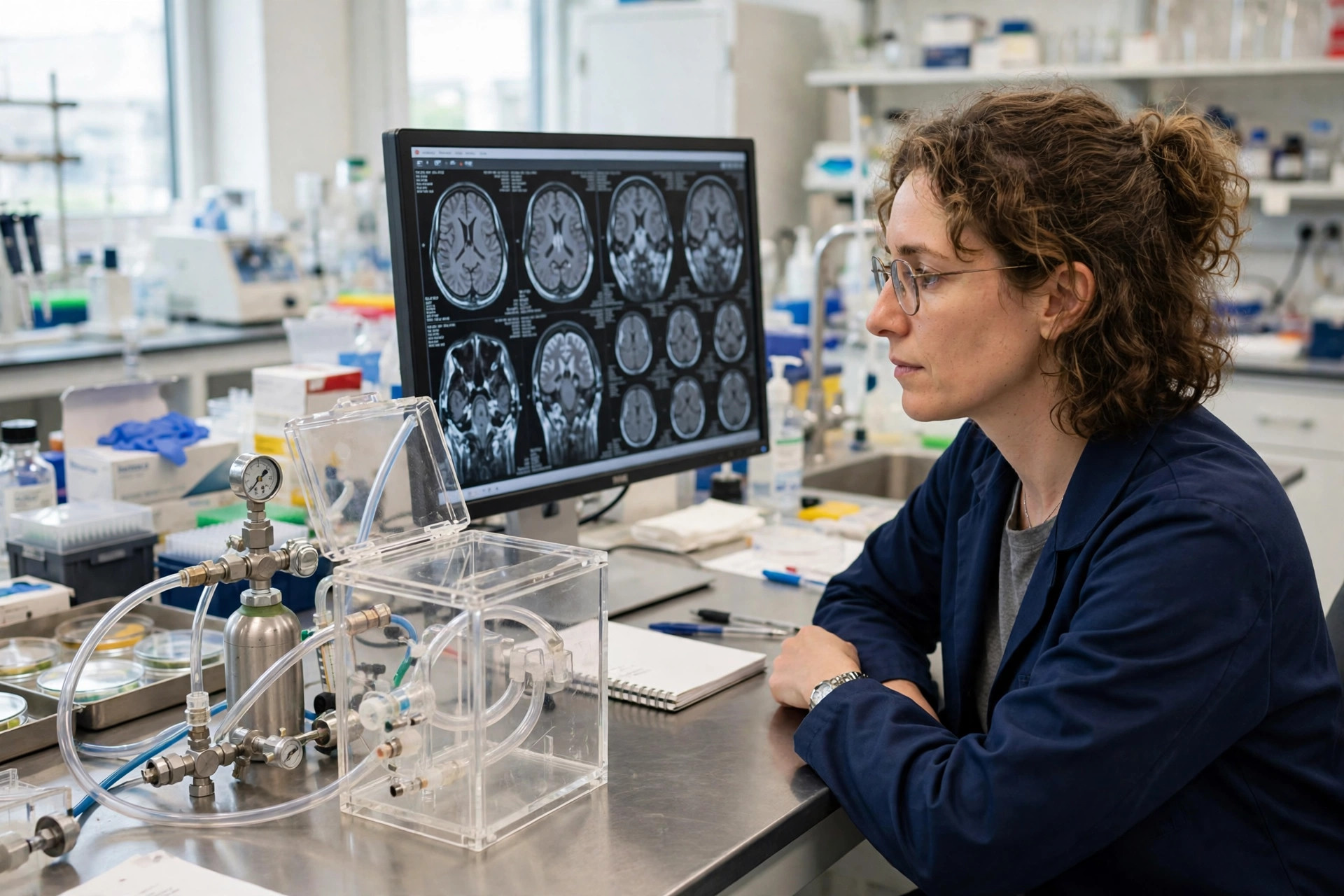
Molecular hydrogen inhalation eased oxidative stress and inflammation in an Alzheimer's mouse model — in lab models
·Tip: press play, then lock your phone or switch apps — the article keeps reading.
Molecular hydrogen (H2) keeps attracting attention in mitochondrial medicine because it is small enough to reach mitochondria and appears to act as a signal, not just a scavenger. Alzheimer's disease is a natural test case: oxidative stress, chronic inflammation, and failing mitochondrial energy production all drive synaptic damage.
In the Antioxidants study (Mo, Bajgai, Rahman and colleagues, 2026), 5xFAD transgenic mice — a widely used amyloid-driven Alzheimer's model — inhaled 2% hydrogen for one hour a day over four weeks, alongside wild-type controls.
What changed in the hydrogen group?
Hippocampal reactive oxygen species fell, systemic catalase activity rose, and hippocampal ATP levels increased. In blood, TNF-alpha and IL-1beta dropped while the anti-inflammatory IL-10 was restored. In the hippocampus itself, NRF2 — a master switch for antioxidant defenses — was upregulated, NF-kB inflammatory activation was attenuated, the BAX/BCL-2 death-signal ratio improved, neuronal marker NEUN was preserved, and amyloid-beta 42 burden decreased.
How does this fit the newer hydrogen mechanism story?
It sits alongside the field's shift away from 'hydrogen mops up radicals' toward 'hydrogen nudges mitochondrial stress signaling.' Recent work has tied H2 to Complex III's Rieske iron-sulfur protein and the mitochondrial unfolded protein response — a debate still open. A multi-pathway animal result like this is consistent with a signaling effect, but it does not settle the mechanism, and mouse amyloid models have a long record of not predicting human Alzheimer's benefit.
Where the evidence stands
- Established: Oxidative stress, neuroinflammation, and mitochondrial dysfunction contribute to Alzheimer's pathology; 5xFAD is a standard amyloid mouse model.
- Preliminary: Four weeks of daily 2% H2 inhalation in 5xFAD mice (Antioxidants, 2026) reduced hippocampal ROS and amyloid-beta 42, raised ATP, and shifted inflammatory markers in a protective direction.
- Absent: Any human evidence that hydrogen inhalation or hydrogen water treats, slows, or prevents Alzheimer's disease.
Join the discussion
To get the conversation started: What questions does this story raise for you? Share them below — every comment is reviewed by our moderators before it appears.
Community discussion only — not medical advice. Every comment is reviewed by our moderators before it appears. Sign in with Google or a free Hyvor account to join in.