
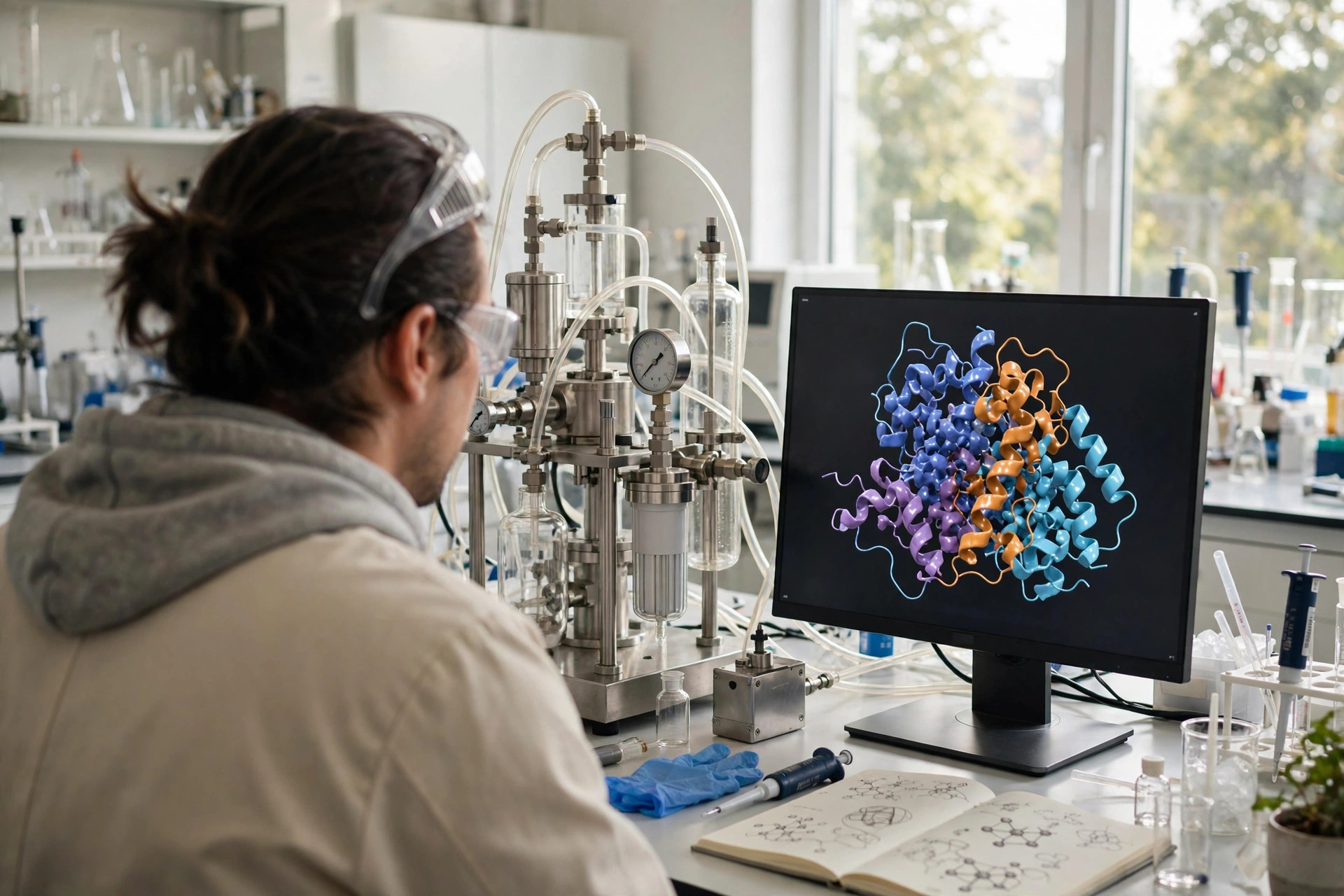
Molecular hydrogen may act on a mitochondrial iron-sulfur protein — but which one is the real entry point is now the debate
·Tip: press play, then lock your phone or switch apps — the article keeps reading.
Molecular hydrogen has always had a mechanism problem: hundreds of studies report biological effects, yet the field's standard explanation — that H2 selectively neutralizes the most damaging free radicals — never fully accounted for them. Work published in Redox Biology (Volume 88, December 2025) gave the field its first concrete mitochondrial target, and a 2026 review in the same journal (DOI 10.1016/j.redox.2026.104003) is now stress-testing that claim.
What did the Complex III experiments find?
The underlying study reported that molecular hydrogen rapidly suppresses the activity of Complex III — one of the core machines of the mitochondrial electron transport chain — through a mechanism involving its Rieske iron-sulfur protein (RISP), followed by LONP1-dependent proteolysis, the cell breaking down and replacing that protein. In plain terms: hydrogen appears to interact with a specific iron-sulfur component, the chain briefly slows, and mitochondrial quality control responds. That is a signaling story, not a scavenging story — closer to a hormetic nudge than to an antioxidant sponge.
So why is the entry point still disputed?
The 2026 review argues that calling RISP the primary target may be premature. From an evolutionary and structural standpoint, the Rieske protein belongs to a wider family of hydrogenase-like iron-sulfur proteins in mitochondria — including succinate dehydrogenase subunit B, iron-sulfur subunits of Complex I, and CISD-family proteins — which share similar redox logic and sit at strategic points in the energy network. The authors place these candidates into a ranked, testable framework and propose the structural, biochemical, and proteostatic experiments that could settle which protein hydrogen touches first.
What does a mechanism debate mean for hydrogen products?
Mostly discipline. A plausible molecular target strengthens the case that hydrogen does something real in cells; it does not establish that any hydrogen water, tablet, or inhalation product treats any disease, because dose, delivery, and clinical outcomes are separate questions that only trials answer. If anything, the new picture — a brief, controlled dip in electron transport that triggers repair programs — argues against more-is-better marketing. Watch this space: the experiments the review proposes are the kind that can actually be run.
Where the evidence stands
- Established: Complex III and its Rieske iron-sulfur protein are core components of mitochondrial energy production, and iron-sulfur proteins share ancient, hydrogenase-like chemistry.
- Preliminary: A Redox Biology study reported that H2 rapidly suppresses Complex III activity via the Rieske protein with subsequent LONP1-dependent proteolysis; a 2026 Redox Biology review contests whether RISP is the primary entry point versus a downstream sentinel, proposing SDHB, Complex I iron-sulfur subunits, and CISD proteins as alternative candidates.
- Absent: Definitive identification of hydrogen's first molecular target in human mitochondria, and clinical-trial evidence that any consumer hydrogen product improves health outcomes.
Join the discussion
To get the conversation started: What questions does this story raise for you? Share them below — every comment is reviewed by our moderators before it appears.
Community discussion only — not medical advice. Every comment is reviewed by our moderators before it appears. Sign in with Google or a free Hyvor account to join in.