
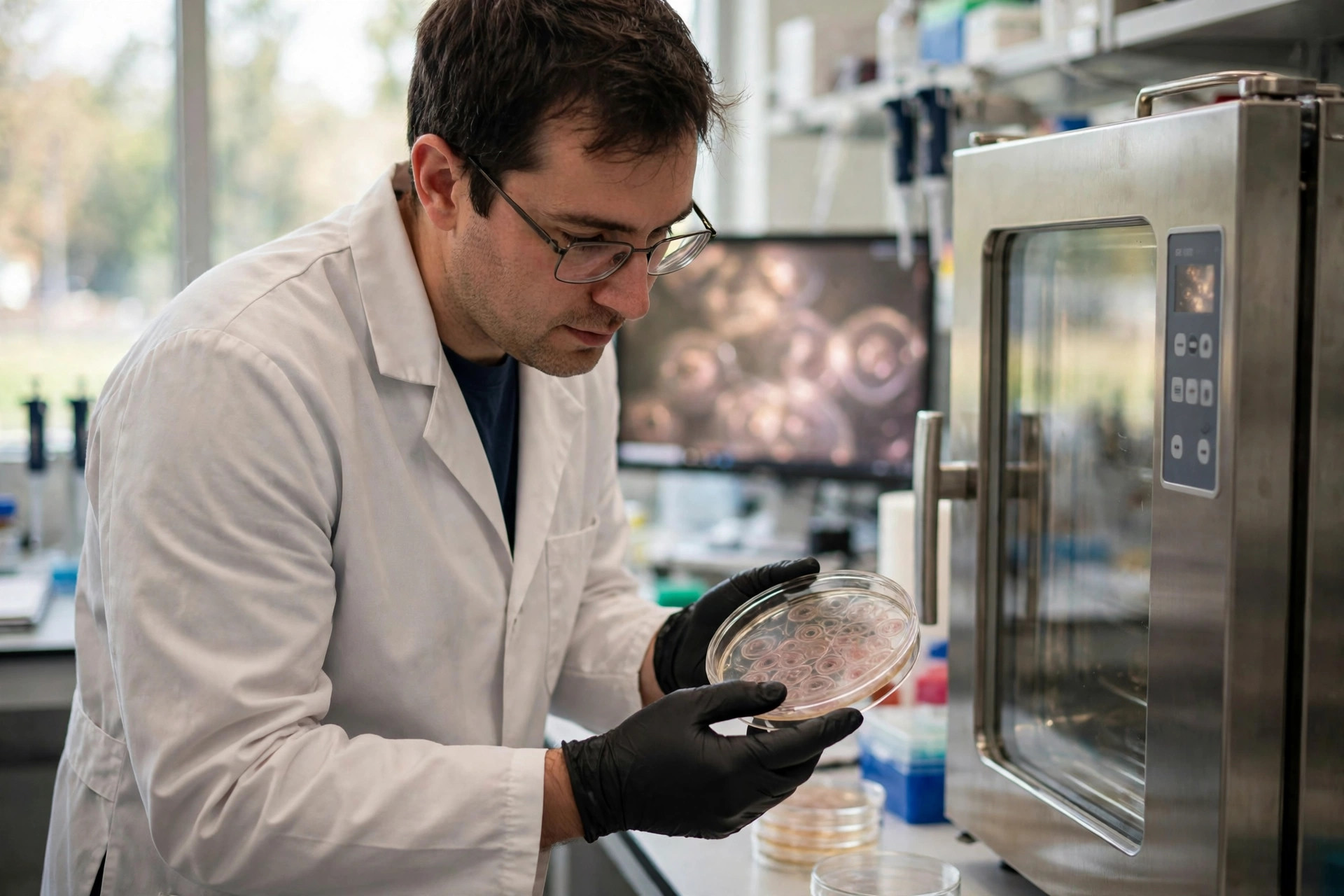
Doubling stem cells' chromosomes grew heart muscle with more, better-working mitochondria — in lab models
Edited by Samael A. Tejada, Founder & Editor-in-Chief
·Tip: press play, then lock your phone or switch apps — the article keeps reading.
In the body, heart muscle cells mature by doubling: fetal cardiomyocytes divide as diploid cells, then stop dividing and become tetraploid as they take on adult workloads. Lab-grown versions rarely make that transition — so the team, led by Yuichiro Miyaoka, made the stem cells double first.
How did they double the chromosomes before differentiation?
Existing methods could not tetraploidize heart cells after differentiation, so the researchers fused pairs of diploid iPS cells using Sendai virus particles, a standard cell-fusion tool. The fused lines were slightly larger, stably kept four chromosome sets on karyotype analysis, and retained pluripotency — the ability to become many cell types — which let the team then direct them into cardiomyocytes carrying the doubled complement.
What showed the heart cells were actually more mature?
Four independent signs pointed the same way: larger cell size matching in-vivo maturation; RNA sequencing showing cell-cycle genes significantly downregulated, as in adult cells that have stopped dividing; immunostaining confirming the contractile protein cardiac troponin T; and electrical-impedance measurements showing stronger, faster contractions with higher, quicker peaks. Energy metabolism matched the picture: the tetraploid-derived cells had increased mitochondrial quantity and functional capacity, consistent with the heavy energy demands of mature heart tissue.
What could this change — and what has it not shown?
The researchers expect the method to improve three uses of lab-grown heart cells: transplantation approaches for heart failure, efficacy and safety testing of new drug candidates, and disease models — all of which are limited today by fetal-like cells. Because polyploidization also accompanies maturation in liver cells, skeletal muscle, platelet-producing megakaryocytes and bone-resorbing osteoclasts, the approach may generalize. It remains a laboratory cell study: no transplanted patient, no drug trial, and no safety result in animals is claimed.
Frequently asked questions
Why do lab-grown heart cells need to mature?
Cardiomyocytes made from standard iPS cells remain fetal-like, which limits their value for heart-failure transplantation therapy, for testing new drugs' efficacy and safety, and for modeling cardiac disease accurately.
What did the researchers do differently?
Instead of trying to double chromosomes after heart cells formed, they fused pairs of iPS stem cells first — creating tetraploid stem cells with four chromosome sets — and then differentiated them into heart muscle cells.
How did mitochondria figure in the result?
The tetraploid-derived heart cells showed increased mitochondrial quantity and functional capacity compared with conventional diploid-derived cells, matching the higher energy demands of mature heart tissue, alongside larger size and stronger, faster contractions.
Has this been tested in patients?
No. This is a laboratory cell study. No transplantation in animals or people, and no clinical safety or efficacy result, is reported.
Where the evidence stands
- Established: About 80% of adult human cardiomyocytes are tetraploid; chromosome doubling accompanies maturation, and conventional iPS-derived cardiomyocytes remain fetal-like, limiting transplant, drug-testing and modeling uses.
- Preliminary: In laboratory cultures (Communications Biology, reported Oct 24, 2026), cardiomyocytes differentiated from fused tetraploid iPS cells were larger, downregulated cell-cycle genes, showed more and better-functioning mitochondria, and contracted more strongly and rapidly than diploid-derived cells.
- Absent: Animal transplantation results, human safety or efficacy data, and any clinical use of tetraploid iPS-derived heart cells.
Join the discussion
To get the conversation started: What questions does this story raise for you? Share them below — every comment is reviewed by our moderators before it appears.
Community discussion only — not medical advice. Every comment is reviewed by our moderators before it appears. Sign in with Google or a free Hyvor account to join in.