
Shielding fruit flies from Earth's magnetic field extended mutant flies' lives by about a fifth — and weakened them
·Tip: press play, then lock your phone or switch apps — the article keeps reading.
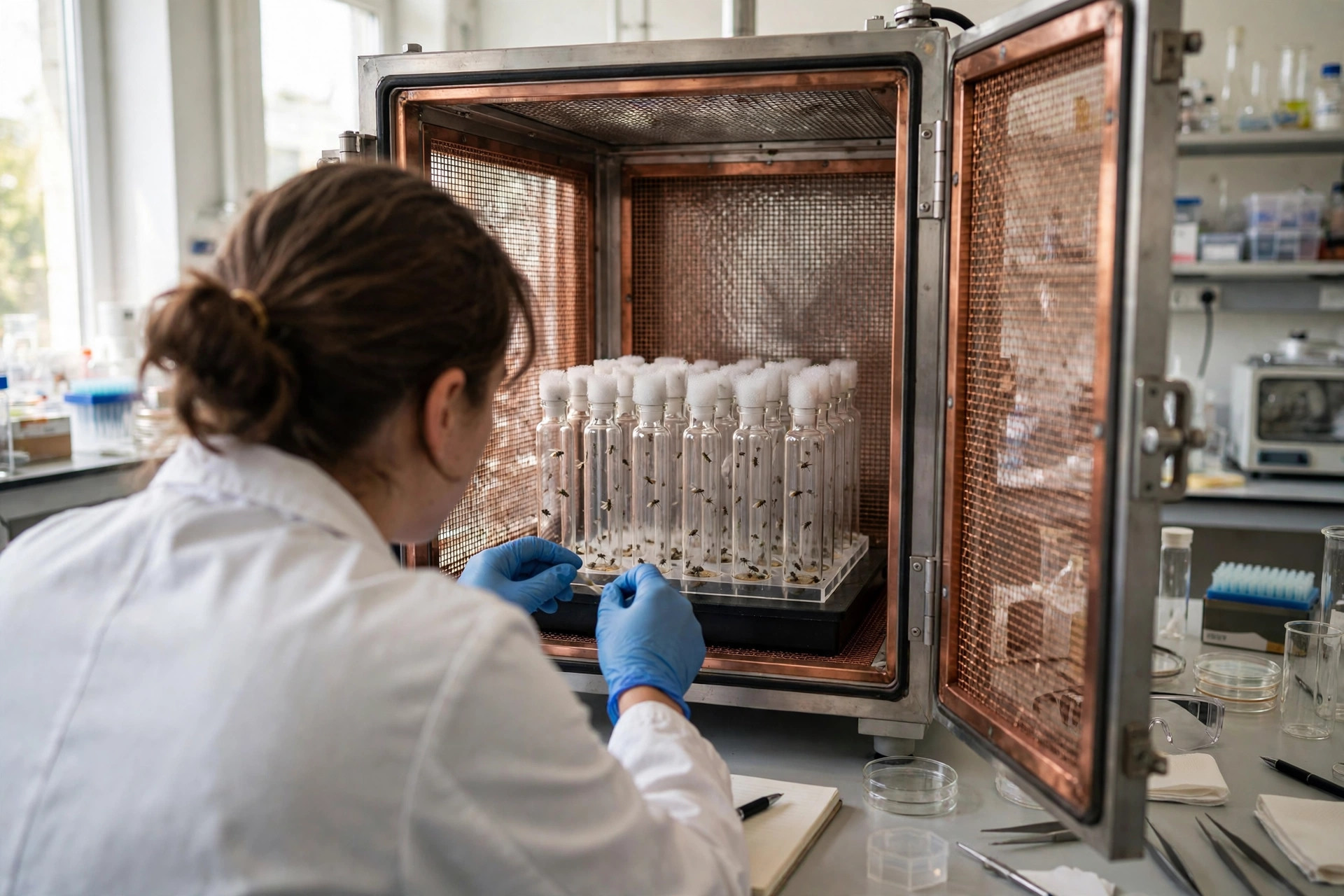
Every cell on Earth lives inside the planet's magnetic field, and mitochondria — with their electron transport chains and reactive oxygen by-products — are a plausible place for that field to matter. A study reported October 16, 2026 tested the idea directly: raise fruit flies in a hypomagnetic environment, shielded from the geomagnetic field, and compare lifespan, movement, and mitochondrial chemistry in healthy flies and in Pink1 mutants, whose broken mitophagy gene models mitochondrial failure and Parkinson's-like degeneration.
What happened inside the shield?
The Pink1-mutant flies lived about 20% longer when shielded — a striking extension from changing nothing but an environmental force. But the trade was written into the result: those longer-lived mutants performed worse physically. Healthy flies responded differently, with healthspan affected but movement improved under the same conditions. Mechanistically, the reduced field measurably changed mitochondrial energy metabolism and levels of superoxide, the reactive molecule mitochondria produce that acts as both damaging oxidant and stress signal. Same environment, opposite outcomes — the deciding variable was the flies' underlying mitochondrial health.
Where the hype version of this story goes wrong
Expect versions of this headline that skip three facts. First, the lifespan gain appeared in genetically damaged flies, not healthy ones. Second, longer life came with worse physical function in those flies — more time, less capability. Third, these are fruit flies in a shielded chamber: there is no human equivalent, no dose, no device, and no evidence that magnetic shielding, magnets, or any consumer product extends human life. What the study genuinely offers is a research lead — that mitochondrial state determines how an organism answers its magnetic environment — worthy of follow-up in the lab, not in a shopping cart.
Where the evidence stands
- Established: Pink1 is a mitochondrial quality-control gene; its loss impairs mitophagy and is used to model mitochondrial failure, and mitochondria generate superoxide as a by-product of energy production.
- Preliminary: In fruit flies (reported Oct 16, 2026), hypomagnetic shielding extended Pink1-mutant lifespan by about 20% while reducing physical performance, affected healthy flies differently, and altered mitochondrial energy metabolism and superoxide levels.
- Absent: Replication in mammals, any human data, and any evidence supporting magnetic-field products or shielding for human longevity.
Join the discussion
To get the conversation started: What questions does this story raise for you? Share them below — every comment is reviewed by our moderators before it appears.
Community discussion only — not medical advice. Every comment is reviewed by our moderators before it appears. Sign in with Google or a free Hyvor account to join in.