
An NAD+ booster given before puberty eased memory problems in a schizophrenia model — in mice
·Tip: press play, then lock your phone or switch apps — the article keeps reading.
A short course of a popular longevity supplement, given during a narrow window of childhood brain development, improved learning and memory in a mouse model of schizophrenia. The study, published in Translational Psychiatry by researchers at Ningxia Medical University, tested nicotinamide mononucleotide (NMN) — one step from NAD+, the coenzyme that powers countless reactions in every cell — and found parallel improvements in hippocampal neurogenesis markers, mitochondrial health, and cognitive performance. The authors are careful: these are associations, not proof — and emphatically not a reason to give NMN to children.
The experiment: a childhood window
The team used a two-hit mouse model designed to mirror schizophrenia's layered origins: maternal immune activation during pregnancy (mimicking the infection–risk link), followed by chronic unpredictable stress in the male offspring. NMN went into the drinking water at 2 grams per liter from postnatal day 21 to 30 — the prepubertal window, roughly analogous to late childhood.
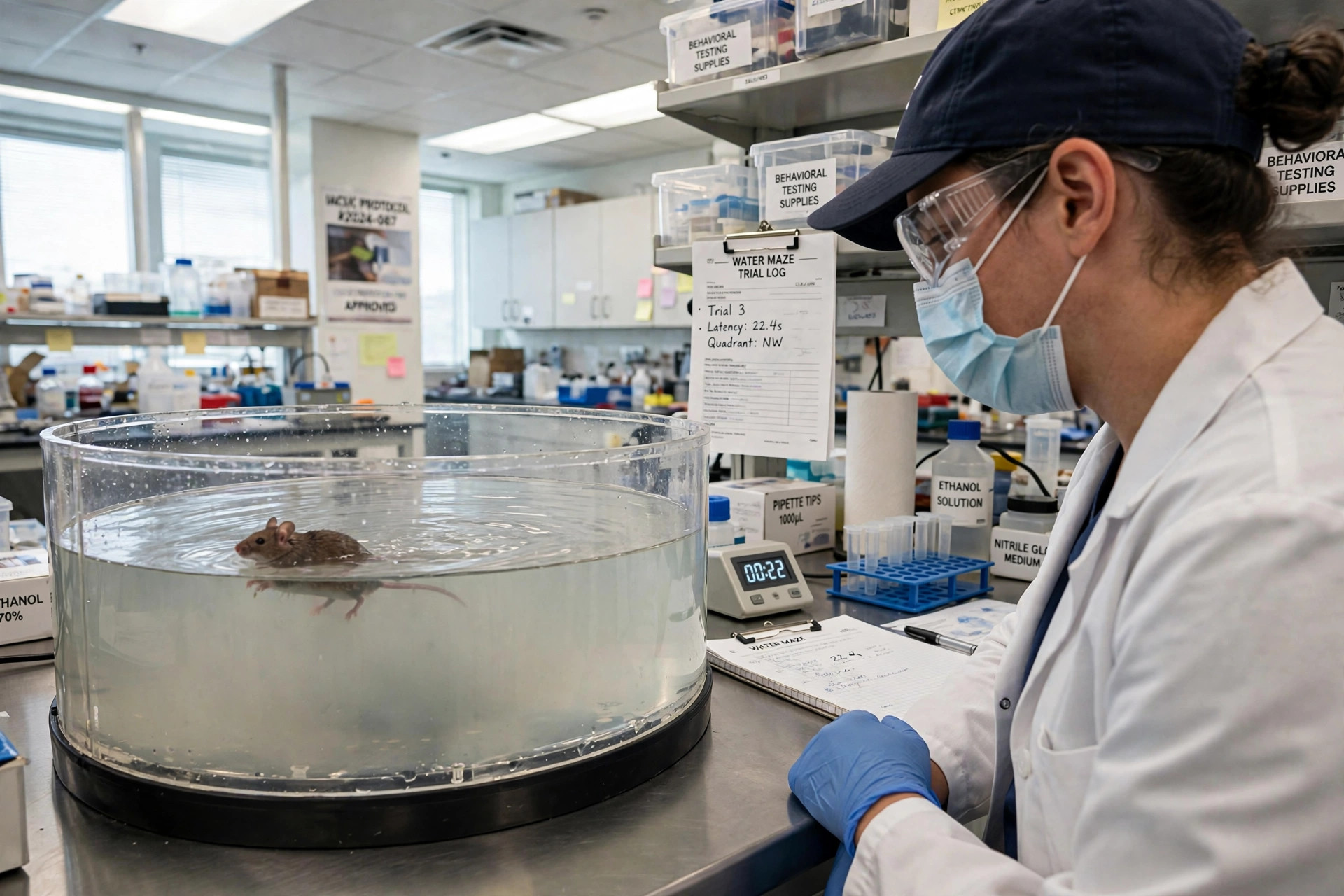
The behavioral results spanned two cognitive domains: treated mice learned the hidden platform location faster in the Morris water maze and showed better recognition memory in the novel object recognition test. Inside the hippocampus, the full neurogenesis pipeline — from SOX2 stem cells through Ki67/DCX progenitors to mature NeuN neurons — appeared to run at a higher level, and the cellular changes correlated with the behavioral gains.
The mitochondria thread — and the big caveat
The mitochondria thread is what earns this story its place here. Electron microscopy showed healthier-looking hippocampal mitochondria; ATP, NAD+, mtDNA copy number, citrate synthase activity, and coenzyme Q10 all shifted in directions consistent with improved mitochondrial content and homeostasis. In cell culture, the benefits traced to the SIRT1–p53–PI3K/AKT/mTOR axis — and vanished when SIRT1 was blocked with EX527.
The caveats are load-bearing: correlation between newborn neurons and maze performance does not prove causation, and the researchers do not know which developmental insult NMN primarily counteracts. But as a proof of concept, it makes a vivid case that the developing brain's metabolic machinery — mitochondria included — may be more amenable to intervention during critical windows than anyone dared to hope. In mice, for now.
Where the evidence stands
- Established: Cognitive impairment is a core driver of disability in schizophrenia and existing drugs offer limited benefit for it; mitochondrial dysfunction is a recurring theme in schizophrenia research.
- Preliminary: Two-hit mouse model (maternal immune activation + chronic stress), NMN at 2 g/L in drinking water from postnatal day 21–30; improved Morris water maze and novel object recognition; higher ATP, NAD+, mtDNA copy number, citrate synthase activity, and CoQ10; SIRT1 mechanism supported by inhibitor (EX527) reversal in vitro.
- Absent: Any human data; causal proof that the neurogenesis changes drove the cognitive gains; the authors explicitly caution against giving NMN to children.
Join the discussion
To get the conversation started: What questions does this story raise for you? Share them below — every comment is reviewed by our moderators before it appears.
Community discussion only — not medical advice. Every comment is reviewed by our moderators before it appears. Sign in with Google or a free Hyvor account to join in.