
A £2.1 million bet on brain mitochondria: Cardiff wins a Wellcome award to hunt the genes that run them, in fruit flies
Edited by Samael A. Tejada, Founder & Editor-in-Chief
·Tip: press play, then lock your phone or switch apps — the article keeps reading.
Cardiff University's Dr Gaynor Smith has won a £2.1 million Wellcome Discovery Award (announced October 28, 2026) to use fruit flies to find the genes that regulate mitochondria in brain cells, aiming at mechanisms behind Alzheimer's and Parkinson's disease. It is a funding decision, not a research result — no findings exist yet, and fly discoveries require mammalian validation.
Big funders rarely pay £2.1 million for a metaphor. Wellcome is paying it for a specific, testable proposition: that the genes controlling mitochondria in brain cells are a missing chapter in dementia — and that a fruit fly is the fastest way to read it.
What exactly was funded?
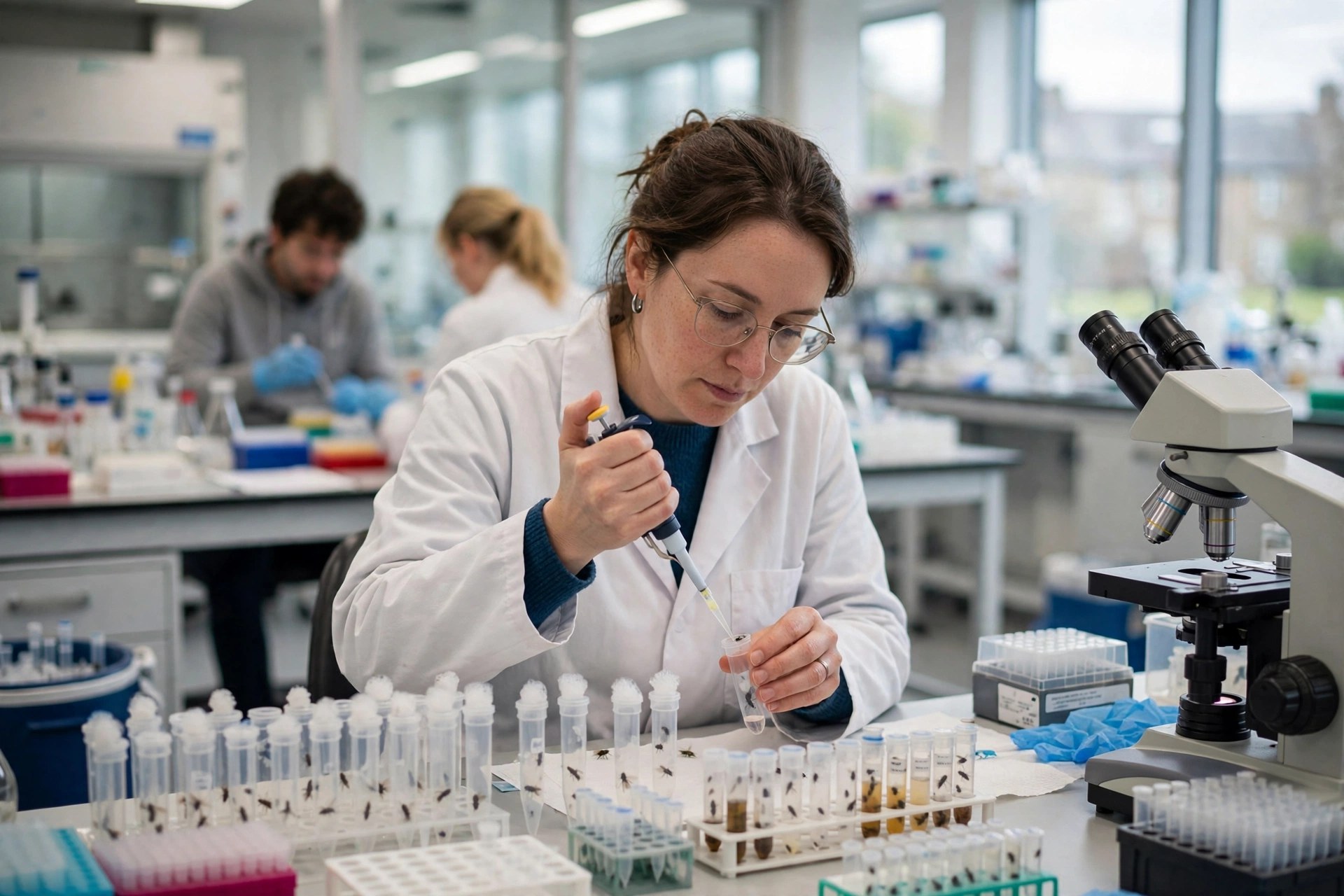
A Wellcome Discovery Award of £2.1 million to Dr Gaynor Smith, Reader at the UK Dementia Research Institute (UKDRI) at Cardiff University, announced by the university on October 28, 2026. The project uses fruit flies to study how cells produce and use energy — specifically, how mitochondria are genetically regulated in brain cells. Smith's framing is direct: neurons need constant energy; mitochondria supply it while continually moving, changing shape, dividing and fusing; mitochondrial dysfunction is increasingly recognised as a key feature of several neurodegenerative diseases; and the genes and molecular pathways controlling mitochondrial behaviour remain poorly understood. The work will investigate how brain cells stay healthy and what happens when their power systems fail.
Why fruit flies for a human brain question?
Because flies are where gene hunts run fastest. A fly's short generation time and mature genetic toolkit let researchers switch genes on and off in specific neurons and watch movement, shape and function change — the same basic mitochondrial behaviours, conserved across species, that this site covered in yesterday's pruning study from King's College London. The UKDRI model is explicit about the pipeline: discovery in tractable systems, then validation toward human biology. What flies cannot do is have Alzheimer's disease; any gene found here earns a hypothesis, not a conclusion, and the honest label for this story is investment in a discovery engine.
What should readers take from a funding story?
Two things, both modest. First, signal: Wellcome's peer reviewers judged the mitochondria-regulation question in dementia important and under-explored enough to fund at £2.1 million — that is evidence about the field's direction, not about any treatment. Second, expectation-setting: Discovery Awards fund years of basic work whose outputs are papers and candidate genes, not clinic-ready interventions. If this project succeeds, its success will look like a shortlist of mitochondrial control genes that mammalian labs then test. Readers burned by 'breakthrough' headlines should hold this one at exactly that size — and it is still worth holding, because dementia's energy failure is real and its control panel is genuinely unmapped.
Frequently asked questions
Who received the award and how much is it?
Dr Gaynor Smith, a Reader at the UK Dementia Research Institute at Cardiff University, received a £2.1 million Wellcome Discovery Award, announced October 28, 2026.
What will the project study?
How mitochondria are genetically regulated in brain cells, using fruit flies — how brain cells stay healthy and what happens when their energy systems fail, with Alzheimer's and Parkinson's disease as the target conditions.
Does this mean a dementia treatment is coming?
No. This is funding for basic discovery research. Its realistic output is candidate genes and mechanisms that other labs would then need to validate in mammalian and human systems.
Where the evidence stands
- Established: Mitochondrial dysfunction is a recognized feature of several neurodegenerative diseases including Alzheimer's and Parkinson's; neurons are highly energy-dependent; and fruit-fly genetics is an established discovery system for conserved mitochondrial biology.
- Preliminary: The award itself: £2.1 million Wellcome Discovery Award to Dr Gaynor Smith (UKDRI, Cardiff University), announced October 28, 2026, to study genetic regulation of mitochondria in brain cells using fruit flies. No research findings have been reported from the project.
- Absent: Any project results, any mammalian validation, and any treatment implication — none exist at the funding stage.
Join the discussion
To get the conversation started: What questions does this story raise for you? Share them below — every comment is reviewed by our moderators before it appears.
Community discussion only — not medical advice. Every comment is reviewed by our moderators before it appears. Sign in with Google or a free Hyvor account to join in.