
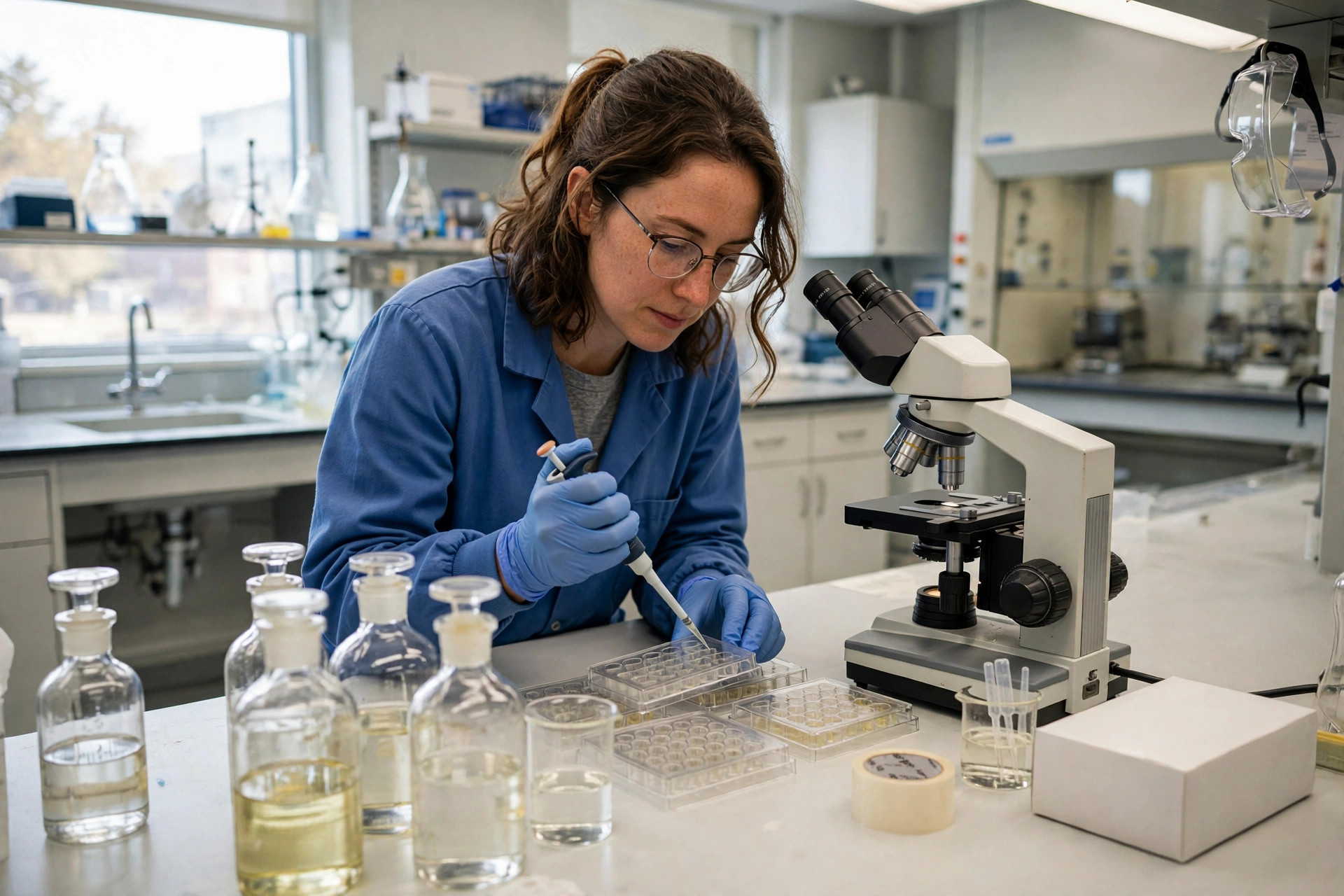
Long-chain PFAS replacement chemicals impaired placental cells' mitochondria — in lab-grown human trophoblast cells
Edited by Samael A. Tejada, Founder & Editor-in-Chief
·Tip: press play, then lock your phone or switch apps — the article keeps reading.
Long-chain HFPO compounds — PFAS replacement chemicals increasingly found in the environment — impaired mitochondrial function in lab-grown human trophoblast (placental-type) cells, cutting mitochondrial membrane potential by up to 73% and raising reactive oxygen species up to 2.7-fold at the highest tested concentration, while short-chain HFPO-DA and PFOA did not show the same toxicity (Environment & Health, November 6, 2026). The evidence is cell-culture only, at laboratory doses.
A replacement chemical earns its place by being different from the one it replaces. This study asks the uncomfortable follow-up: different in structure — but different in what it does to the cells that build a placenta?
What did the long-chain compounds do to the cells?
In HTR-8/SVneo human trophoblast-like cells, HFPO-TA and HFPO-TeA produced pronounced, concentration-dependent toxicity: suppressed proliferation, S-phase cell-cycle arrest, and impaired migration and invasion — the behaviours placental trophoblasts need to establish a pregnancy. HFPO-DA (short-chain) and PFOA did not produce the same pattern, making chain length, not the PFAS label alone, the deciding variable in this experiment. Transcriptomics showed selective disruption of integrin-mediated adhesion and focal-adhesion pathways with activation of cellular stress responses, and functional assays confirmed disrupted focal-adhesion assembly and inhibited FAK/PI3K/Akt signalling.
What happened to the mitochondria?
In parallel, the long-chain HFPOs induced mitochondrial dysfunction with oxidative stress. TMRM analysis showed mitochondrial membrane potential — the voltage mitochondria maintain to make ATP — falling by 19% and 31% under 50 and 100 micromoles per litre of HFPO-TA, and by 12%, 24% and 73% under 25, 50 and 100 micromoles per litre of HFPO-TeA. Intracellular reactive oxygen species rose markedly at the same time, reaching 1.8-fold for 100 micromoles per litre HFPO-TA and 1.7-fold and 2.7-fold under 50 and 100 micromoles per litre HFPO-TeA. Molecular docking suggested HFPO-TeA interacts preferentially with integrin subunits, linking the adhesion and mitochondrial arms of the mechanism the authors propose.
How far does a cell study reach?
Not to a pregnancy outcome — and the paper's own design says so. These are immortalized trophoblast-like cells in dishes, exposed to micromolar concentrations chosen for mechanism-hunting, not measured human exposures. The authors also note their airway-cell comparison line (16HBE bronchial cells) is not a placental model and should not be read as evidence about airway or systemic effects. What the study does establish is a mechanistic framework: for this chemical family, fluorinated chain length tracks with integrin-centred adhesion disruption and mitochondrial injury in a relevant human cell type. That is exactly the kind of early signal exposure science is supposed to catch before, not after, a replacement becomes ubiquitous.
Frequently asked questions
What are HFPO compounds?
Hexafluoropropylene oxide (HFPO) homologues are fluorinated chemicals used as alternatives within the PFAS family. They are increasingly detected in environmental and biological samples, and this study compared long-chain forms (HFPO-TA, HFPO-TeA) with a short-chain form (HFPO-DA) and PFOA.
What did the study find about mitochondria?
In human trophoblast-like cells, the long-chain compounds reduced mitochondrial membrane potential by up to 73% (HFPO-TeA at 100 micromoles per litre) and raised reactive oxygen species up to 2.7-fold, alongside impaired cell proliferation, migration and invasion. Short-chain HFPO-DA and PFOA did not show the same effects.
Does this prove these chemicals harm pregnancies?
No. It is a laboratory study in cultured cells at experimental concentrations. It establishes a mechanism worth investigating — chain-length-dependent mitochondrial and adhesion injury in a placental cell model — not a demonstrated human pregnancy risk.
Where the evidence stands
- Established: PFAS alternatives including HFPO homologues are increasingly detected in environmental and biological systems; mitochondrial membrane potential and ROS are standard, validated readouts of mitochondrial injury in cell models.
- Preliminary: The chain-length toxicity framework: one study in a single human trophoblast-like cell line (Environment & Health, 2026), with docking analysis supporting — not proving — the integrin mechanism.
- Absent: Human exposure-level evidence. No animal pregnancy data, no human biomarker or outcome data, and no demonstration that environmental HFPO levels reproduce these cellular effects.
Join the discussion
To get the conversation started: What questions does this story raise for you? Share them below — every comment is reviewed by our moderators before it appears.
Community discussion only — not medical advice. Every comment is reviewed by our moderators before it appears. Sign in with Google or a free Hyvor account to join in.