
Could gut microbes’ hydrogen gas protect mitochondria from “heavy” hydrogen? A new hypothesis — not yet tested
·Tip: press play, then lock your phone or switch apps — the article keeps reading.
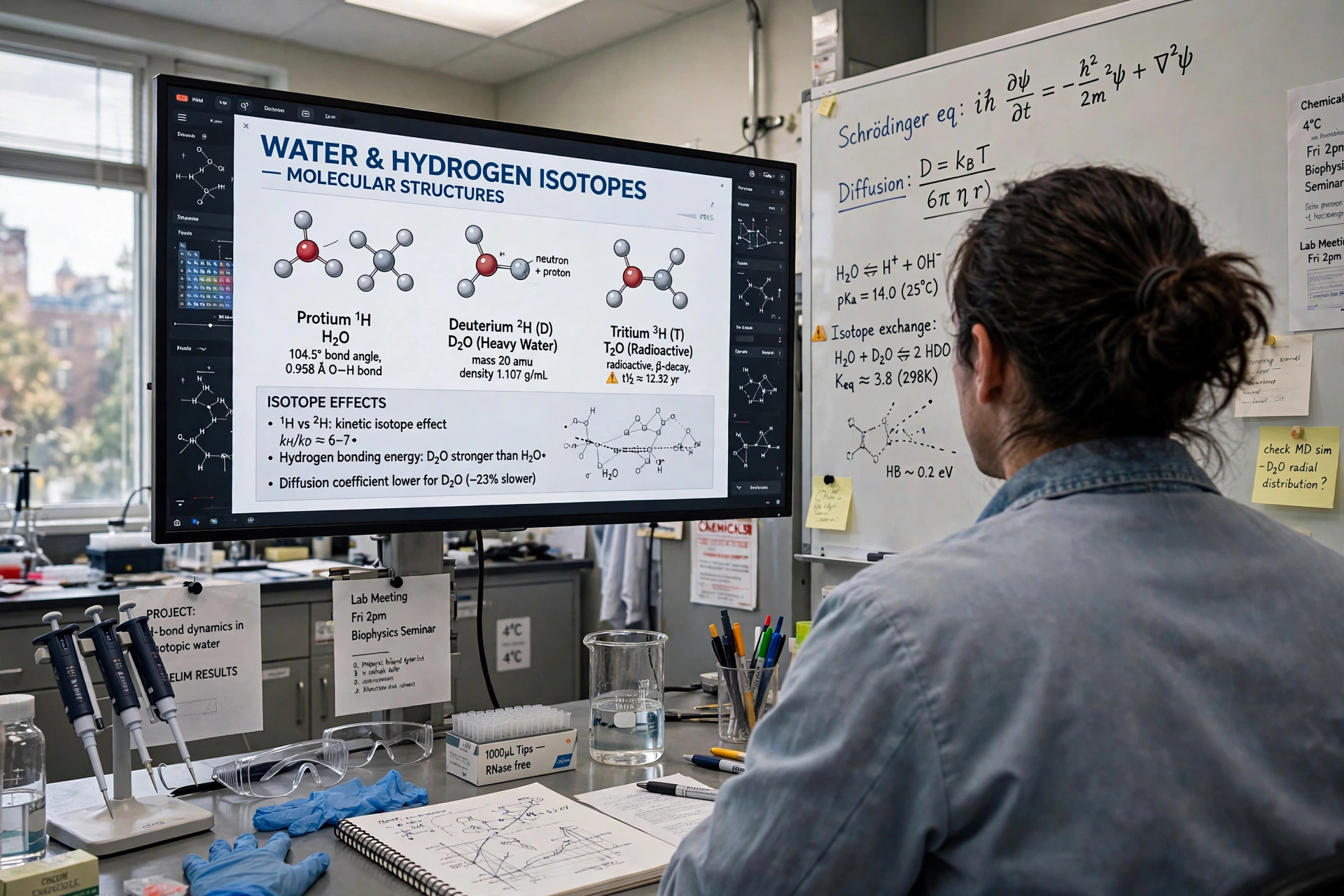
Here is a story about an idea — and we are labeling it exactly that. A new hypothesis paper in Frontiers in Microbiology proposes a novel reason molecular hydrogen might matter for mitochondria: not just as an antioxidant, but as a source of "light" hydrogen that shields the cell’s energy motors from deuterium, hydrogen’s heavier isotope. The authors state plainly that the idea "awaits validation" — there are no experiments in the paper at all.
The idea in plain language
Deuterium is a natural, heavier form of hydrogen — twice the weight — present in seawater at about 156 parts per million. The paper argues that mitochondrial ATP synthase, the rotary "nanomotor" that manufactures ATP, is exquisitely sensitive to it: deuterium impedes proton flow through the motor and can stall its rotating shaft, increasing energy-wasting leakage. The hypothesis then proposes that the body exploits a quirk of physics — when gases form, heavier deuterium tends to stay behind in the liquid — so small gases produced by gut microbes (hydrogen, methane, ammonia, hydrogen sulfide and others) arrive naturally depleted in deuterium. Enzymes that make and process these gases may further filter out deuterium through quantum proton tunneling, which the heavier isotope performs poorly.
What the paper does — and doesn’t — contain
What it does: a sweeping synthesis of isotope chemistry, enzyme kinetics, and microbiome metabolism, including a 1961 finding that hydrogen gas made by a marine microbe carried 80% less deuterium than its seawater, and measured kinetic isotope effects of up to 20-fold in enzymes processing methylated amines. What it doesn’t: a single experiment testing whether microbial gases actually lower mitochondrial deuterium, or whether that would improve energy output. The authors are explicit — appropriate experiments by expert researchers are still needed.
Why cover an untested idea — and what not to do with it
We track molecular hydrogen closely on this site, and a genuinely new mechanistic hypothesis is worth readers’ attention — clearly labeled. The honest takeaway: this is interesting physics and biology, not a finding. It is not evidence for any hydrogen product, and it certainly isn’t a reason to buy deuterium-depleted water, a product category that already trades on exactly this kind of speculation. If experiments ever confirm it, we’ll cover those. Until then, file under "watch with interest."
Where the evidence stands
- Established: Deuterium is a naturally occurring heavy isotope of hydrogen; kinetic isotope effects are real, measured physics; gut microbes produce molecular hydrogen and other small gases.
- Absent: Any experiment testing whether microbial gases reduce mitochondrial deuterium load or improve mitochondrial function; any human data whatsoever.
Join the discussion
To get the conversation started: What questions does this story raise for you? Share them below — every comment is reviewed by our moderators before it appears.
Community discussion only — not medical advice. Every comment is reviewed by our moderators before it appears. Sign in with Google or a free Hyvor account to join in.