
3,637 papers screened, 7 that qualified: mitochondria-targeted light therapy for triple-negative breast cancer is thinner than it looks
Edited by Samael A. Tejada, Founder & Editor-in-Chief
·Tip: press play, then lock your phone or switch apps — the article keeps reading.
A November 7, 2026 critical review of mitochondria-targeted nanoparticle photodynamic therapy for triple-negative breast cancer screened 3,637 records and found only seven original studies meeting its criteria — mostly in one mouse tumour model (4T1), with variable proof of mitochondrial targeting and limited translational assessment. The approach is preclinical and promising in principle; the evidence base is narrow.
The funnel is the finding. A field can look enormous from its paper count and very small from the number of studies that survive a strict definition — and honest reviews say so, as this one does.
Why target mitochondria with light therapy at all?
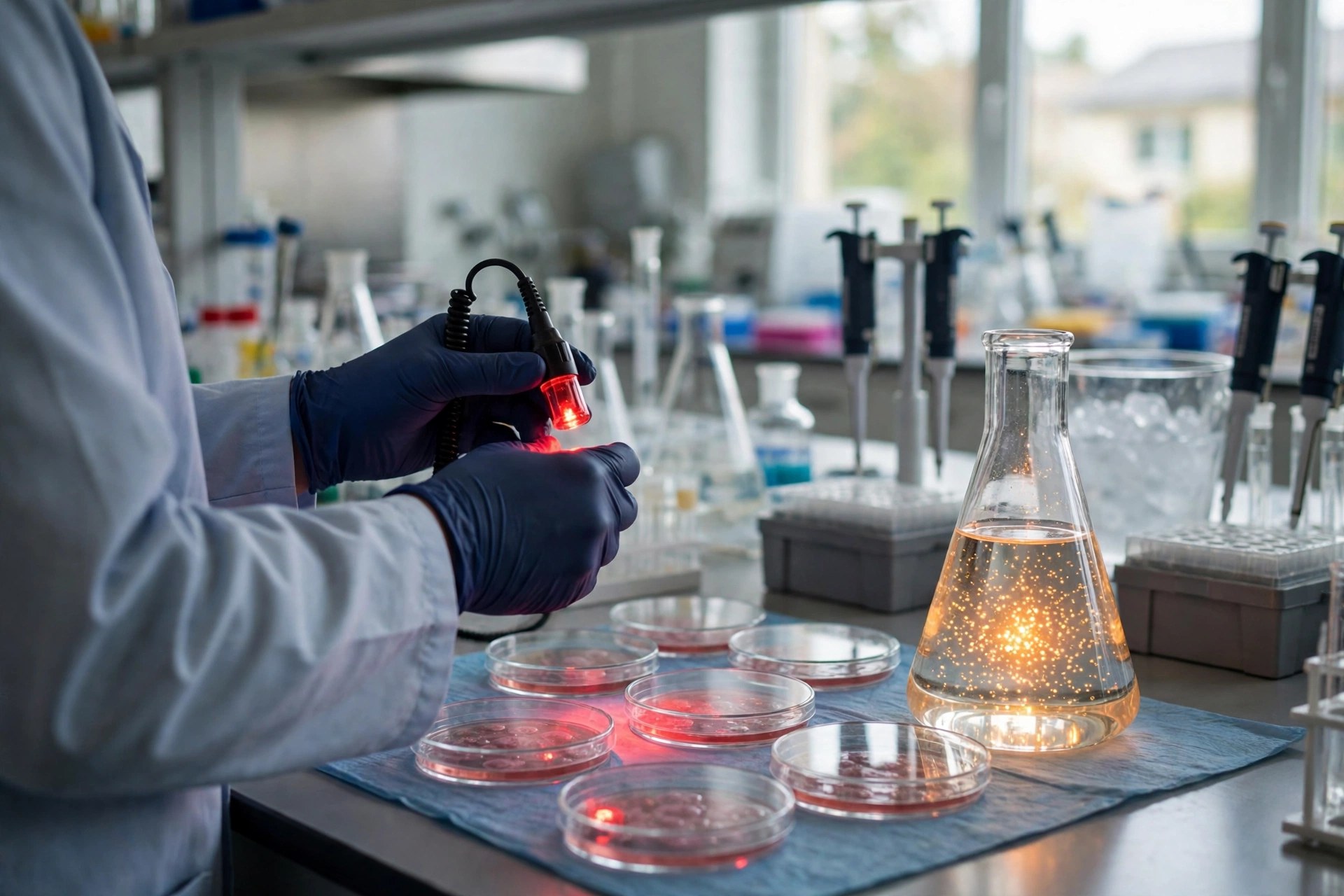
Photodynamic therapy uses a light-activated compound to generate reactive oxygen species that kill cells. Because those species survive for microseconds and diffuse only nanometres, the damage lands essentially where the compound sits. Parking the photosensitiser in mitochondria — the organelle coordinating energy and cell-death decisions — aims the damage at the cell's control centre. The seven qualifying studies reached mitochondria three ways: photosensitisers with intrinsic mitochondrial affinity, added mitochondriotropic ligands, and multistage delivery systems. Reported cell-death routes were correspondingly rich: apoptosis, pyroptosis, immunogenic cell death and cGAS–STING signalling, which can recruit anti-tumour immunity.
What did the screening funnel actually find?
The structured search identified 3,637 records; after duplicates (1,848) and screening, seven original studies fulfilled all predefined criteria for nanoparticle-mediated classical PDT in TNBC with mitochondrial targeting. Seven is not nothing — the designs are inventive, combining type I photochemistry, oxygen-availability modulation, glutathione depletion, metabolic interference, plasmonic enhancement and combined photothermal treatment. But seven small preclinical studies, published within a twenty-month window, is a beginning, not a body of evidence — and the review names the weaknesses itself: dominance of 4T1-based models, variable strength of mitochondrial-targeting validation (some papers assert mitochondrial localization more strongly than they prove it), and limited translational assessment.
What should readers take from this?
Two things can be true: mitochondria-targeted PDT is a rational, actively advancing preclinical strategy for a cancer that badly needs options — and no patient should mistake it for an available treatment. Nothing in the seven studies is a human trial; light delivery to deep or metastatic tumours, nanoparticle manufacturing consistency, and long-term safety are unaddressed at clinical level. When clinics or products borrow this vocabulary — 'mitochondria-targeted light therapy' — the question to ask is which of the seven-study preclinical base, if any, their claim rests on, and whether any human data exist. Today, the answer to the second part is no.
Frequently asked questions
What is mitochondria-targeted photodynamic therapy?
A preclinical cancer strategy in which a light-activated compound is delivered by nanoparticles into a tumour cell's mitochondria, so the reactive oxygen species generated by light damage the organelle that coordinates energy production and cell death.
How strong is the evidence for it in triple-negative breast cancer?
Thin, per the November 2026 review: of 3,637 records screened, seven original studies met strict criteria, mostly using the 4T1 mouse tumour model, with variable validation of mitochondrial targeting and limited translational assessment. There are no human trials.
Can I get this treatment?
No. It is an experimental preclinical approach studied in cell and mouse models. No mitochondria-targeted nanoparticle photodynamic therapy for TNBC is clinically available.
Where the evidence stands
- Established: Photodynamic therapy's reactive species act over nanometre distances, making subcellular localization decisive; TNBC lacks many targeted treatment options; the 4T1 mouse model is a standard TNBC preclinical model.
- Preliminary: Mitochondria-targeted nanoparticle PDT in TNBC: seven qualifying original studies (2025–2026) per this review, all preclinical, with variable mitochondrial-targeting validation.
- Absent: Human evidence — no clinical trial of mitochondria-targeted nanoparticle PDT in TNBC has been reported, and no such treatment is clinically available.
Join the discussion
To get the conversation started: What questions does this story raise for you? Share them below — every comment is reviewed by our moderators before it appears.
Community discussion only — not medical advice. Every comment is reviewed by our moderators before it appears. Sign in with Google or a free Hyvor account to join in.