
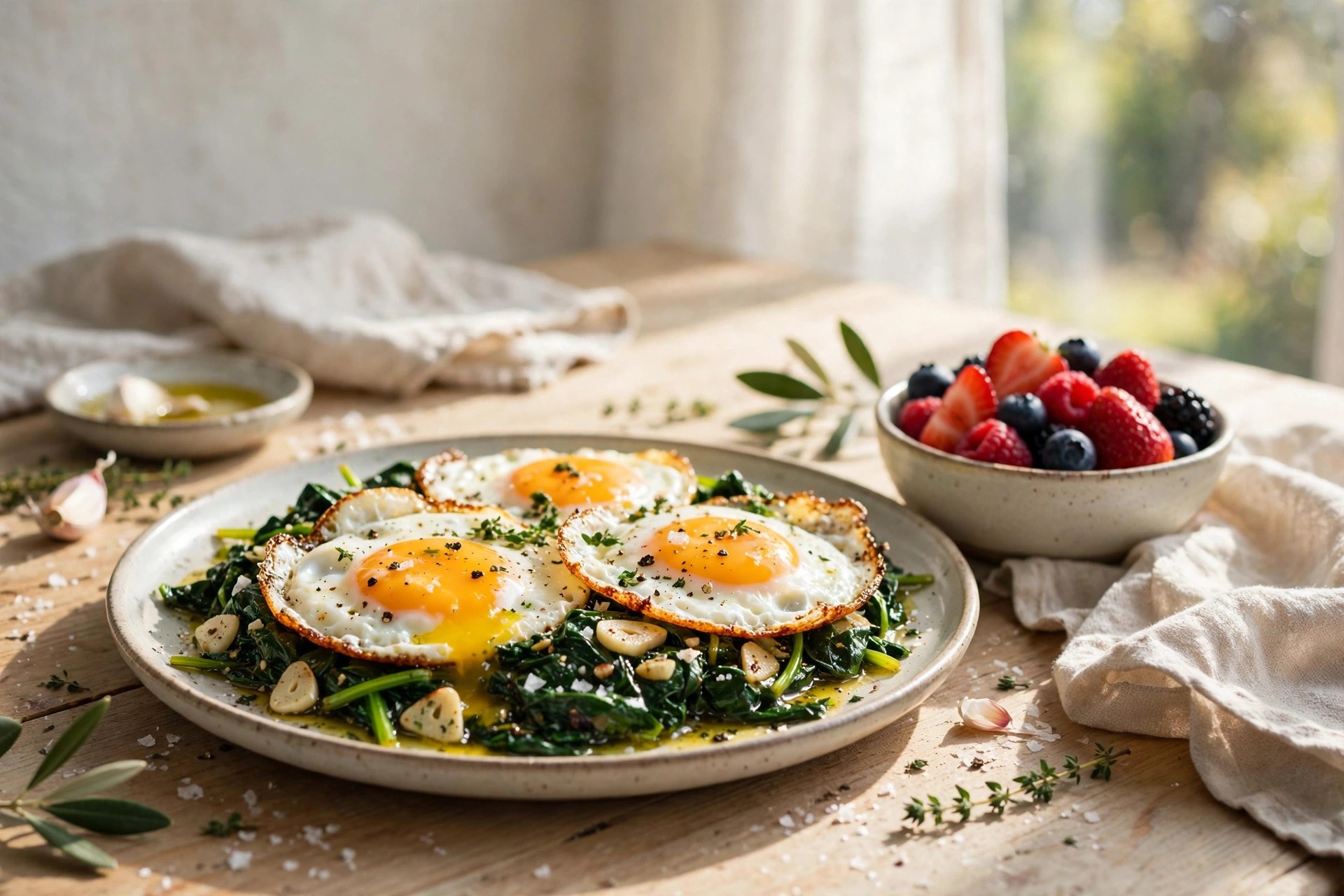
Olive-Oil Eggs with Sauteed Greens and Berries: A Mitochondria-Friendly Breakfast
Edited by Samael A. Tejada, Founder & Editor-in-Chief
·Tip: press play, then lock your phone or switch apps — the article keeps reading.
Breakfast is where mitochondrial nutrients quietly stack up. Egg yolks are one of the richest everyday sources of choline, which your cells need to build phosphatidylcholine — a core phospholipid of the membranes mitochondria are wrapped in. Dark leafy greens bring lutein, folate, and vitamin K; olive oil brings its polyphenols; and the berries bring anthocyanins, the pigments studied for vascular and metabolic health. None of this treats anything — it is a nutrient-dense way to start the day, ready in about 15 minutes.
This is the breakfast version of the pattern our diet guide keeps coming back to: whole foods, plants at the meal, good fats, enough protein. It just happens to taste like a cafe brunch.
Why eggs and greens belong together
The choline connection. Every membrane in every cell — including the double membrane around each mitochondrion — is built substantially from phospholipids, and phosphatidylcholine is the most abundant of them. Making it requires choline, an essential nutrient most people get mainly from eggs. Two eggs supply roughly 300 milligrams, about half to two-thirds of a day's target for most adults. Choline is not a supplement trend; it is a structural input your cells cannot skip.
Greens plus fat is a deliberate pairing. Leafy greens carry lutein and zeaxanthin, carotenoids concentrated in the eye and brain, plus folate and vitamin K. Lutein is fat-soluble: it absorbs far better eaten with fat than alone, which the egg yolks and olive oil handle automatically. This is the quiet logic of traditional food pairings — greens wilted in oil are not just tastier, they are better used.
The berries are more than decoration. Berries bring anthocyanins, the deep-red and blue pigments that observational research and small trials link to vascular and metabolic benefits. Direct effects on human mitochondria are not established, and this page will not pretend otherwise — but as the sweet element of a breakfast, berries beat juice on fiber alone.
The recipe
Prep: 5 minutes · Cook: 10 minutes · Total: 15 minutes · Serves: 2
Ingredients
- 4 large eggs
- 3 tablespoons extra-virgin olive oil, divided
- 2 garlic cloves, thinly sliced
- 8 cups (about 8 oz / 225 g) mixed greens — spinach, chard, or kale, tough stems removed
- 1/4 teaspoon chili flakes (optional)
- Sea salt and black pepper, to taste
- 1 cup mixed berries, to serve
- 1 lemon wedge, to serve (optional)
Steps
- Warm 1 tablespoon of the olive oil in a large skillet over medium heat. Add the garlic and cook for 30 seconds, until fragrant but not browned.
- Add the greens in handfuls with a pinch of salt. Toss until just wilted — 2 to 3 minutes for spinach, 4 to 5 minutes for kale. Pile onto two warm plates.
- Wipe out the pan, add the remaining 2 tablespoons of olive oil, and heat over medium. Crack in the eggs and cook until the whites are set and the edges are lacy, 2 to 3 minutes. For firmer yolks, cover the pan for the last minute.
- Slide the eggs over the greens. Finish with chili flakes, black pepper, and a squeeze of lemon if you like. Serve the berries alongside.
Make it yours: a slice of sourdough under the greens turns this into a knife-and-fork tartine. A spoonful of chili crisp instead of flakes works beautifully. Swap the berries for a sliced orange in winter. If you are feeding a crowd, roast the eggs on a sheet pan over a bed of greens at 425 degrees F (220 degrees C) for 6 to 8 minutes.
Nutrition, estimated
- Calories: about 340 kcal
- Protein: 15 g
- Fat: 24 g (saturated 5 g)
- Carbohydrates: 14 g
- Fiber: 4 g
- Sodium: about 280 mg, depending on seasoning
- Choline: about 300 mg from the two eggs
Estimates per serving, calculated from standard ingredient reference values (USDA FoodData Central). Your numbers will vary with brands, portion sizes, and how much salt and oil actually land on the plate. Treat them as a map, not a lab result.
Frequently asked questions
Do the yolks have to be runny?
No — that is pure preference, and the nutrient profile barely changes with a firmer yolk. Cook eggs the way you enjoy them. Standard food-safety guidance still applies: people who are pregnant or immunocompromised should cook eggs until the yolks are firm.
Can I make this ahead on a Sunday?
The greens reheat well for two or three days, so you can wilt a big batch ahead. The eggs are best cooked fresh — but at three minutes in the pan, that is hardly a burden. Assemble, fry, and eat.
From our guides
Questions and answers carried over from our evergreen guides, where they are explored in full.
Do specific superfoods or supplements matter more than the overall pattern?
The evidence favors patterns over items. Dietary patterns have far stronger trial data than any single food or supplement. Our companion guide covers specific foods and supplements for mitochondrial health, each evidence-graded.
What is the bottom line on the best diet for mitochondrial health?
No dietary pattern is proven best for mitochondria in head-to-head human trials. The Mediterranean-style pattern earns the top recommendation because it uniquely combines the deepest clinical evidence (established for cardiovascular and metabolic health) with the most encouraging early mitochondrial signals (preliminary for direct mitochondrial improvement). DASH is a solid alternative with absent mitochondrial data; plant-predominant patterns are plausible but extrapolated; keto has real therapeutic uses but contested evidence as a general mitochondrial diet.
Where the evidence stands
- Established: Choline is required to make phosphatidylcholine, a core phospholipid of mitochondrial membranes, and eggs are among the richest common food sources.
- Established: Fat in a meal improves absorption of fat-soluble nutrients such as lutein — one reason eggs and olive oil pair well with leafy greens.
- Preliminary: Berry anthocyanins are linked to vascular and metabolic benefits in observational and small-trial data; direct mitochondrial effects in humans are not established.
Join the discussion
To get the conversation started: What does your usual breakfast actually do for you — and what would you swap first?
Community discussion only — not medical advice. Every comment is reviewed by our moderators before it appears. Sign in with Google or a free Hyvor account to join in.