
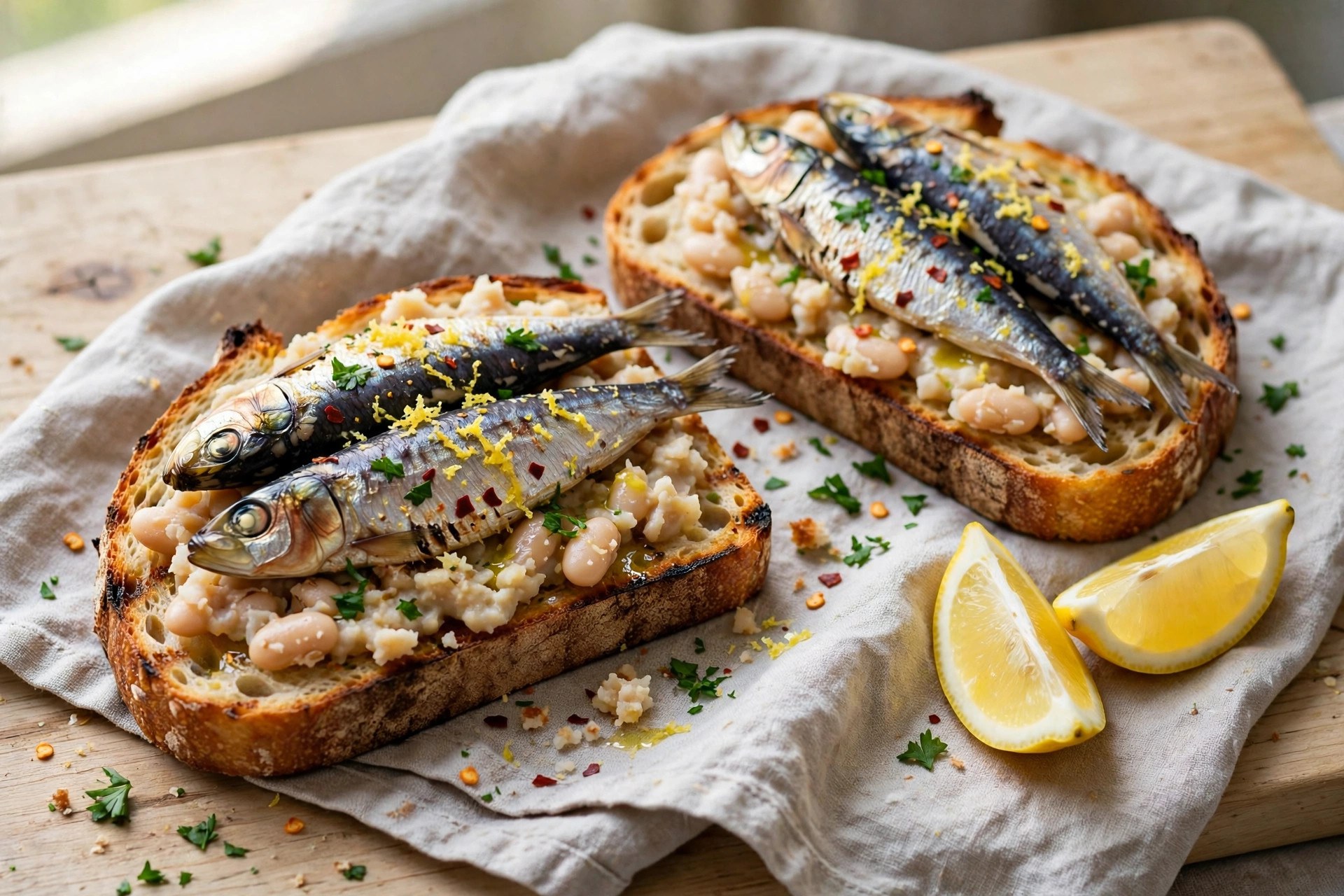
Sardine and White Bean Toast: A Mitochondria-Friendly Lunch
Edited by Samael A. Tejada, Founder & Editor-in-Chief
·Tip: press play, then lock your phone or switch apps — the article keeps reading.
Sardines are the shortcut. A single tin delivers the omega-3 fats EPA and DHA, vitamin B12, vitamin D, calcium from the soft bones, and some of the CoQ10 your mitochondria use to shuttle electrons — nutrients many people chase in supplement form. On grilled sourdough with lemony white beans and herbs, that becomes a 15-minute lunch with roughly 27 grams of protein. The evidence here is nutritional, not clinical: no trial has tested this toast, but every nutrient on it has a defined job in energy metabolism.
If sardines have been sitting in your pantry as a "someday" food, this is the recipe that converts people. Lemon, garlic, chili, and crunchy toast do the persuading; the nutrient profile is the bonus.
Why sardines punch above their weight
A whole nutrient stack in one small fish. Sardines are eaten whole — bones, skin, and all — which is why a tin delivers things fillets do not: calcium from the soft bones, vitamin D, and vitamin B12, a nutrient your cells need for the methylation chemistry that keeps energy metabolism running. Because sardines are small and short-lived, they also sit at the very low end for mercury among fish.
The CoQ10 footnote, kept honest. CoQ10 is the molecule that ferries electrons between complexes inside mitochondria — without it, the energy assembly line stalls. Sardines are one of its richer food sources. But "richer food source" still means single-digit milligrams per tin, while supplement studies use 100 to 300 milligrams a day. Eat the toast because it is a nutrient-dense lunch, not as a CoQ10 strategy; our CoQ10 guide grades what the supplement evidence actually shows.
The beans are doing quiet work. White beans bring fiber, plant protein, and folate, and they turn two slices of toast into a meal that keeps you full. The lemon is functional as well as bright: vitamin C helps your gut absorb the non-heme iron in beans. Old Mediterranean cooking figured these pairings out long before the mechanisms were named.
The recipe
Prep: 10 minutes · Cook: 5 minutes · Total: 15 minutes · Serves: 2
Ingredients
- 2 thick slices sourdough bread
- 1 1/2 cups cooked white beans (cannellini), drained and rinsed — about one 15 oz (425 g) can
- 1 tin (4.4 oz / 125 g) sardines in olive oil
- 1 small garlic clove, grated or finely minced
- Zest and juice of 1/2 lemon, plus lemon wedges to serve
- 2 tablespoons extra-virgin olive oil, plus a little oil from the sardine tin
- 1/4 teaspoon chili flakes
- 2 tablespoons chopped flat-leaf parsley
- Sea salt and black pepper, to taste
Steps
- Toast or grill the sourdough until deeply golden and crisp at the edges.
- In a bowl, smash the beans with a fork, leaving them chunky. Stir in the garlic, lemon zest and juice, olive oil, salt, and pepper.
- Pile the beans onto the toast. Lay the sardines over the top, breaking them into large pieces, and spoon over a little of the oil from the tin.
- Finish with chili flakes and parsley. Serve with lemon wedges on the side.
Make it yours: a handful of arugula under the sardines adds a peppery bite. Mackerel (the other great tinned fish) swaps in one-for-one. If raw garlic is too sharp at lunch, rub the hot toast with a cut clove instead — the classic bruschetta move — and skip it in the beans.
Nutrition, estimated
- Calories: about 480 kcal
- Protein: 27 g
- Fat: 18 g (saturated 3.5 g), including roughly 1.4 g of EPA + DHA omega-3s
- Carbohydrates: 48 g
- Fiber: 9 g
- Sodium: about 640 mg, varying with the tin and the bread
Estimates per serving, calculated from standard ingredient reference values (USDA FoodData Central). Your numbers will vary with brands, portion sizes, and how much salt and oil actually land on the plate. Treat them as a map, not a lab result.
Frequently asked questions
Do canned sardines count, or do I need fresh?
Canned are the standard for this recipe and for most sardine eating worldwide — the nutrition holds up, and the soft bones in canned sardines are where much of the calcium lives. Sardines packed in olive oil taste best here and the tin oil is worth spooning over the toast.
What if I can't stand the taste of sardines?
Start gentler: mash the sardines completely into the beans with extra lemon and chili, and the flavor mellows into something closer to a tuna salad. Or swap in tinned mackerel, which is milder and carries a similar nutrient profile.
From our guides
Questions and answers carried over from our evergreen guides, where they are explored in full.
Should healthy people take CoQ10?
Human trials show oral CoQ10 raises blood levels but generally does not raise muscle CoQ10 or improve exercise capacity in healthy, non-deficient adults. It is genuinely indicated for genetic CoQ10 deficiency and has rationale (not proof) for statin users.
What is the best diet for mitochondrial health?
No dietary pattern is proven best for mitochondria in head-to-head human trials. The Mediterranean-style eating pattern has the strongest combined case: established benefits for cardiovascular and metabolic health plus emerging, still preliminary mitochondrial signals.
Where the evidence stands
- Established: Sardines supply EPA and DHA, vitamin B12, and vitamin D in meaningful amounts, and are among the lowest-mercury fish because they are small and short-lived.
- Established: CoQ10 is an obligatory electron shuttle inside mitochondria. Sardines are one of its richer food sources, though a tin provides single-digit milligrams — far below supplement study doses.
- Preliminary: Higher oily-fish intake tracks with better cardiovascular outcomes in observational research; direct mitochondrial endpoints in humans are rarely measured.
Join the discussion
To get the conversation started: Be honest: are sardines already in your pantry rotation, or is this the week that changes?
Community discussion only — not medical advice. Every comment is reviewed by our moderators before it appears. Sign in with Google or a free Hyvor account to join in.