
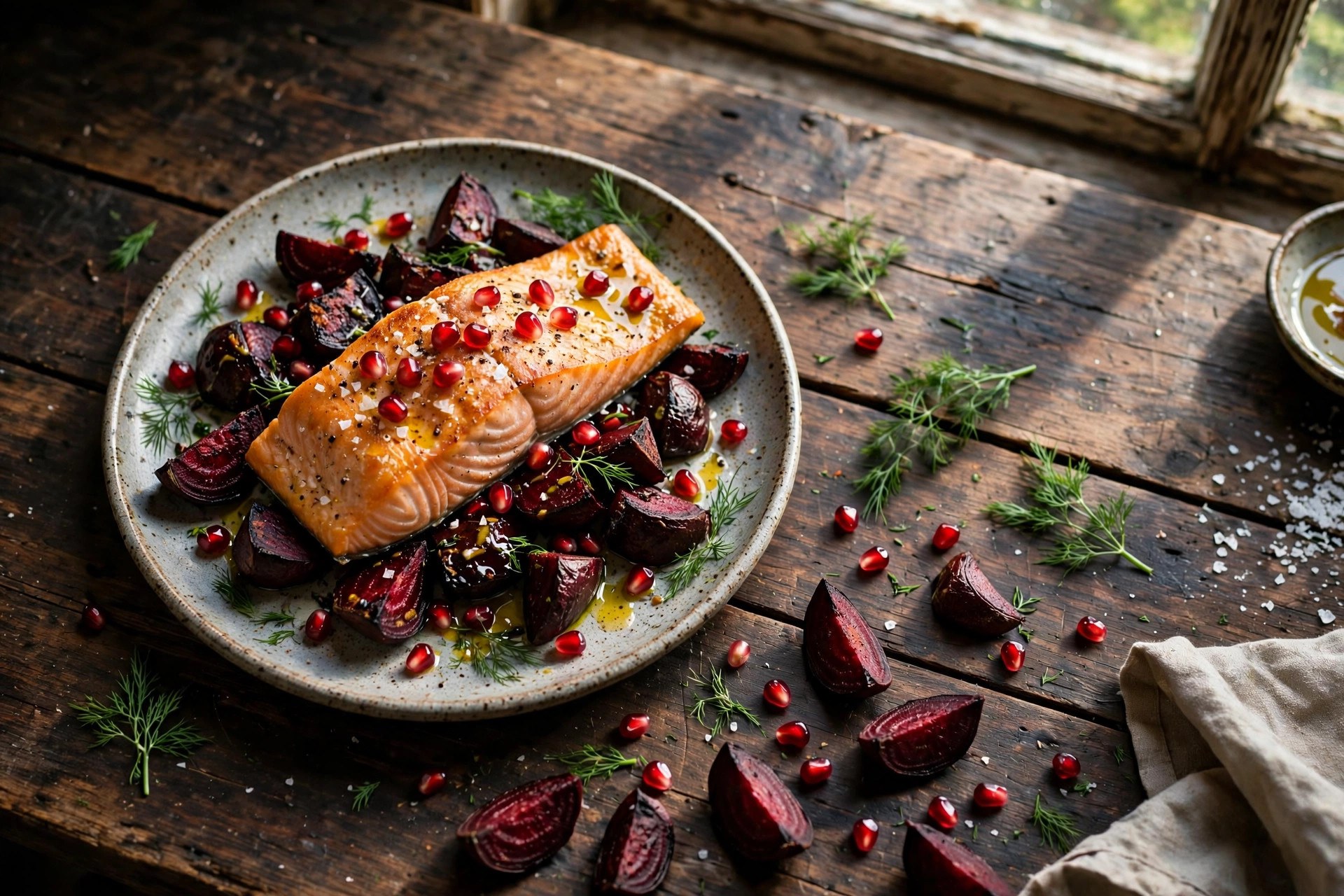
Wild Salmon with Beetroot and Pomegranate: A Mitochondria-Friendly Dinner
Edited by Samael A. Tejada, Founder & Editor-in-Chief
·Tip: press play, then lock your phone or switch apps — the article keeps reading.
This dinner stacks three of the best-studied food levers for mitochondrial health on one plate. Salmon brings EPA and DHA, the omega-3 fats built into mitochondrial membranes. Beetroot brings dietary nitrate, which small human trials link to more efficient oxygen use in muscle. And pomegranate brings the polyphenol precursors your gut bacteria can convert into urolithin A, a compound shown in human trials to engage mitophagy — the recycling of worn-out mitochondria. It is food, not therapy: the evidence supports the pattern, not a promise.
It is also, not incidentally, a genuinely good dinner: sweet caramelized beetroot, rich crisp-skinned fish, and the bright pop of pomegranate over the top. The science explains why the plate is built the way it is; the cooking is weeknight-simple.
Why this plate earns its place
The salmon. Mitochondria are wrapped in membranes, and the fats you eat become part of those membranes. EPA and DHA — the long-chain omega-3s found almost only in oily fish — are structural components of mitochondrial membranes, and salmon is one of the most reliable sources. A 6-ounce wild fillet also carries a little coenzyme Q10 (CoQ10), the electron shuttle mitochondria use to make energy, plus vitamin D and selenium. None of that makes one dinner a treatment; it makes salmon a sensible regular.
The beetroot. Beetroot is one of the richest common sources of dietary nitrate. Your body converts nitrate to nitric oxide, a signaling molecule involved in blood flow and in how efficiently muscle mitochondria use oxygen. Small trials in exercising adults have found nitrate-rich beetroot juice can reduce the oxygen cost of exercise. The effect sizes are modest and the setting is sport, but the mechanism is real physiology, not marketing.
The pomegranate. Pomegranate seeds carry ellagitannins, polyphenols that some people's gut bacteria convert into urolithin A. Purified urolithin A, tested in randomized human trials, engaged markers of mitophagy — the cell's system for clearing out damaged mitochondria. Whether the seeds on this plate get converted depends entirely on your gut bacteria, which is why our foods and supplements guide treats the food and the supplement as related but different things (see "From our guides" below).
The olive oil. Extra-virgin olive oil is the fat backbone of the Mediterranean pattern, the eating style with the deepest clinical evidence base. It also helps you absorb the fat-soluble nutrients on the plate.
The recipe
Prep: 15 minutes · Cook: 35 minutes · Total: 50 minutes · Serves: 4
Ingredients
- 4 wild salmon fillets, about 6 oz (170 g) each, skin on
- 1 1/2 lb (680 g) beetroot, scrubbed and cut into wedges
- 3 tablespoons extra-virgin olive oil, divided
- 1 teaspoon sea salt, divided, plus more to taste
- 1/2 teaspoon black pepper
- 1 teaspoon lemon zest, plus lemon wedges to serve
- 1 tablespoon red wine vinegar or sherry vinegar
- 1/2 cup pomegranate seeds (arils)
- 1/4 cup fresh dill, roughly chopped
Steps
- Heat the oven to 425 degrees F (220 degrees C). Toss the beetroot wedges with 2 tablespoons of the olive oil, half the salt, and the pepper on a rimmed sheet pan.
- Roast for 30 to 35 minutes, turning once, until the wedges are tender and caramelized at the edges.
- While the beetroot roasts, pat the salmon very dry with paper towels and season with the remaining salt and the lemon zest. Dry skin is the whole secret to crisp skin.
- Heat the remaining tablespoon of olive oil in a heavy skillet over medium-high heat. Lay the fillets in skin-side down and press gently for 10 seconds. Cook without moving for 5 to 6 minutes, until the skin is crisp and releases easily.
- Flip and cook 30 to 60 seconds more, until the center is still slightly translucent. Rest 2 minutes; the fish finishes as it rests.
- Toss the warm beetroot with the vinegar. Spoon onto plates, top with the salmon, and scatter the pomegranate seeds and dill over everything. Serve with lemon wedges.
Make it yours: farmed salmon works fine here (the fat profile differs slightly and the flesh is often richer). Golden beetroot swaps in one-for-one if red stains bother you. Pre-packed pomegranate seeds save ten minutes of careful work over a bowl of water. Leftovers flake beautifully into a salad the next day.
Nutrition, estimated
- Calories: about 520 kcal
- Protein: 38 g
- Fat: 28 g (saturated 5 g), including roughly 1.5–2 g of EPA + DHA omega-3s
- Carbohydrates: 24 g
- Fiber: 5 g
- Sodium: about 550 mg, depending on seasoning
Estimates per serving, calculated from standard ingredient reference values (USDA FoodData Central). Your numbers will vary with brands, portion sizes, and how much salt and oil actually land on the plate. Treat them as a map, not a lab result.
Frequently asked questions
Can I use farmed salmon instead of wild?
Yes — the recipe works exactly the same way. Farmed salmon tends to be a bit fattier overall, with a somewhat different omega-3 balance, and wild salmon is usually leaner. Either one delivers EPA and DHA; buy the best fish you can afford and cook it the same way.
I don't like beetroot. What swaps in?
Sweet potato wedges or chunky carrots roast in the same time at the same temperature and give you the same sweet, caramelized base. You lose the dietary-nitrate angle, but the plate — oily fish, roasted roots, something bright on top — still works.
Do I have to seed a whole pomegranate?
No. Pre-packed pomegranate seeds (arils) are widely sold and are exactly what this recipe was tested around. A whole fruit is cheaper and the seeds keep about a week in the fridge, but nobody's mitochondria are grading your knife skills.
From our guides
Questions and answers carried over from our evergreen guides, where they are explored in full.
Can I get urolithin A from food?
Pomegranate, walnuts, and berries supply its precursors, but conversion depends on gut bacteria that many people lack. Food-dose effects should not be equated with the 500–1,000 mg/day doses used in trials.
What do Mediterranean, DASH, and plant-based diets all agree on?
Mostly whole foods, plants at every meal, unsaturated fats over saturated ones, protein adequate to need, and far fewer ultra-processed foods, refined carbohydrates, and added sugars. Chronic overnutrition itself is a mitochondrial stressor.
Where the evidence stands
- Established: Omega-3 fats EPA and DHA are structural components of cell and mitochondrial membranes, and oily fish is their main dietary source.
- Preliminary: Dietary nitrate from beetroot has improved exercise efficiency and muscle oxygen use in small human trials; effects on everyday energy are less certain.
- Preliminary: Urolithin A — made by gut bacteria from pomegranate polyphenols — engaged mitophagy markers in randomized human trials of the purified compound; food-level effects depend on your gut bacteria.
- Absent: Any evidence that a single meal measurably changes mitochondrial function. The case for this plate is the pattern, eaten regularly.
Join the discussion
To get the conversation started: Which of these three — salmon, beetroot, pomegranate — already shows up on your plate most weeks?
Community discussion only — not medical advice. Every comment is reviewed by our moderators before it appears. Sign in with Google or a free Hyvor account to join in.